
When your vehicle breaks down, your first call often goes to a tow truck driver. But once the job is done, a question lingers—should you tip the person who came to your rescue? While tipping has become a widespread practice in many industries, it’s less clear-cut in the realm of roadside assistance. This guide will delve into the culture of tipping tow truck drivers, exploring various situations where a tip might be appropriate, regional differences, the economic realities affecting this industry, and the cultural perspectives surrounding tipping. By the end, you’ll be equipped with the knowledge to make an informed decision the next time you find yourself needing a tow.
Tow Truck Etiquette During a Moment of Need: Understanding When and Whether to Tip
A roadside breakdown or an accident forces a rapid shift from control to dependence. In that moment, the question of tipping can feel almost irrelevant against the backdrop of urgency and anxiety. Yet it is precisely in these high-stress moments that the social cueing around tips matters most. The simple question—do you tip a tow truck driver?—has no single answer, because tipping practices vary with location, company policy, and the driver’s conduct. What remains constant is the recognition that tow services are, at their core, professional work. The expectation often centers on the service fee already agreed and paid up front. The towing fee is designed to cover labor, fuel, and the heavy equipment required to move a vehicle from one place to another. In many cases, that fee reflects a bundled package rather than a line item ripe for a separate gratuity. The practical implication is straightforward: tipping is not a standard expectation in most tow scenarios. Yet the practical reality of a breakdown introduces nuance that is worth unpacking for anyone who might someday face this exact decision. The core idea is simple: you don’t owe a tip in the ordinary course of business, but you may offer a small tip if the service goes beyond what is expected or if the situation presents particular challenges that the driver handles with aplomb. This approach respects both the norm and the occasional exceptions that make a real difference in an emergency.
The first pillar of understanding is the general custom in the industry. In the United States, tow truck work is typically paid through a pre-agreed fee that covers the drive, the equipment, and the crew’s time. Unlike hospitality sectors where gratuities are a woven part of wages, towing services usually do not rely on tips to supplement pay. For many drivers, the wage structure and company policies assume that compensation comes from the service charge rather than from customer tips. That said, a small gratuity is not criminalized in most situations, and it can be a way to acknowledge exceptional assistance without upsetting the formal payment structure. The key is to approach tipping with discretion and respect for the professional boundary that each company sets.
There are clear exceptions where tipping may be appropriate. When a driver goes above and beyond the call of duty, a tip can be a meaningful token of appreciation. Think of a scenario where the tow requires extra care in a dangerous or technically demanding situation—pulling a car from a ditch on a rocky slope, securing a vehicle under risk of rollover, or working through a complex, multi-vehicle incident in inclement weather. In such cases, a little extra can recognize the skill, patience, and calm presence the driver brings to a potentially life-saving moment. A discreet tip in these instances—often in the range of five to twenty dollars, depending on the level of effort and the regional tipping culture—can be a meaningful gesture. It’s important, however, to keep expectations in check. Even when you feel compelled to offer more, many drivers have policies that limit what they can accept, or they may pass the tip to the company as part of standard practice. A tip should never be pressed upon a driver as a form of permission slip or a social obligation; it should be a voluntary expression of gratitude for outstanding service.
Another important dimension is the driver’s safety and the company’s guidelines. Some towing companies maintain strict policies that prohibit drivers from accepting tips. These policies are often crafted to avoid any potential conflict of interest or liability concerns. Insurance considerations, the protection of credit card data, and the integrity of the business model all play a role in these decisions. It is entirely reasonable to ask, politely and in the moment, whether tipping is allowed before offering any gratuity. If a driver or the company indicates that tips are not accepted, a sincere verbal thank you or a public commendation can still carry weight. In the same breath, you should be mindful not to pressure a driver who is simply doing their job well. The tension between gratitude and policy can create awkward moments, but it is solvable with a respectful, low-pressure approach.
Regional and cultural variation adds another layer. In some places, tipping is more ingrained in everyday service culture. In others, gratuities for certain trades are less common or discouraged by local norms or regulations. Even within the same country, expectations can differ from one city to another based on competing practices, the presence of union or non-union labor, and the specific policies of a towing firm. The bottom line is that tipping tow truck drivers is not a universal rule. The most reliable path is to follow the local practice, listen to the driver or the dispatcher, and act in a way that communicates appreciation without creating discomfort or conflict with policy.
If you find yourself leaning toward a tip, the form you choose matters. Cash remains the most practical option because it is immediate and universally accepted. A small bill tucked into a glove compartment or handed discreetly can convey appreciation without complicating payment records. Some drivers prefer no tips for privacy and safety reasons, so a discreet, verbal expression of thanks may be equally appropriate. In any event, avoid elaborate gifts or personal items that could blur professional boundaries or create expectations. A simple gesture is often more appropriate than a grand one in the tension-filled moments that accompany roadside emergencies.
Communication in the moment also plays a crucial role. Before offering any gratuity, consider asking a brief, respectful question if it feels right. A concise, “Is tipping allowed for your company, or would you prefer I show appreciation another way?” can dissolve potential confusion. If the driver says tips aren’t allowed, accept the response with grace and proceed with a sincere thanks. If permitted, you can place the tip in a visible but unobtrusive way—handing it directly, or leaving it with the driver after the vehicle is secured, depending on the driver’s preference. The essential aim is to honor the service without creating awkwardness or implying a bargain. The moment is about safety, not social theater.
Beyond the immediate encounter, small gestures can extend appreciation in meaningful, non-monetary ways. A positive online review that mentions the driver’s skill and calm demeanor can influence future work opportunities and company reputation more than a one-time gratuity. A note of thanks to the dispatcher can also reinforce the driver’s efforts by highlighting the day’s challenges and the crew’s effective coordination. If you want to explore broader context around service expectations and professional standards in this field, you can read more at the Santa Maria Tow Truck Blog, which covers a range of topics on how drivers balance customer needs with operational realities. Santa Maria Tow Truck Blog.
In reflecting on the question, the most practical answer remains grounded in both policy and principle. You do not need to tip a tow truck driver under normal circumstances. The base fee is designed to compensate the service comprehensively. A tip is an optional acknowledgment of exceptional handling or particularly challenging conditions. When you choose to tip, keep it modest, ensure it aligns with company policy, and deliver it with discretion and respect. When you choose not to tip, express genuine appreciation for the service rendered and consider other forms of recognition if the opportunity arises. The goal is to maintain a respectful, professional tone that recognizes the driver’s expertise and the stressful context in which they worked.
Ultimately, the act of tipping in towing services is less about an obligation and more about a mindful response to quality service delivered under pressure. It is a small, human gesture that can affirm a driver’s additional effort without complicating a transaction that is already clearly defined by a pre-arranged fee. Your handling should reflect your judgment of the situation, the policies in place, and the level of care you observe. As with many service interactions, courtesy, clarity, and consideration go a long way in shaping the experience for both the person providing the service and the person receiving it. In the end, the question—do you tip a tow truck driver?—is less about a universal rule and more about a careful, situational decision that respects professional boundaries while acknowledging real acts of exceptional service when they occur.
To Tip or Not to Tip: Navigating Tow-Driver Etiquette
Tow services are more than a simple ride; they are tasks performed under pressure, often on busy roads, in bad weather, and with safety at the forefront. Because the base tow fee is designed to cover core costs such as labor, fuel, and equipment, tipping is not a universal expectation. Still, a small gesture can recognize exceptional professionalism or sensitivity to your situation. The key is to tip only when the service warrants it, and to do so discreetly and respectfully if you choose to do so at all.
Consider the timing and setting when a tow arrives. A driver who reaches you quickly in a snowstorm, on a slick highway, or during a late-night emergency has already faced increased risk and pressure. In such moments, a tip is less about paying for the basic service and more about acknowledging safe, steady handling, clear communication, and steps taken to protect you and your vehicle under challenging conditions. A modest tip or a simple word of thanks can reinforce the value of careful decision making and safety adherence when circumstances are demanding.
There are also occasions when a driver goes beyond the basics. If the operator secures your vehicle, offers practical help such as jump starts or tire assistance, or provides extra tools and guidance beyond what is standard, these acts demonstrate initiative and added effort. In these moments, a tip can feel well earned. A small cash amount or a discreet digital tip, if accepted, signals appreciation for the extra mile without implying that the core service depends on gratuity. The tip should be proportional to the added value and not expected as a requirement for service.
Distance and complexity add another layer. Long-distance towing, coordinating with other responders, or handling unusual vehicle types often requires more time and planning. In such cases, the driver is owed recognition for punctuality, clear updates, and careful logistics management. A tip here should reflect the additional burden and expertise involved, even if it is a modest amount.
Demeanor matters as well. A courteous, calm driver who communicates respectfully can ease anxiety and de-escalate tension, turning a stressful moment into a safer, smoother process. If a professional answers questions clearly and stays composed, a tipping decision may feel more natural as a human acknowledgment of good service, not just a financial reward.
Local rules and company policies also shape tipping. Norms vary by region and organization, and some roadside services may discourage tipping or prohibit it altogether. In such cases, the right approach is to be aware of local expectations and to show appreciation through non-monetary means such as a kind word, positive feedback, or a note to the dispatch center. The bottom line remains that tipping is optional and situational, not a universal requirement.
If you decide to tip, keep it simple and unobtrusive. A cash tip handed at the end of the interaction, or a discreet digital tip if the driver accepts it, is often sufficient. A brief thank you can accompany the gesture without delaying the driver or your own safety. If a quote or fee was provided upfront, consider tipping after the job is completed and you are back on your way.
For readers seeking broader etiquette guidance, consider local guidelines, company policies, and reputable sources on roadside assistance. A well-placed review or a note of appreciation to the company can carry significant weight and encourage continued excellence in service.
If tipping is not feasible or allowed, there are still meaningful ways to express gratitude. A positive online review, a commendation to the dispatch or company, or a clear, specific compliment about what went well can be valuable and lasting. Feedback helps service providers learn and improve, and it often carries as much impact as a tip in the right circumstances.
Finally, remember that the base tow fee reflects anticipated costs, not a floor for gratuity. Tipping should acknowledge exceptional circumstances or outstanding conduct, not be used to secure basic service. Your decision to tip, and the amount you choose, should align with local norms, company policy, and your own budget. By staying mindful of these factors, you recognize skilled tow operators while preserving fair pricing and service integrity.
Tipping Tow Truck Drivers: Reading Regional Etiquette Across the Roadside
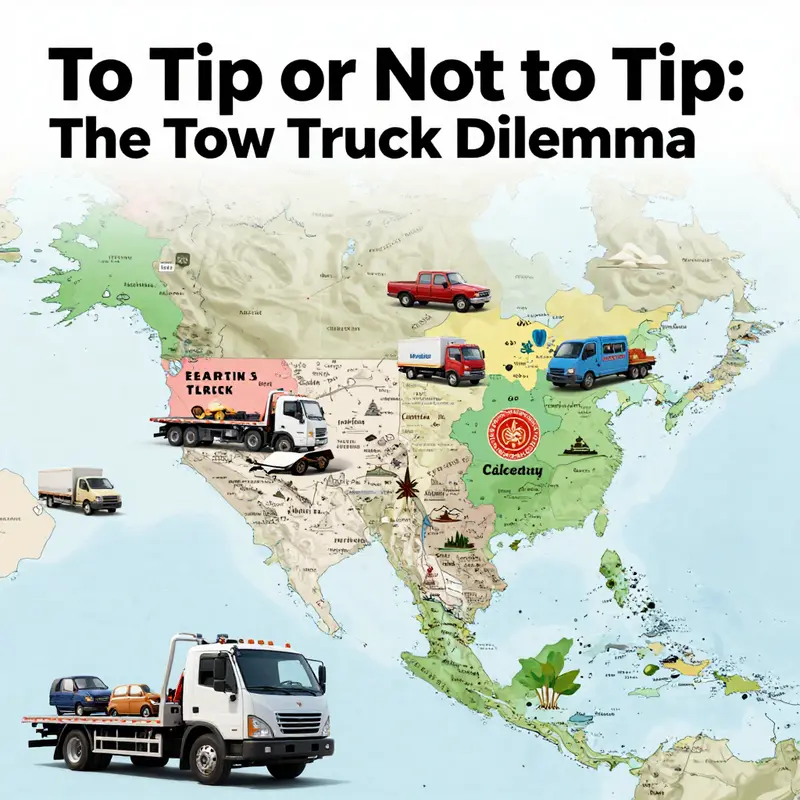
When a tow truck arrives, the scene often unfolds with a mix of urgency and uncertainty. A vehicle that won’t move, a moment of stress, perhaps after an accident or a breakdown, and the tow operator stepping into a space where safety, precision, and clear communication matter most. In these moments, tipping can feel like an afterthought or a question that travels with the driver like a muffled echo: should I tip, and if so, how much? The honest answer is that tipping is not universally expected for tow services. A pre-arranged fee typically covers the labor, fuel, equipment, and the time spent on a potentially long haul. Still, the nuance lies in where you are and what the driver actually does. If the service involves more than simply loading and hauling, or if the tow requires a dangerous or technically complex maneuver, a small gesture of appreciation can feel appropriate and fair. Understanding this nuance requires moving beyond a one-size-fits-all rule and into a broader sense of regional etiquette and situational discernment.
In the United States, regional culture shapes tipping expectations in telling ways. Across the Midwest and into the South, it is more common for customers to add a tip to the base fare. Typical amounts often land in the range of ten to twenty dollars, and drivers may come to expect or at least appreciate this extra acknowledgment when the service includes more than straightforward towing. If the driver goes the extra mile—jump-starting a vehicle, removing debris from the roadway, or offering practical advice about what to do next—the tip often mirrors that extra effort. The same gesture in a different place can carry a noticeably different weight. In the Northeast and on the West Coast, tipping for towing is less predictable. Some residents regard it as unnecessary or even inappropriate, based on the belief that the quoted price should reflect the complete cost of the service. In those regions, drivers themselves may frame expectations differently, and customers may be uncertain about whether to offer a tip at all. The variability is enough to make a quick judgment call rather than a habitual reflex, and many people err on the side of following local cues or asking a nearby resident for guidance when feasible.
Beyond national borders, tipping customs shift again. In Canada, the United Kingdom, and most European countries, tipping for towing is generally not customary. The price you are quoted is typically intended to cover the entire job, including labor and travel. Offering a tip in these contexts can confuse the message, potentially implying that the driver’s base pay is insufficient. It can also place the driver in an awkward position, where accepting a tip might seem like contravening professional norms or policy. These tendencies do not erase the possibility of a gesture if the service stands out in significant ways, but they do call for a careful read of local expectations rather than a reflexive habit drawn from another country or a different part of the world.
The guidance that emerges from this landscape is practical and humane: let local norms guide your decision. If you are unsure, you can observe the routine by noting what locals in that area typically do or by asking a nearby resident what is common. If you land in a region where a tip is welcomed or expected, a small amount can be perfectly appropriate when the service demonstrates exceptional care. If the driver performs under ordinary conditions, tipping remains optional and modest in scale. The general principle is simple enough: tip should reflect the quality of service and the context of the work done, not the mere act of towing itself.
The most important factor remains the nature of the service provided. Tow drivers often navigate unpredictable and risky conditions: icy roads, uneven terrain, vehicles that are stuck, or drivers who must extract a car from a ditch or from under a dangerous position. In such cases, a driver’s skill and restraint contribute to safety and recovery outcomes. A tip acknowledges the extra effort, risk, and extended time that such tasks may entail. Conversely, if the tow is routine, handled efficiently, and ends without any extraordinary complication, tipping is not a required courtesy, and the absence of a tip should not be interpreted as dissatisfaction or disrespect. This balanced approach respects both the professional norms of the trade and the diverse etiquette landscapes travelers encounter across regions.
What constitutes a thoughtful, unobtrusive gesture in these circumstances? If you decide to give a tip, a small amount—five to twenty dollars depending on the service level and the complexity of the job—can be a meaningful sign of appreciation without implying any expectation on future visits. It is perfectly acceptable to hand the tip directly to the driver, with a brief expression of thanks, or to place it in an envelope or a small folded note if you are concerned about timing or privacy in a busy roadside setting. The key is to offer the tip in a straightforward, respectful manner that reflects the moment and your appreciation for competent, careful work. A tip is not a formality but a voluntary acknowledgment that the driver went beyond the basics in a way that improved your safety and the outcome of a stressful situation.
In some tense scenarios, the tipping decision can become part of a broader conversation about roadside safety, preparedness, and how communities value emergency responders and service professionals. It is here that a principled stance helps. A tip should never substitute for a fair, transparent price, nor should it be seen as a bargaining tool for better, faster, or more attentive service in the future. Tipping is a discretionary nod to good service, not a guarantee of preferential treatment or a surcharge for meeting standard obligations. If you want to ground your approach in a more informed framework, you can explore regional discussions and practical guidance that illuminate how tipping norms vary across different locales. For a broader look at regional practices, you can see santamariatowtruck.com/blog/.
As with many etiquette questions, local context matters most. The same tow operator may work across several counties or states, dealing with different customer expectations on different days. In these cases, a driver’s personal preferences rarely translate into a universal rule, and the tides of etiquette shift with the locale and with the specific work performed. The most respectful approach is to listen, observe, and respond with discretion. If a driver has gone out of their way to navigate a hazardous scene safely, to explain the process clearly, or to offer practical guidance about what comes next, a modest tip is a natural way to acknowledge that extra effort. If the service is straightforward, and the driver has completed the job efficiently and professionally, gratitude can still be expressed in a courteous thank-you—without an accompanying tip, if that is more appropriate for the setting.
The conversation around tipping tow truck drivers reveals a broader truth about roadside assistance: while the mechanics of payment are clear, the social etiquette surrounding it is fluid. It invites you to weigh regional customs, the specifics of the job, and your own sense of fairness in the moment. The goal is not to chase a universal standard but to participate in a respectful exchange that honors the work of the driver while recognizing the realities of local practice. In regions where tipping is more common, your contribution can reinforce positive service and encourage drivers to continue offering careful, reliable help during difficult moments. In areas where tipping is less common, your decision to refrain from tipping should be taken as a standard of fairness rather than an indication of dissatisfaction with service. Either way, the core value remains consistent: treat the person who helps you with courtesy, acknowledge their professionalism, and make your choice in a way that aligns with local norms and your own judgment.
External resources offer additional perspective on tipping etiquette across services, including towing, and can help you calibrate your approach when you are unsure. For a broader, regionally informed guide, see The Spruce’s overview of tipping tow truck drivers, which compiles practical tips from various settings and highlights common expectations. This external reference complements the nuanced regional discussion while keeping the focus on respectful, informed choices when you face a roadside emergency.
Tow, Fee, and Gesture: The Hidden Economics Behind Tipping Tow Truck Drivers
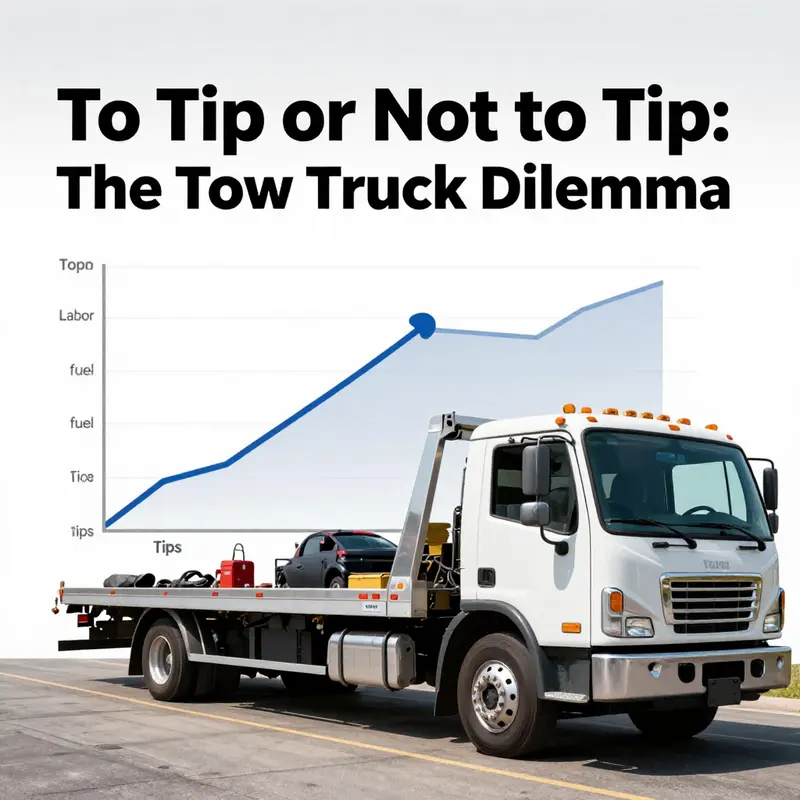
When a tow truck arrives on a roadside moment of vulnerability, it is more than a vehicle being moved: it is a small service operation under pressure. The posted price is meant to cover equipment costs, fuel, insurance, crew time, and the complexity of the job. A flatbed tow or a recovery involves careful handling and ongoing maintenance for the fleet. Because that cost structure is anchored in predictable charges rather than variable tips, many companies discourage tipping to preserve pricing transparency and avoid confusion about whether gratuities replace or supplement the quoted price.
The human element remains undeniable. A driver can diffuse tension with clear explanations, practical help, and safety-conscious decisions that go beyond loading a vehicle. Tipping becomes a discretionary gesture when service goes smoothly under pressure, not a price reduction. The perception matters: tips can be seen as recognition for exceptional handling, or as a signal that the quoted price didn’t fully reflect the value delivered. The balance is often kept simple by design.
Geography matters. Tipping culture varies by region and industry. In some places tipping is common and accepted; in others, it is discouraged in towing to maintain pricing consistency and avoid implying drivers depend on gratuities. The practical takeaway is that tipping should be a one-off gesture of appreciation, not a structural element of compensation. It remains a personal choice, tied to the quality of service and the circumstances, not a means to negotiate or discount the fee.
From an economic perspective, the tow industry relies on high fixed costs: equipment, maintenance, software, and regulatory compliance. Revenue flows from service charges rather than tips, so tipping has little effect on a company’s core finances. That said, a small gratuity can still acknowledge a job well done and help reinforce positive service behavior without altering the price.
If you decide to tip, aim for a modest amount that reflects the length and difficulty of the tow and is separate from the quoted price. Respect any company policy on tipping, and if no policy exists, remain mindful of local norms and the context of the service. A clearly voluntary tip is acceptable but not required.
For readers seeking a broader lens, external analyses discuss tipping as a social and economic phenomenon across industries. A detailed external resource: https://www.example.com/tow-truck-tipping-analysis-2025
Tipping the Line: Cultural Currents and Practical Etiquette for Tow Truck Interactions
A roadside tow often arrives as a moment of disruption, when plans derail and momentum halts in a span of minutes. In those moments, the person behind the wheel of a tow truck is not merely a technician with heavy equipment; they become a conduit for safety, direction, and swift problem-solving. The question of whether to tip a tow truck driver sits at the intersection of culture, economy, and personal judgment. The practical answer, grounded in most places, is that tipping is not expected or customary in the same way it might be for a restaurant meal or a hotel stay. The service fee for towing, which covers labor, fuel, equipment, and travel time, is intended to compensate the driver. Yet tipping remains a nuanced gesture—one that can acknowledge exceptional service without becoming a ritual that is universally expected. The conversation about tipping, then, belongs to the broader arc of how societies value assistance delivered under stress and complexity, and how travelers navigate local norms when the situation feels out of their control.
Across North America, tipping tow truck drivers is often common, though not legally required. In the United States and Canada, a tip of roughly 10% to 20% of the service charge is frequently considered appropriate, particularly when the driver handles a difficult scenario—pulling a vehicle from a ditch, extricating a car from ice, or assisting on a busy highway at night. The compatibility of tip size with the severity of the task can reflect not only the quality of service but also the extra risk the driver faced and the additional time spent assisting beyond basic towing. Drivers may welcome cash tips as a quick, direct sign of appreciation, even when the formal payment structure already covers the core costs. It is important to read the room: a small tip in challenging conditions can feel more meaningful than a larger tip offered for routine services, simply because it signals acknowledgement of effort and risk that might be invisible to a casual observer.
In many parts of Europe and Asia, tipping roadside assistance is far less customary. In countries such as Germany, France, or Japan, the price you see is typically the price you pay, with professional service included in the quoted charge. Offering extra money in those contexts can be perceived as inappropriate or even diminishing the perceived professionalism of the driver. This distinction rests on broader cultural norms that equate good service with a fair, bundled price rather than with an added gratuity. The impulse to tip as a supplement to wages—once more common in some sectors—has not translated uniformly into the roadside assistance sphere. For travelers, the key takeaway is to observe local behavior and, when in doubt, err on the side of respecting local practice rather than introducing a custom that might feel foreign or misread as implying a lack of fairness in the base rate.
The historical roots of tipping illuminate why the practice persists in some economies more than others. In the United States, tipping emerged amid a labor market that relied on tips to augment relatively low base wages for service workers. Over time, tipping became woven into the economics of many service encounters, including transportation support. Tow truck drivers, who endure long hours and unpredictable, high-stress conditions, may rely on tips as a supplementary income stream. This reality helps explain the variance you encounter from one region to another. In other words, tipping is not simply a courtesy; in some contexts it serves as a financial acknowledgment of the risk, skill, and irregular hours these drivers keep. Yet the distinction between a gesture of appreciation and an expectation can be subtle, and it is wise to calibrate your response to the specific service encounter at hand.
Travelers, in particular, face a complex calculus. When you are stranded at night on a busy highway, the driver’s prompt arrival, calm communication, and effective problem-solving can be as valuable as the technical act of towing. A small tip, when given with tact, can convey gratitude without implying that the base charge is insufficient. In contrast, in a city where roadside assistance is standardized and the market for emergency services is highly competitive, the practice of tipping may fluctuate with local norms and employer policies. It is prudent to prepare in advance: understand the likely expectations in the region you are visiting, carry a modest amount of cash, and be ready to adapt your response to the technician’s demeanor and the complexity of the job. A tip is one possible signal of appreciation, not a demand that coaxes a gratitude that should be freely offered only when sincerely warranted.
Beyond the numbers, the etiquette of tipping is best understood as a matter of discernment and respect. If the driver goes above and beyond—offering clear safety guidance, helping you navigate a tricky detour, or providing practical advice about vehicle recovery and next steps—that is the moment to consider a gratuity. The gesture should feel proportionate to the effort and to the circumstances. If the service was routine and efficient, a polite thank you suffices. If you choose to tip, cash is often simplest and most direct, especially in urgent scenarios where card processing could slow the flow of help. If a card is offered as the only payment method, a tip added to the card transaction can also be appropriate, provided it aligns with your payment plan for the service.
People moving through multiple locales or traveling internationally can benefit from recognizing how tipping for roadside assistance fits into a larger pattern of social reciprocity. The same gesture that is appreciated in one circumstance can be misread in another. For that reason, it helps to limit tipping to moments when the assistance clearly warrants it and to avoid turning the interaction into a transactional expectation that might overshadow the intrinsic value of professional service. Observing how locals handle gratuities in similar situations is a practical habit. When in doubt, seeking a discreet, culturally attuned signal—such as a simple thank-you and a verbal acknowledgment of the driver’s help—can convey respect without risking a misstep.
Within a broader ecosystem of service culture, actors in the towing industry also navigate their own expectations and policies. Some shops and fleets discourage tipping to maintain uniform pricing and wage structures, while others may welcome tips as a source of supplementary income in a market characterized by irregular demand and seasonal fluctuations. This range reflects the varied economics of the field, where employees balance fixed wages against variable incentives. For the consumer, the takeaway is straightforward: tipping is not a universal obligation, but it remains a kind and context-dependent option. A thoughtful approach—considering the task’s difficulty, the driver’s conduct, and the regional norms—helps ensure that you honor both your values and the realities of the service encounter. A well-timed gratuity, when offered with sincerity, can reinforce a positive interaction that reflects gratitude for someone who has steadied a moment of crisis.
For readers seeking a broader framework, engaging with local customs and common-sense etiquette can be as informative as any explicit rule. If you want deeper context from a related industry discussion, see the Santamaria Tow Truck blog. This resource offers perspectives on how fleets prepare for emergencies, how operators handle complex recoveries, and how community expectations shape front-line service. It can illuminate the practical realities behind those split-second decisions drivers must make when a tow becomes a life- or property-protecting action. As you explore tipping in your own travels, carrying that awareness into your interactions helps maintain respect for professional service and sensitivity to local norms.
The question, then, is not a universal decree about tipping tow truck drivers. It is a gentle inquiry into what your gesture can communicate in a moment of need. Can a small tip reflect appreciation for competence under pressure? Can a quiet nod or a clear expression of thanks honor the driver’s professionalism without creating awkward expectations? The answers lie in the specifics of each encounter—its timing, its risk, and the shared understanding that, in many cases, the service is already paid for in full by the quoted fee. As the road curves and the scene shifts from emergency to relief, the ability to respond with both practicality and humanity becomes the real measure of courteous conduct.
External reading on the evolving landscape of tipping in a world increasingly shaped by automation and changing work norms can complement your understanding. See https://www.bbc.com/worklife/article/20231019-the-future-of-tipping-in-a-world-of-automation for broader context on how tipping practices may adapt as technology, wages, and expectations evolve across service sectors.
Final thoughts
Determining whether to tip a tow truck driver comes down to the individual experience and context of the service provided. While not commonly expected, a thoughtful tip can signify appreciation for remarkable assistance, especially in stressful situations. Understanding regional customs and the economic dynamics can further guide your decision-making. Ultimately, it’s about recognizing the hard work and care that tow truck drivers put into their services, which can go a long way in fostering goodwill within the community.