
Understanding whether a Commercial Driver’s License (CDL) is required to operate a tow truck is crucial for local drivers, auto-related businesses, and property managers. With regulations varying significantly by state, the implications of licensing can affect safety, compliance, and operational practices. This guide dives into federal regulations, state-specific exceptions, weight classifications, and the impact on towing companies while emphasizing the importance of safety and training. Each chapter builds on these insights to ensure you are well-informed and prepared for your responsibilities on the road.
Tow Truck CDL Essentials: Weights, Endorsements, and the State-by-State Roadmap
When a tow truck rolls into the lot, technicians and shop crews often hear the question whispered like a rumor in a break room: do you need a commercial driver’s license to operate this vehicle? The straightforward answer is usually yes, but the details matter a great deal. The licensing landscape in the United States is built around the Gross Vehicle Weight Rating, or GVWR, which is the maximum safe weight of a vehicle including its cargo, fuel, and all equipment. For tow trucks, that number is rarely small. Federal rules set by the Federal Motor Carrier Safety Administration (FMCSA) require a CDL when the tow vehicle’s GVWR is 26,001 pounds or more. That threshold applies to the truck itself, regardless of whether it is actively towing another vehicle at the moment. In practical terms, most tow trucks—whether they are wheel-lift units, heavy wreckers, or flatbed carriers—sit above that line, and operators will almost always be expected to hold a CDL to drive them legally on public roads. The nuance lies in the exact weight, the way the vehicle is used, and the weight of whatever is being towed. A careful owner or fleet manager will look not only at the truck’s own GVWR but also at how a given operation classifies the work, because there are exceptions and state-specific twists that can shift the licensing requirements into a different lane of licensing and endorsements. For fleets that maintain a variety of heavy-duty vehicles, this is where the road map becomes essential and where a thoughtful approach to compliance can save time, money, and risk down the line. To connect the licensing question with the bigger picture of how a tow fleet operates, it helps to keep an eye on the broader framework of fleet standards and emergency readiness. This is a topic that links licensing to training, vehicle maintenance, and incident response, and it is explored in depth in resources focused on standardizing practices across an entire fleet. fleet standardization and emergency readiness.
The weight thresholds are a clear starting point, but they are not the whole story. The FMCSA regulations emphasize GVWR, but they also call attention to the difference between a vehicle that simply retrieves a disabled car and one that carries hazardous materials or passengers. In many tow operations, the vehicle remains a single-unit truck with a GVWR above 26,000 pounds. In those cases, a Class B CDL is the typical route. A Class B license covers most single-unit trucks with a GVWR exceeding 26,001 pounds and allows the operator to drive most tow units without the extra complexity of an A-class license. The picture changes, however, when the operation involves a combination that includes a trailer, or when the vehicle is designed to transport not just another vehicle but also cargo that pushes the combined weight into another category. If the operation involves a tow truck that is part of a combination vehicle—such as a wheeled unit towing a heavy trailer—the appropriate license could shift toward Class A, which governs combinations with higher gross combined weights. In practice, many tow operators do need to consider whether the vehicle pulls a trailer and how that trailer contributes to the GCWR, or gross combined weight rating. In other words, the moment a towed load, plus the tow vehicle itself, creates a weight that triggers the combined rating, the licensing landscape becomes more complex and may require adjustments to the driver’s license or the endorsements held by the operator. This is why the exact configuration of the vehicle, and the duties assigned, are essential to determine the right CDL class.
Endorsements add another layer of specificity. If a tow operation involves transporting hazardous materials, the driver will typically require endorsements beyond the base CDL class. Similarly, if the operation involves carrying more than 15 passengers, the driver must meet additional passenger endorsements. In most towing contexts, however, those extreme cases are less common, and the typical concern centers on whether the vehicle requires a Class B CDL for a single-unit heavy tow or whether a Class A license is necessary for a towed trailer scenario. The specifics can vary by state, and the line between state standards and federal requirements is not always perfectly aligned. State laws exist to refine these general federal guidelines, and they frequently tailor classification choices to reflect local traffic patterns, enforcement practices, and the particular duties performed by tow operators. For a fleet manager, this is why understanding the local regulatory climate is not a mere formality but a practical necessity. It guides hiring, training, and compliance documentation, and it also helps in designing job roles where a driver with a specific license is matched to a corresponding vehicle type and to the tasks the operation intends to perform. When considering the broader question of licensing for a tow driver, one should not focus solely on the sticker on the door or the weight printed on the dash. It is essential to confirm with the state’s department of motor vehicles, and when in doubt, consult the FMCSA’s official guidance on regulated vehicle classifications. The aim is always to align the driver’s certification with the vehicle’s actual use and weight rating, not just the nominal status of “tow truck operator.”
To make this more concrete, imagine a tow company that operates a fleet consisting of several wheel-lift units and a couple of heavy wreckers. The wheel-lift units, with GVWRs that surpass 26,001 pounds, typically require a Class B CDL. The heavy wreckers, especially those configured to haul a disabled car or a caravan of equipment, add the dimension of possible trailer involvement, which might push certain drivers toward Class A or at least a higher level of certification with the appropriate endorsements. In a well-run fleet, the licensing plan mirrors the actual operation: the most common drivers hold Class B for the single-unit heavy tow trucks, with additional endorsements only if the job duties necessitate more complex operations. And if any driver is going to handle vehicles that transport hazardous materials or a larger passenger load, the licensing plan expands accordingly, ensuring all operators are compliant with both federal guidelines and the state-specific rules that can differ from one jurisdiction to another.
In this landscape, the role of training cannot be overstated. Merely possessing a CDL does not guarantee safe or compliant operation. Tow truck work demands specialized knowledge about vehicle dynamics, braking, braking distances under heavy loads, the peculiarities of recovering vehicles in tight spaces, and the specific safety protocols that protect the operator, the towed vehicle, and other road users. Training programs that focus on compliant load securement, proper use of lifting devices, and the correct procedures for roadside recovery help bridge the gap between license class and day-to-day practice. Many fleets incorporate a standard onboarding curriculum that covers the basics of CDL requirements for the various vehicle types in their lineup, followed by ongoing in-service training that reflects updates to state rules or FMCSA guidance. The emphasis is on creating a shared understanding of what each license allows and what it does not, ensuring that drivers are not inadvertently functioning beyond their authorized scope. This is where the broader principles of fleet standardization—consistent job roles, shared safety practices, and uniform documentation—become practical tools for staying within the law while maintaining high performance and reliability in emergency or roadside situations. A well-designed framework reduces variance in practice across shifts and operators, which in turn minimizes the risk of noncompliance while enabling a fleet to respond more effectively to incidents on the highway.
The practical upshot for drivers, shop managers, and business owners is straightforward: start with the weight of the vehicle and the way it will be used, then align licensing with those facts. Check the vehicle’s GVWR plate and understand whether a trailer is involved and, if so, how the GCWR is defined for the entire pairing. Review state rules carefully, since some jurisdictions require CDL for heavy tow units even when the operation is limited to moving vehicles rather than transporting cargo. Keep in mind that endorsements may be required for hazardous materials or transport of passengers, and be prepared to update documentation whenever a new vehicle type enters the fleet or when duties expand. In many cases, the most reliable path is to partner with the state DMV or a knowledgeable compliance advisor who can interpret the intersection of federal thresholds and state practice for a specific operation. Beyond the optics of licensing, the true objective is to ensure safety, legality, and readiness. A tow operation that adheres to a clear licensing framework is better prepared to handle emergencies, to maintain a steady cadence of service even during high-stress periods, and to protect its people and the public in the process.
For readers who want to explore how licensing fits into broader fleet management considerations, the discussion around standardization and readiness provides a valuable lens. It invites a holistic view of how coverage, training, maintenance, and incident response all converge around the licensing decisions that govern who may drive what, when, and under what conditions. The licensing question, then, becomes not a simple checkbox but a living part of a fleet’s operational philosophy. With the right information, a towing operation can strike a careful balance between compliance and efficiency, ensuring that the people behind the wheel are prepared, that the vehicles they drive are appropriately classified, and that the company meets the expectations of regulators, customers, and road users alike. For anyone faced with a concrete scenario—such as a heavy tow truck paired with a trailer, or a lighter unit tasked with vehicle retrieval without cargo—the safest course is to verify the exact classification through official channels and to document the decision-making process so that it can be revisited as rules evolve. This is the practical underpinning of responsible towing operations, and it is the backbone of a compliant, ready, and reliable fleet.
External resource: For authoritative guidance on CDL classifications and the regulatory framework, consult the FMCSA Regulations. FMCSA Regulations.
Tow Truck CDL Rules Unfolded: Navigating State Variations, Exceptions, and Compliance
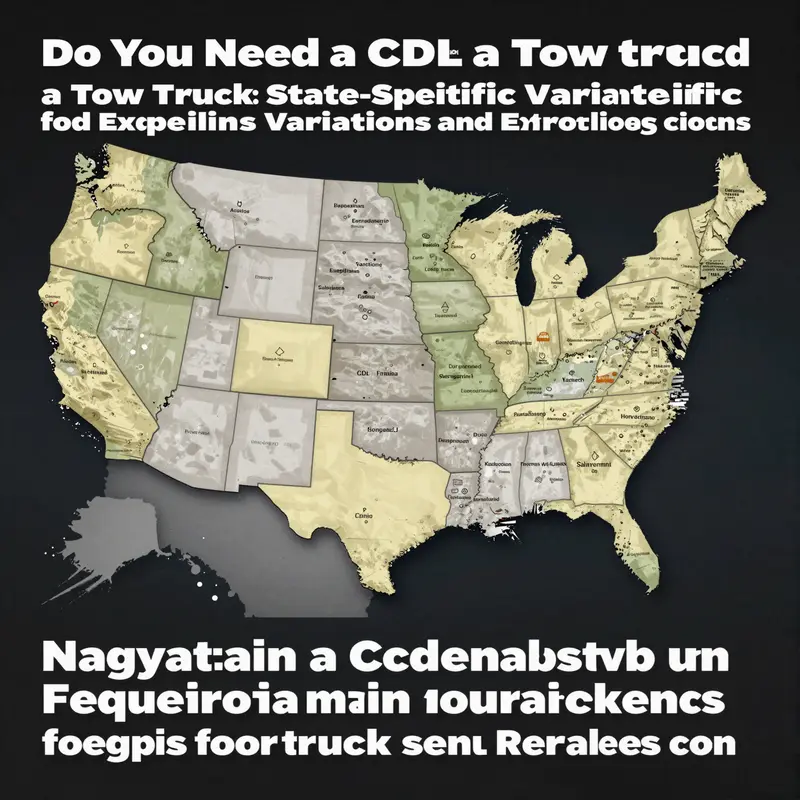
A tow truck sits at an unusual crossroads in the world of licensing. It’s not just a matter of buying a big vehicle and hitting the road; it’s about understanding when federal rules apply and how state laws shape everyday work on the shoulder of a highway. The question Do you need a CDL for a tow truck? invites a straightforward answer in many cases, but the real story is the spectrum of weight, configuration, and intended use that every operator must map out before turning the key. At the heart of the matter is the gross vehicle weight rating, or GVWR. When a vehicle’s GVWR exceeds 26,000 pounds, federal guidelines generally require a Commercial Driver’s License to operate it. That threshold is not a mere suggestion. It is a line drawn to ensure drivers handling heavy, potentially hazardous or high-risk equipment have the training, testing, and responsibility that comes with moving a vehicle capable of causing serious harm if misused. Yet this rule is a ceiling more than a ceiling for all tow trucks. Many operators will discover that their day-to-day duties fall into gray areas where state rules, exemptions, or endorsements decide the actual licensing path. The moment a tow truck is used solely to tow other vehicles—without any cargo beyond a recovery job, and not for profit or in a commercial capacity—the classification can tighten or loosen depending on where you live. The federal standard remains a backdrop; the states paint the foreground with their own requirements.\n\nAcross the United States, weight and use drive the licensing conversation for tow operators, but the specifics shift from state to state in ways that can surprise even experienced drivers. In most jurisdictions, a GVWR over 26,000 pounds triggers a CDL requirement when the vehicle is operated in any commercially viable context. If a truck is heavy, configured to tow, and intended to move a vehicle, the operator typically enters the CDL arena. But the line between commercial and private use is not always clear, and several states carve out exceptions that can matter for small fleets, independent operators, or private individuals who tow as a hobby or personal necessity. The practical upshot is this: before you assume you can dodge the CDL by driving a large tow truck with a private license, you must check your state’s specific rules and the exact designation of the vehicle you intend to drive.\n\nThe state-specific examples illustrate the landscape well. California, for instance, makes the rule more stringent in some cases. Any tow truck with a GVWR over 26,000 pounds requires at least a Class B CDL, even if the vehicle is used privately or for non-profit purposes. California’s approach emphasizes the potential for significant weight and the attendant risk, placing a higher hurdle for operators who work outside traditional commercial settings. In contrast, Texas presents a more permissive path for lighter machines. If the tow truck’s GVWR is 26,000 pounds or less, a CDL may not be required so long as the operator is not transporting hazardous materials and is not performing work for hire. That distinction—weight plus the nature of the job—shapes the licensing process for Texas tow operators who are managing private recoveries, nonprofit tasks, or private business needs without the heavier legal obligations that accompany the CDL system in other states. Florida adds another layer with endorsements that align more closely with the vehicle’s role than its raw weight. A T endorsement on a standard driver’s license can be permitted for certain towing configurations, particularly those serving emergency response or utility functions. In Florida, that endorsement can provide a practical path for operators who are involved in sanctioned emergency or utility work where a full CDL would be unnecessary or unduly burdensome for a specific operation. The Florida approach illustrates how endorsements, rather than full CDLs, can bridge the gap between necessity and regulation in fast-moving service environments.\n\nThese state patterns underscore a critical point for any operator contemplating a tow truck career or adding a heavy-duty recovery vehicle to a private fleet: do not assume your license heals all the way across borders. The GVWR tag tells part of the story, but the use case—whether you operate for hire, transport people, or perform private recoveries—tells another. In many states, even when a CDL isn’t technically required for the vehicle, there can be other licensing or permitting hurdles. Local municipalities may demand a towing operator’s permit, a business license, or specific approvals to operate on public roads, particularly if you’re running a fleet or performing regulated roadside services. The need for insurance, bonding, and compliance training can also be intertwined with licensing. And it’s not uncommon for certain counties or cities to impose additional requirements that extend beyond the state DMV. The practical consequence is clear: for anyone planning to work as a tow truck operator, a comprehensive compliance checklist is indispensable. It should cover not just the driver’s license but also vehicle classifications, endorsements, permits, business registrations, and operating restrictions that vary by jurisdiction.\n\nWhen you examine the licensing framework, two ideas stand out. First, classify the vehicle correctly and know its GVWR. Second, know the service model—the way you use the tow truck—because that use often defines what kind of license or endorsement you must hold. If the plan is to operate a tow truck with a GVWR above the federal threshold, the safest course is to pursue a CDL appropriate to the vehicle’s weight and configuration. If you’re working with a lighter recovery unit, explore whether a standard license with a state-specified endorsement suffices, or whether a specific tow endorsement is required to align with the intended duties. It’s not just about passing a test; it’s about the competence to manage a heavy, potentially hazardous piece of equipment in real-world conditions—on the road, at accident scenes, and in potentially volatile environments.\n\nThe discussion also bears on professional development and fleet readiness. Operators who belong to a business entity or a public safety or municipal service should consider how licensing intersects with training, equipment standards, and operating procedures. The CDL becomes a baseline qualification, but ongoing safety training, vehicle familiarization, and scenario-based practice significantly reduce risk on the job. A well-structured program includes not only the driver’s license requirements but also the specific endorsements if applicable, and it integrates with internal fleet standards that address maintenance, response protocols, and emergency readiness. For those who manage fleets or provide contracted tow services, the licensing decision influences staffing, scheduling, insurance, and the ability to respond quickly and legally to incidents across a wide service area.\n\nThe practical takeaways for someone weighing whether a CDL is needed begin with a careful, step-by-step assessment. Start by identifying the GVWR of your tow truck and confirming whether it falls above or below the 26,000-pound federal threshold. Then determine how the vehicle will be used: will it transport other vehicles as a primary function, will it be operated for hire, or will it serve private needs? This triad—weight, use, and jurisdiction—will guide the licensing path. If the vehicle sits above the threshold and is used in any commercial sense, plan for a CDL appropriate to the vehicle’s configuration. If the vehicle is lighter, verify whether a state-endorsed license with a “T” endorsement or an equivalent provision applies, and be prepared to meet any related training or certification requirements. Always corroborate with your state DMV or equivalent authority, because rules can change. For a general orientation and to refresh your understanding of the broader landscape, you can explore industry discussions and practical perspectives at the Santamaria Tow Truck Blog, which offers related considerations on standards, readiness, and fleet practices: https://santamariatowtruck.com/blog/.\n\nBeyond the doorways of licensing, it’s wise to anticipate a chain of administrative steps that accompanies a tow operation. Even where a CDL may not be required for the vehicle itself, many operators encounter licensing nuances tied to business registration, accident reporting requirements, hauling insurance standards, and compliance with local towing ordinances. When planning a fleet or a solo tow operation, a proactive approach helps avert last-minute surprises. It involves mapping out the licensing requirements by state, verifying whether a T endorsement or its equivalent is needed, and confirming any hazardous materials or passenger-carrying considerations. It also means recognizing the importance of ongoing education and safety practices—how to load vehicles safely, how to secure a scene, how to manage traffic at a recovery site, and how to coordinate with law enforcement and emergency responders when a tow is required. The rules may appear rigid, but they exist to protect operators and the public. When followed, they become a dependable framework within which professional towing can thrive.\n\nFor those seeking official, state-specific clarity, the sources of truth lie with the state DMV and the official transportation authorities that interpret and enforce licensing standards. Federal guidance provides a scaffold, but state laws determine the day-to-day reality. Keeping abreast of changes is essential, as rules evolve with safety research, infrastructure needs, and the demands of emergency response. If you’re navigating this space for the first time or refreshing your understanding after a period away from the field, a careful, methodical approach will yield the best outcomes: confirm the GVWR, confirm the intended use, check for any endorsements required, and then align with local permitting and business licensing obligations. In the end, a compliant operator is not just a goal but a practical necessity for reliable, safe, and efficient tow operations across different jurisdictions.\n\nFor authoritative details on state-specific tow truck licensing and endorsements, see the California DMV Tow Truck Requirements. This resource provides a concrete example of how one state codifies these questions in a way that can inform broader planning and compliance decisions: https://www.dmv.ca.gov/portal/dmv/detail/vr/cdl/towtruckrequirements.
null
null
Tow Weight, Big Rules: Navigating CDL Requirements for Tow Trucks
Whether a tow truck operator needs a Commercial Driver’s License (CDL) depends primarily on vehicle weight and how the vehicle is used. Federally, a CDL is generally required for vehicles with a Gross Vehicle Weight Rating (GVWR) over 26,000 pounds, or for vehicles designed to transport 16 or more passengers (including the driver). Many heavy-duty tow trucks used for recoveries or long-distance towing exceed that threshold and therefore require a CDL. States may adopt additional or different rules, so operators working across jurisdictions must confirm state-specific requirements.
Lighter tow trucks with GVWR at or below 26,000 pounds often do not trigger the federal CDL requirement, but state definitions and intended vehicle use can change that determination. A vehicle configured more like a cargo carrier or used in certain commercial contexts might fall under stricter licensing rules in some states. Because of this variability, towing companies should inventory their fleet by GVWR, typical usage, and operating area to determine which drivers need CDLs and any relevant endorsements.
Obtaining a CDL involves written knowledge tests and practical skills testing to confirm a driver’s ability to operate heavy vehicles safely and handle specialized equipment (winches, dollies, etc.). Beyond legal compliance, CDL training improves scene safety, load handling, and overall professionalism. Employers should treat licensing as part of a broader safety and training program that includes maintenance practices, recordkeeping of licenses and medical certificates, and contingency staffing for peak demand.
Non-compliance carries tangible risks: fines, operational restrictions, reputational harm, insurance consequences, and potential loss of contracts. For these reasons, many fleets prefer hiring CDL-qualified drivers, even when a CDL might not be strictly required for every vehicle, because the credential reduces operational risk and improves reliability.
Practical steps for fleets: maintain an up-to-date vehicle classification by GVWR and use; document each driver’s license class, endorsements, and medical qualifications; implement training and periodic requalification; and coordinate with state motor vehicle agencies to track rule changes. For operations spanning multiple states, build a proactive compliance program that treats licensing as ongoing rather than one-time. Resources such as the FMCSA guidance and state DMV publications are useful references for specifics.
In short, determine CDL needs by vehicle GVWR and use, verify state rules, invest in training and recordkeeping, and make licensing part of a continuous safety and compliance program to protect drivers, customers, and the business.
Tow Truck CDL Essentials: Navigating Weight Rules, Safety Protocols, and Compliance on the Open Road
Tow trucks sit at a critical junction where licensing, safety, and the realities of the road intersect. For many operators, the central question is not simply whether a CDL is useful, but whether it is legally required to pull off the everyday tasks of roadside recovery, accident scene response, and fleet support. The short answer drawn from federal guidance is straightforward: in the United States, a Commercial Driver’s License is typically required when the tow truck, together with its load, pushes past a specific weight threshold. Yet as with most rules in transport, the details matter. A truck’s weight, how it is used, and where it operates can tilt the balance between needing a CDL and operating under a lighter, non-commercial license. The practical reality is this: most tow trucks are built to move heavy vehicles and equipment, and most of them end up falling into the category that triggers a CDL. The weight threshold, framed by the Gross Vehicle Weight Rating, is the starting point for understanding the licensing obligation. When the combined vehicle and load exceed 26,001 pounds, the federal standard generally requires a CDL. If a tow operation is strictly limited to moving other vehicles and the weight does not exceed that limit, some states and certain classifications may apply a different licensing credential or, in some cases, no CDL at all. This nuance explains why a tow operator cannot rely on a one-size-fits-all rule. The best approach is to confirm the details with the state’s Department of Motor Vehicles or its official transportation authority, because state regulations can bend the federal framework in ways that reflect local traffic realities and enforcement priorities. Within this landscape, the federal baseline remains the core reference: a CDL is the standard path for operators whose tow trucks and their cargo bring the GVWR above the critical threshold. That is the gravity of the weight rule, and it has meaningful, practical implications for training, insurance, and daily operations. It also signals the need for careful planning when a fleet evaluates new equipment or expands its towing capabilities. A heavier tow truck, a larger tow apparatus, or a heavier towed load can shift a vehicle from a non-CDL pathway into a CDL pathway almost by itself. For those in fleets, this is more than a legal checkbox; it is a driver’s class, a training track, and a safety mindset bundled into one credential that governs how the vehicle is operated, how drivers communicate with dispatch, and how the vehicle interacts with the highway and the scene of a breakdown. The weight rule is reinforced by material conditions that accompany many tow truck operations. The same bedrock requirement—CDL when GVWR is exceeded—often comes with other triggers that can complicate licensing: hazardous materials, or carrying more than 15 passengers including the driver, can push a driver into CDL territory even when the tow truck’s basic weight is on the lighter side. The logic behind these triggers is rooted in a broader concern for safety and regulatory oversight. Hazardous materials require heightened security, training, and incident-response readiness because the potential consequences of a mishap escalate when the cargo is dangerous. Passenger transport, too, introduces risk when multiple people share a single vehicle, compounding the complexity of timetables, routes, and emergency readiness. For tow operators, this means that licensing decisions are rarely about a single weight figure alone. They are about the role the vehicle plays in the broader transportation ecosystem. It is not unusual for a mid-sized tow truck carefully designed to move vehicles to still fall under a Class B or another state-specific classification, depending on how the state interprets the vehicle’s weight and intended use. The takeaway is simple but essential: know the exact GVWR of the truck in question, understand how it will be used, and verify the state requirements to avoid gaps that could leave a fleet non-compliant or an operator uncredentialed if law enforcement or regulatory audits occur on the road. The licensing landscape is further complicated by endorsements and special certifications that may apply even to lighter-weight tow configurations. In some jurisdictions, there is an “N” endorsement for certain low-weight vehicles that do not require a full CDL. Other endorsements, such as “H” for hazardous materials or “X” for tank vehicles, reflect the possibility that even within towing operations, a job can involve specialized cargo that shifts licensing needs. The overarching message is clear: licensing is not a single decision made in isolation. It grows from the intersection of vehicle weight, usage, and cargo, and it is continually shaped by state licensure practices and the evolving regulatory environment. Beyond the letter of the law, there is a powerful case for robust training and strict safety protocols that apply regardless of whether a CDL is strictly required. Tow operators face dynamic and potentially dangerous situations—accidents, stuck vehicles, and unstable wrecker recoveries demand disciplined procedures. Training becomes a living framework: how to secure vehicles securely so they do not loosen during recovery or transport; how to manage dynamic loads when the tow rig is in motion on uneven pavement or in high-traffic conditions; how to position the wrecker’s stabilizers and outriggers so that the scene remains stable while a vehicle is attached and detached. Mastery of these tasks rests not only on licensing but on comprehensive instruction in vehicle securing, load distribution, proper use of wheel lifts or dollies, and the stepwise procedures that keep both tow operators and the public safe. Emergency readiness ties into this training as a parallel thread. Operators must be prepared for a range of incidents: a vehicle fire during recovery, an on-scene hazard such as a fuel spill, or a collision involving multiple responders and bystanders. The ability to communicate clearly with dispatch, coordinate with law enforcement, and implement safety measures in a fluid, high-pressure environment is an indispensable compliment to the legal requirements. Compliance, therefore, extends from the actual driving test to the daily discipline of operating on the road. This means logging hours in ways that comply with hours-of-service rules when operating as part of a commercial fleet, maintaining medical certification where required, and keeping records that may be inspected during audits. It also means staying current with both state and federal regulations. Rules evolve as new truck models, new towing equipment, and new safety standards enter the market. Fleets that succeed in this space often pursue a proactive approach: they align weight classifications with vehicle procurement, ensure drivers understand the licensing implications of each truck in the yard, and establish training programs that reflect the real-world demands of towing work. In practice, this alignment translates into a disciplined routine that blends licensing with hands-on safety. The concept of fleet standardization and emergency readiness becomes a practical blueprint for daily operations. It is easy to understate how critical this integration is. A well-run fleet develops standardized procedures for securing a towed vehicle, for setting up the recovery scene, and for communicating with other road users and responders. This reduces the likelihood of mistakes, speeds up response times, and supports regulatory compliance. For operators seeking to deepen this approach, a useful resource exists that focuses on the broader framework of standards and readiness across towing operations. It offers insight into how crews can structure training, equipment, and procedures to meet real-world demands while remaining within regulatory boundaries. fleet standardization and emergency-readiness resources. As you read this material, consider how your own fleet, or your own work as a driver, fits into that broader vision. The practical implications extend beyond the moment a vehicle is secured for transport. They touch the entire lifecycle of a tow operation: from selecting the appropriate vehicle weight class, through obtaining the proper endorsements, to maintaining the right training and safety culture that makes every recovery safer and more efficient. The regulatory framework provided by the FMCSA anchors these decisions in fact, and the official source remains the most authoritative guide for the precise rules that apply to a given state or operation. For a complete understanding of the current requirements and any recent changes, consult the FMCSA official website as your primary reference. In the meantime, the core takeaway for tow operators is that licensing is deeply connected to weight, usage, and cargo, and that safety and compliance are inseparable from the license held. By recognizing the weight thresholds, understanding the range of endorsements that can apply, and investing in comprehensive training and emergency readiness, tow professionals can operate with confidence and accountability on the open road. For ongoing, formal guidance, refer to the FMCSA’s official resources. External reference: https://www.fmcsa.dot.gov
Final thoughts
Navigating the requirements of operating a tow truck, particularly regarding CDL licensing, is essential for various stakeholders, including local drivers, auto repair shops, and property managers. By understanding federal regulations, state-specific variations, and the implications of weight classifications, you can ensure compliance and maintain safety. It is vital to invest in training and commit to ongoing compliance to enhance operational efficiency and safety, benefitting both businesses and the community at large.