
Tipping is a common way to express appreciation, especially in service-oriented industries. When it comes to tow truck drivers, the customary practice can vary widely based on factors like service complexity, location, and exceptional effort. For vehicle owners and property managers, understanding how much to tip can enhance relationships with service providers while ensuring fair recognition for their efforts. This guide will explore general tipping guidelines, influential factors, regional norms, and exceptional circumstances, providing a comprehensive overview of how much to tip tow truck drivers effectively.
null
null
Gauging the Right Tip: Factors That Shape How Much to Reward a Tow Truck Driver
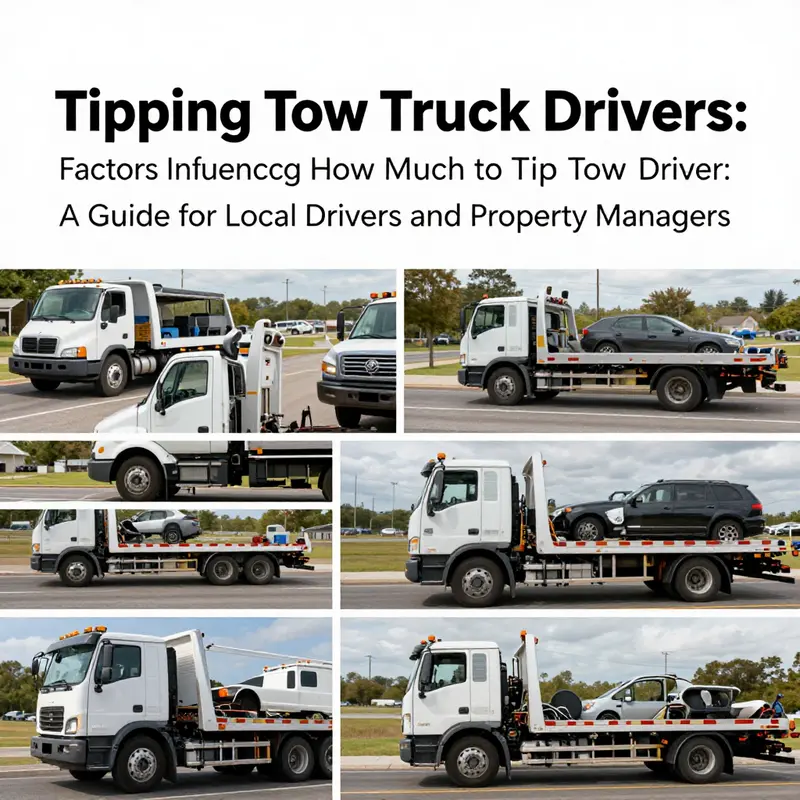
When you call a tow truck, you’re asking for help in a moment of vulnerability and urgency. Tipping acknowledges the extra effort and care the driver provides. The amount should reflect service complexity, conditions, and local norms, not a rigid rule. Practical guidance can help you decide a fair gesture in real-world scenarios.
For routine tows from a parking lot or roadside breakdown, a tip in the range of ten to twenty dollars is reasonable. If the job is straightforward but done professionally—clear communication, prompt response, careful loading—a tip toward the lower end is appropriate, especially in mild weather with no added risks. Consider a higher amount only if extra effort, risk, or courtesy is evident.
For more complex or demanding situations—long-distance travel, recovery from difficult terrain, severe weather, or after-hours emergencies—twenty to fifty dollars or more may be warranted. In these cases, the driver’s extra time, risk management, and dedication during inconvenient hours support a larger gratuity.
Local norms and policy matter. If company policies discourage tips or cash handling is awkward, ask politely at the outset or arrange an electronic gratuity where available. A simple check-in can prevent discomfort and ensure your gesture is welcome.
Ultimately, tipping is a gesture of appreciation, not an obligation. If the service exceeded expectations or helped reduce stress, a tip at the upper end of the range is reasonable. If you’re unsure, err on the side of restraint and ask the driver or company about tipping norms.
null
null
Beyond the Fare: How Exceptional Circumstances Can Widen the Tip for Tow Truck Drivers
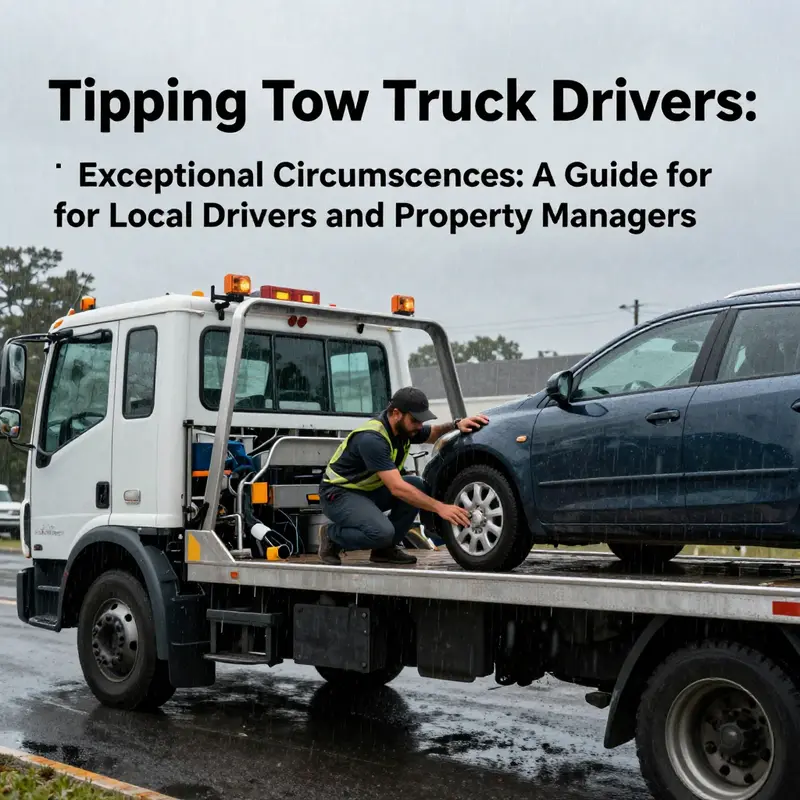
When a tow truck rolls into view on a roadside shoulder, the scene often carries more tension than celebration. A driver arrives under pressure—perhaps with a car that won’t start, a tire that’s blown, or a vehicle that simply won’t move. The service is usually a paid transaction, not a personal favor, and tipping isn’t universally expected. Yet many people respond with generosity when the situation feels especially demanding or when the driver goes beyond the basics of the call. This chapter examines how certain exceptional circumstances can widen the range of tipping, how to judge when a gratuity is appropriate, and how a simple gesture can reinforce a positive, safety-conscious culture in a field where help is both practical and potentially perilous. The aim isn’t to prescribe a rigid formula but to illuminate the factors that shape a fair and thoughtful response to service that unfolds under stress and in challenging conditions.
In ordinary towing—say, a routine tow from a parking lot or a roadside breakdown—the baseline tipping range tends to be modest. A tip of ten to twenty dollars is often cited as reasonable by both service providers and motorists who want to acknowledge competence without making the moment awkward. The driver has completed the core task: securing the vehicle, ensuring it’s safely loaded, and delivering it to a destination that meets the customer’s needs. There is something appreciable about recognizing that a job with such immediacy and potential danger requires steady hands, clear communication, and a calm demeanor amid traffic, weather, or time pressure. When the weather is calm and the distance is short, the implicit contract between customer and driver remains almost transactional, and a tip in that ten-to-twenty range often serves as a courtesy rather than a demand.
Yet the same scene can change quickly. When the job expands beyond a straightforward pull onto a tow truck or when the driver must navigate a more complicated route, the tipping calculus shifts. For longer-distance towing, heavy vehicle recovery, or service that occurs outside regular hours, a tip of twenty to fifty dollars—or more—becomes a more fitting reflection of the extra effort involved. The driver might be contending with unfamiliar roadways, dispatch delays, or the need to maneuver a vehicle that requires special equipment or careful handling. In these cases, the driver’s skill is not just in driving but in problem-solving under time constraints, in coordinating with dispatch, and in maintaining a calm line of communication with a client who may be worried about the fate of a vehicle, a deadline, or a workday interruption. Acknowledging that complexity with a larger tip is not simply about money; it’s about signaling appreciation for expertise under pressure.
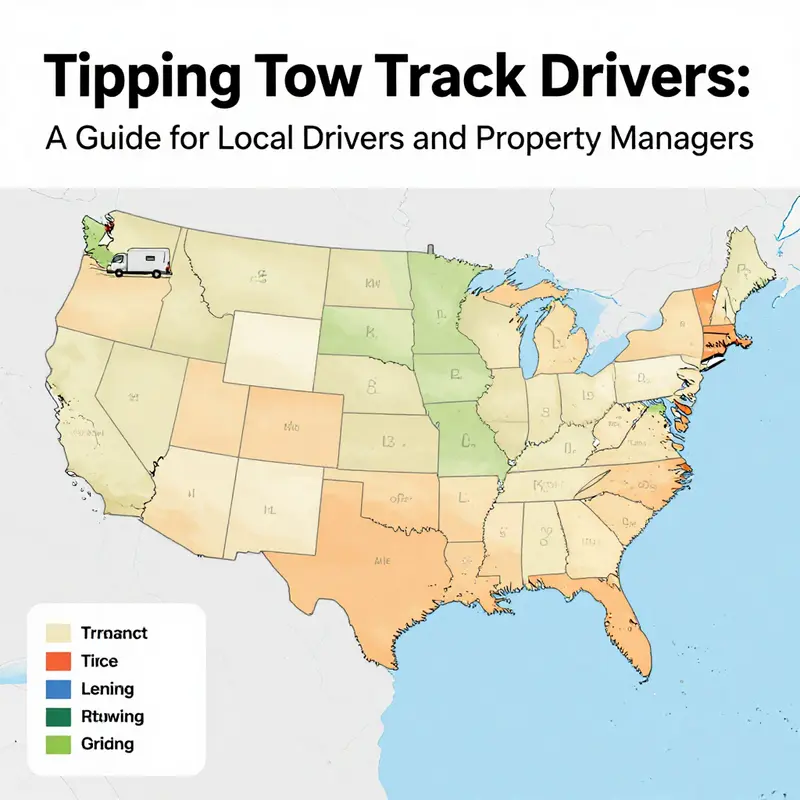
The literature on tipping etiquette for roadside assistance emphasizes that tipping remains highly contextual. The decision to tip—and how much—can be influenced by regional norms, local customs, and company policies. In some areas, tipping is culturally less common for professional services, while in others, it is an accepted practice that aligns with the broader habit of rewarding frontline workers who keep people safe and mobile in times of need. An important caveat is that some tow companies may have policies against accepting tips, or drivers themselves may be restricted from accepting gratuities. In those cases, asking the driver or the company first is prudent. The goal, after all, is to acknowledge service in a way that respects local norms and organizational rules, while still conveying gratitude when the service has been helpful beyond the standard.
Exceptional circumstances can take many forms, but they share a common thread: they demand more from the driver than the routine tow. Severe weather, for instance, introduces an element of risk that goes beyond the usual drive. Snow, heavy rain, sleet, or ice can complicate access, slow down arrival times, and heighten safety concerns for both the driver and the customer. In such moments, a tip can function as a tangible acknowledgment of risk, perseverance, and professional care. If a driver navigates slick lanes to reach a stranded motorist, climbs into uncertain terrain, or coordinates with other responders to secure a safe, stable arrangement for a vehicle, the extra effort deserves consideration. The size of the tip, in those cases, shouldn’t be arbitrary, but rather a reflection of the extra mile the driver walked—literally and figuratively—in the service of safety and timely resolution.
Distance from home or usual driving area is another factor that makes a difference. When a tow truck travels a long way to assist, the logistical burden on the driver increases: additional fuel, a longer time window away from routine duties, and potential scheduling complications for the customer and the company. A long-distance tow may also imply the driver is handling more coordination, whether it’s arranging a tow route that avoids road restrictions, managing paperwork after an accident, or guiding a vehicle to a destination that is off the beaten path. In such scenarios, tipping twenty to fifty dollars or more can be a meaningful way to recognize the broader commitment involved. It’s a signal that the effort is valued, not merely the act of towing itself.
Remote or hazardous locations introduce a heightened degree of risk and complexity. A call that unfolds on a busy highway at night, during a severe storm, or in a remote area with limited lighting magnifies the driver’s attentiveness and the potential hazards faced. The driver must stay vigilant about traffic, other responders, and the vehicle’s secure placement on a tow rig. It’s in these moments that a tip—though not demanded—can feel like a direct expression of appreciation for the driver’s courage, communication, and meticulousness. A small tip of ten to twenty dollars is still a thoughtful gesture in many cases, but the actual amount may be higher if the driver demonstrates exceptional care, resourcefulness, or proactive safety guidance that goes beyond the call of duty.
Extra care and communication stand out as perhaps the most human dimension of tipping. A tow operator who remains patient, explains each step of the process, helps with paperwork, offers safety advice, or helps navigate the next steps after a breakdown earns more than a paycheck for the moment. The act of providing clarity—explaining how the vehicle will be secured, what to expect next, and what the customer should do to stay safe—builds trust. In those moments, tipping becomes not merely a reward for the outcome but an acknowledgment of the driver’s courtesy and the reassurance they provide in a potentially stressful situation. The gesture may be modest, but the sentiment behind it can be immense, turning a difficult incident into a more manageable, even humane experience.
Across this spectrum, a practical approach emerges. While tipping is not a universal obligation, it is a flexible signal of gratitude that should be calibrated to the circumstances. The typical baseline remains modest, yet exceptional circumstances justify a larger gesture. A safe rule of thumb could be: start with the standard ten to twenty dollars for routine service, consider twenty to fifty dollars for more complex or emergency work, and adjust upward when the driver’s performance shows extraordinary care or when conditions intensify the challenge. Such adjustments should be proportional to the effort and the impact of the service, not merely to the cost of the tow or the time elapsed. Importantly, always check local norms and company policies; what feels appropriate in one city may be less common or even discouraged in another.
As readers reflect on these ideas, a reminder may help keep expectations reasonable and respectful. Tipping a tow truck driver is a gesture of appreciation rather than an obligation. In many communities, the professional relationship centers on reliability, safety, and clear communication rather than gratuity. Yet when the driver demonstrates additional effort—whether by arriving quickly in bad weather, by managing an unusually complex recovery, or by offering guidance that eases the customer’s anxiety—the tip becomes a natural extension of that service quality. It is not about inflating the bill but about recognizing a moment when expertise, courage, and courtesy converge to help someone regain mobility and control as soon as possible.
For readers seeking a broader sense of tipping etiquette in the context of emergency services, the narrative here complements practical advice with a grounded sense of proportion. If you’re curious about how professionals in the field frame gratuities or want to see real-life examples of tipping decisions, you can explore related perspectives in the broader online discourse, including discussions hosted by industry voices and consumer guides. (For more context and details, see the Santa Maria Tow Truck Blog.) You can learn more about the dynamic of roadside assistance and how operators communicate with customers during stressful moments by visiting the internal resource linked here: Santa Maria Tow Truck Blog.
Ultimately, the question of how much to tip a tow truck driver under exceptional circumstances comes down to a blend of situational awareness, empathy, and respect for local norms. The driver’s competence, the safety of everyone involved, and the customer’s sense of relief after a difficult episode all shape the gesture. A thoughtful tip—whether modest or sizable—can reinforce the social contract that supports good service in challenging environments. It signals admiration for professional conduct and gratitude for the human touch that makes a stressful moment a little more manageable. In that spirit, readers are invited to weigh the factors described above and, when appropriate, respond with a gratuity that aligns with both the scale of the service and their own means. The goal is not to chase a fixed figure but to honor the effort and risk that often lie just beneath the surface of a roadside repair.
For readers who want a concise reference on this topic, the guidance remains adaptable: see the range for routine work, consider bumps for longer or more complex tasks, and stay mindful of safety, policy, and local custom. In moments of doubt, a simple courtesy—paired with a clear, respectful conversation about tipping—can help ensure that the gesture is received with appreciation and understood to reflect the driver’s commitment to safety and service. As this field continues to evolve with technology, scheduling pressures, and regional differences, the core principle endures: tipping is a personal decision shaped by context, not a rigid rule handed down from above. To explore more about how experts frame tips in emergency services, consult reputable consumer guidance and industry resources. For broader practical reference, see the external resource: The Balance’s discussion on tipping tow truck drivers: https://www.thebalance.com/tipping-tow-truck-drivers-3356748
Final thoughts
Understanding how much to tip tow truck drivers is essential for fostering positive relationships and appreciation for their hard work. By considering general guidelines, recognizing the impact of service complexity, being mindful of regional differences, and acknowledging exceptional circumstances, both vehicle owners and property managers can ensure they show the appropriate level of gratitude to these service providers. This thoughtful practice not only boosts morale but also reinforces the importance of their role in our communities.