
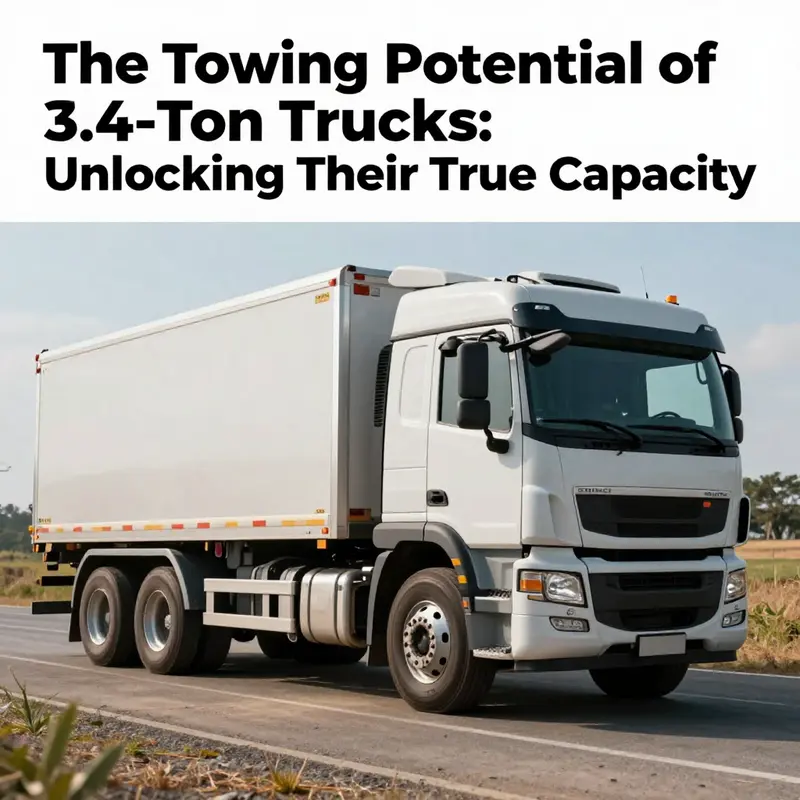
Understanding the towing capacity of 3.4-ton trucks is essential for local drivers, auto repair shops, property managers, and more. This article dives deep into how much these trucks can tow, considering their design, intended use, and industry applications. We will explore three key areas: the fundamentals of towing capacity, the critical factors affecting it, and real-world scenarios where 3.4-ton trucks prove their worth in diverse industries. By equipping you with this knowledge, you can make informed decisions that optimize the use of these powerful vehicles.
Tow Limits Demystified: Reading the Real Pull Power of a 3/4-Ton Truck
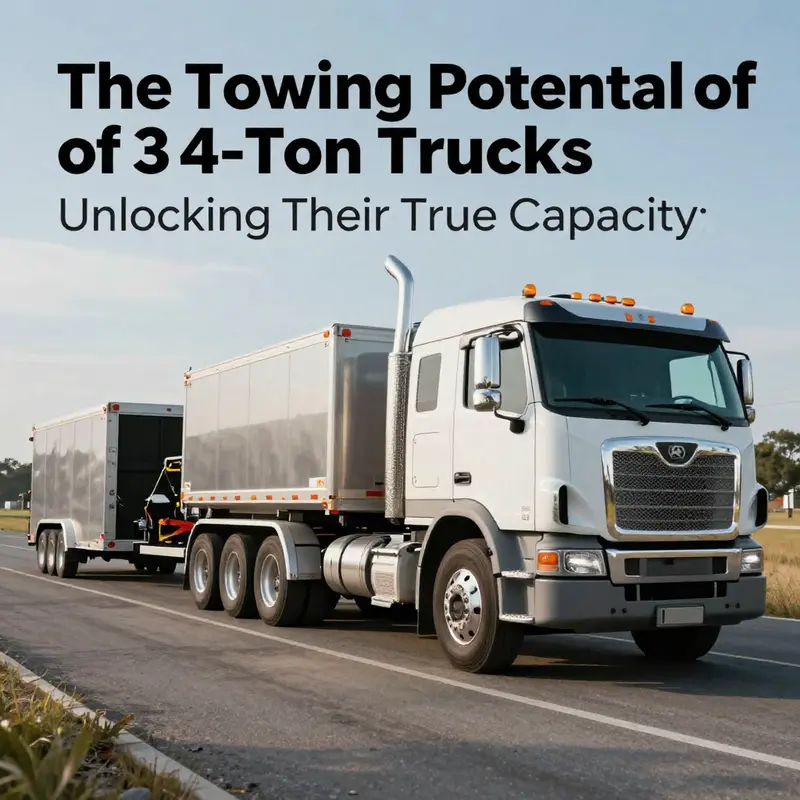
Towing capacity is not a single, fixed number etched into a dashboard badge. It is a moving target that shifts with every choice a owner or fleet manager makes about the vehicle and the load it’s asked to carry. When you talk about a 3/4-ton truck, you start with a weight class that sits between light-duty workhorse pickup trucks and the heavier chassis models designed for industrial use. Yet even within that broad class, the actual ability to pull a trailer depends on a constellation of built-in tools—a well-tuned engine, a robust transmission, the strength of the axles, the gearing, the braking system, and the overall frame and suspension geometry. The term “3/4-ton” often corresponds to a vehicle with a GVWR that places it in a category used for serious towing, but the towing capacity itself is not synonymous with GVWR. GVWR is the maximum weight the vehicle can safely carry in terms of its own weight, passengers, cargo, and fuel. Towing capacity, by contrast, refers to how much a vehicle can pull behind it while staying within safe and legal operating limits. These distinctions matter because a chassis rated for heavy hauling will still have a ceiling on trailer weight, and that ceiling can vary by design and configuration.
For anyone weighing options about how much they can tow with a 3/4-ton capacity, the practical bottom line is that the number you see in a brochure or on a data sheet is not universal. It reflects what the chassis, drivetrain, and braking system can handle under test conditions and with specific equipment. The same truck that can pull a few tons in one setup may struggle with a heavier trailer or require upgrades to wheels, tires, and suspension to maintain safety margins. The difference between a thin, urban delivery duty and a robust, long-haul job can be as wide as several thousand pounds. This is why precise guidance—consulting the exact model’s official specifications and understanding the trailer’s weight—remains essential.
The chapter you’re reading emerges from a practical synthesis of how weight, power, and control intersect in real-world towing tasks. It is not enough to know that a 3/4-ton truck can haul a given trailer when empty or when test engineers push it to the limit on a straight road. Real operation includes gradients, wind drag, braking demands, road conditions, and the dynamic forces that occur during turning, stopping, and curving. In that sense, towing capacity is not just a static figure but a safety envelope that must accommodate the trailer’s weight distribution, hitch type, and the driver’s experience. The consensus across credible sources is that the typical 3/4-ton pickup in today’s market offers a broad operating window: commonly around twelve thousand to sixteen thousand pounds of towing capacity when properly configured. Diesel engines tend to push toward the higher end of that range, thanks to greater torque at low RPMs and more durable drivetrains designed for heavy work. Gasoline variants can still deliver respectable numbers, but they often give up some towing headroom to the diesel options. This variability underscores the recurring warning: always confirm the exact specifications for your model and configuration before committing to a heavy trailer.
The conversation about towing capacity is, at its core, a conversation about coverages. It’s about ensuring that every component in the propulsion and control chain—engine torque, transmission gear ratios, axle gearing, frame rigidity, braking torque, and even the electronic safety systems—contributes to stability rather than overstress. A 3/4-ton truck that is configured for heavy-duty work typically carries a heavy-duty chassis, stronger axles, and a drivetrain that can sustain high workloads without compromising steering feel, pedal effort, or brake response. A 2WD setup may offer a slightly different balance than a 4WD variant because the latter often carries extra weight in the transfer case, different axle geometry, and additional driveline losses. Those nuances are not mere trivia; they translate directly into whether a given trailer is a safe match for the truck. The act of pairing a trailer with a 3/4-ton workhorse becomes a careful balancing act: the goal is to ensure the trailer’s gross vehicle rating (the trailer’s GVWR) is within the truck’s practical pull capacity while also accounting for tongue weight, hitch strength, and the braking demands of the trailer itself.
To grasp the full spectrum of what a 3/4-ton truck can tow, it helps to separate three related but distinct concepts: towing capacity, payload capacity, and GVWR. Towing capacity is the maximum weight you can safely pull behind the vehicle, including the trailer’s weight and any load it carries. Payload capacity is the weight the truck can carry in its bed and cab, such as passengers, tools, and cargo—not the weight it pulls. GVWR is the sum of the vehicle’s own weight plus its maximum allowable cargo and passengers. This triad provides a framework for thinking about how a 3/4-ton truck can be used most effectively. When a owner looks at a trailer with a GVWR of, say, 15,000 pounds, they must ensure that the truck’s stated towing capacity exceeds that figure, leaving a margin for safe handling, braking, and potential contingencies. This is precisely why the official data sheets from manufacturers and the owner’s manual remain indispensable references. They spell out the conditions under which the stated numbers apply, including the type of hitch, whether the drivetrain is 2WD or 4WD, the wheel and tire configuration, and the presence of any towing aids or weight-distributing hardware.
The practical upshot is that the 3/4-ton class can enable a wide range of towing tasks, but the ability to tow a given load is not universal across all configurations. A 3/4-ton truck with a robust diesel engine and a well-chosen axle ratio can approach the upper end of the 12,000–16,000 pound spectrum, particularly when equipped with a transmission tuned for heavy duty and with a frame that tolerates long hours under load. If the objective is to pull very large trailers—such as big fifth-wheel campers or substantial commercial equipment—the choice of configuration matters even more. The more powerful variants, designed for long-haul freight and heavy-duty logistics, often pair with drivetrains and chassis that are deliberately engineered to support higher towing numbers. The corresponding towing capacity will reflect those architectural choices. Conversely, models oriented toward urban delivery and general use tend to prioritize fuel efficiency and maneuverability, which can modestly cap towing numbers while preserving practicality for day-to-day responsibilities.
Because the maximum towing capability for a given 3/4-ton truck is so configuration-dependent, the single most reliable step you can take is to consult the official technical data sheet for the exact model you are considering. The sheet will specify the maximum trailer weight for the specific drivetrain and cab configuration, the GCWR (gross combined weight rating) if applicable, and any conditional notes about trailer weight distribution hitches. It is not unusual to encounter scenarios where a truck’s listed towing capacity changes when you switch from a regular cab to a crew cab, or when you opt for a longer wheelbase, a different rear axle, or a larger fuel tank. All of these factors can subtly affect the available headroom for safe towing. In some cases, the difference between two nearly identical trucks can be several hundred pounds of towing capacity, which translates into meaningful decisions about which trailer to buy or how to configure a hitch package. Armed with the precise numbers, you can plan with confidence and avoid the common trap of overestimating what a given 3/4-ton setup can safely pull.
That is why the mass of the trailer itself matters far beyond the trailer’s own name or appearance. A bulky trailer with a high GVWR imposes heavy demands on braking, steering, and suspension while descending grades or negotiating sharp bends. The tongue weight—the portion of the trailer’s weight that rests on the hitch—also must stay within what the truck and hitch can safely handle. If tongue weight exceeds the hitch’s rating or the rear axle’s design tolerance, steering control can become unpredictable, braking distance can lengthen, and the risk of trailer sway increases. Likewise, a trailer with insufficient braking capability or a poor weight distribution setup can transform a modestly sized load into a challenging safety problem on the highway. The interplay of these factors shows why a one-size-fits-all answer to “how much can a 3/4-ton truck tow?” does not exist. The right answer must account for the trailer’s GVWR, the trailer’s braking capacity, the hitch specification, and the truck’s own rated towing capacity under the exact configuration being used.
In practical terms, the typical window of twelve thousand to sixteen thousand pounds emerges in scenarios where the trailer weight and its cargo sit within a balanced envelope, the hitch and braking systems are properly matched, and the driver operates within the limits of what the engine and transmission can deliver. Diesel engines bring strong torque at low RPM, helping with initial acceleration and hill pulling, and they tend to tolerate sustained high-towing tasks with less stress than gasoline powertrains in comparable conditions. However, even with a diesel engine, the operator must respect the braking requirements of the trailer and the trailer’s own weight distribution across axles. A heavy load behind a 3/4-ton truck demands a properly adjusted weight-distributing hitch, adequate trailer brakes, and a well-maintained braking system on both vehicle and trailer. It also demands a driver who understands the dynamics of towing, including how vehicle speeds, steer angle, and road grade interact with trailer inertia to produce sway, overshoot, or loss of control if thresholds are crossed.
To navigate these complexities, many operators rely on the combination of published numbers and careful real-world testing. They compare the manufacturer’s stated maximum with their own practical requirements, and they plan for a margin of safety beneath the upper limit. They also verify that the trailer’s GVWR does not exceed the truck’s towing capacity and that the GCWR remains within safe limits when the trailer is connected. This approach, though conservative, is the prudent route for anyone who plans to use a 3/4-ton truck for anything beyond light towing. It ensures that the vehicle can accelerate, maneuver, and brake with a trailer in tow without crossing into a zone where the risk of mechanical failure or unsafe handling becomes unacceptable. The best practice is to model the planned trip around the numbers provided by the manufacturer and to use the trailer’s own data as a constant reference point. A trailer’s weight, its distribution, and its braking characteristics should be treated as fixed inputs in the calculation of safe operability, while the truck’s configuration provides the ceiling within which you can work.
When the topic turns to making decisions about the right configuration, many crews and individual operators want a simple rule of thumb. The rule still holds: the trailer’s GVWR should be less than the truck’s official towing capacity for the configuration you are using. This is the core safeguard that helps ensure you have enough reserve braking power, stable steering, and predictable handling under load. It explains why a well-equipped 3/4-ton truck with the appropriate transmission, axle ratio, and drivetrain option can deliver substantial towing capability, while a lighter setup or a mismatch between trailer weight and truck capability can produce a hazardous situation. The precise number—whether closer to the lower or upper end of the common range—will come down to the exact pairing of equipment and how the vehicle is operated in the field. The takeaway is clear: do not assume, do not guess, and always verify with the official data sheet and the trailer’s GVWR. This disciplined approach protects people, equipment, and the reliability of the operation over time.
For readers who want to connect this topic to broader safety and operations considerations, it helps to situate towing capacity within the larger framework of motor-vehicle safety and road-transport best practices. In many professional contexts, tow planning includes documenting the payload, the trailer weight, the tongue weight, the hitch rating, and the braking compliance. It also involves confirming that the planned route, road grades, wind exposure, and traffic conditions can be accommodated within the truck’s rated performance envelope. Avoiding overextension protects not only the truck and trailer but also nearby drivers, pedestrians, and the cargo itself. The discipline of towing capacity is really a discipline of safety—an ongoing practice of measuring, verifying, and validating that every piece of equipment will perform within its designed limits when it matters most.
If you’re ever unsure about safety and legality in the moment of towing, practical reminders exist that can help. For instance, paying attention to the signs and guidelines about where towing is permitted, what kind of trailers are allowed, and how to conduct safe towing operations can prevent costly mistakes and unsafe actions. A helpful resource in this regard is the set of practical signals and indicators that alert drivers to improper towing, including common signs that a trailer is not properly secured, the hitch is not correctly attached, or the load is unbalanced. Such checks are part of a broader habit of daily pre-tow inspections that can catch problems before they become emergencies. In this spirit, a quick reference to the concept of recognizing illegal or unsafe towing practices can be useful. For an accessible summary of these cues, you can consult resources like Spot Illegal Towing: Key Signs to Know, which provides guidance on identifying problematic situations and taking corrective steps promptly. Spot Illegal Towing: Key Signs to Know
Beyond these practical checks, the broader science of towing capacity rests on fundamental engineering choices. The engine’s torque curve, the gearbox’s ability to hold a chosen gear under load, and the braking system’s ability to dissipate thermal energy are all part of a tightly integrated system. The axle ratio is another critical lever: a higher ratio improves low-end torque and helps pull heavy trailers, but it can also reduce top speed and fuel economy. The drive configuration—whether the truck uses a two-wheel-drive layout or a four-wheel-drive setup—also changes performance. A four-wheel-drive system increases traction and low-speed stability in slippery conditions or rough terrain but adds weight and complexity that can, in some configurations, lower the gross towing figure slightly when compared to a lighter two-wheel-drive setup. The combination of cab style, wheelbase, and chassis reinforcement further refines what a given vehicle can safely carry in tow. Each of these design decisions is weighed by manufacturers to meet the intended mission of the truck, whether that mission is urban deliveries, regional hauling, or long-haul construction work. The result, in practice, is a family of models sharing a common nameplate but delivering somewhat different towing realities depending on the exact configuration chosen by the buyer.
In the end, the question of how much a 3/4-ton truck can tow is not about a single maximum. It is about the safe, reliable operation of a system where the vehicle, the trailer, and the road all interact. The best guidance blends hard data from manufacturer data sheets with practical planning that accounts for the trailer’s weight, the weight distribution, the brake system, and the driver’s ability to manage the load. It also respects that towing is not just about pulling heavy weight; it is about maintaining control, stopping power, and stability under variable conditions. For people who use these trucks as a daily tool, the payoff comes not from chasing the highest number but from choosing the right configuration for the job, testing the pairing under controlled conditions, and never exceeding the limits set by the vehicle’s official specifications. With those principles in hand, a 3/4-ton truck can be a capable partner for a wide range of tasks—from transporting large, well-balanced trailers to supporting demanding industrial needs—without compromising safety or dependability. External resource: https://www.nhtsa.gov
Tow Power in the 3–4 Ton Range: Reading the Numbers Behind Real-World Hauling
When people ask how much a 3–4 ton truck can tow, the first impulse is to hunt for a single number. The truth is more nuanced. A vehicle in this class sits between light-duty and heavy-duty work trucks, and its actual towing capability depends on a bundle of interacting systems that must balance allowed weight, control, and safety. In practical terms, you are looking at a moving target that is defined by how the truck is engineered, how it is loaded, and how its components handle the stress of pulling, braking, and changing direction with a trailer in tow. The question becomes not just how much weight a truck can pull, but how that weight transfers to the road in the conditions you will encounter. This is why the most reliable answer comes from reading the manufacturer’s specifications, understanding the difference between weight ratings, and thinking through the realities of your own hauling tasks.
At the heart of the discussion lies the distinction between weight the truck can carry and weight it can pull. The Gross Vehicle Weight Rating (GVWR) is the maximum weight the truck can safely carry, including passengers, cargo, and fuel. The Gross Combined Weight Rating (GCWR) is the cap for the total weight of the truck plus the trailer combined. The towing capacity, then, is not a fixed badge on the bumper but a derived figure. A common way to express it is simply: Towing Capacity = GCWR − GVWR (the weight of the truck itself when loaded to its maximum payload). This simplified relationship masks a lot of engineering nuance, but it captures the essential idea: the heavier the truck is when it’s loaded to the limit, the less trailer weight you can safely add under the same GCWR.
For a class of trucks around 3 to 4 metric tons, the numbers can vary widely—but they tend to cluster around a few practical ranges. A lighter, urban-oriented 3.4-ton work truck—typically designed for daily deliveries or service tasks in urban environments—speaks with a relatively modest towing capacity, often in the neighborhood of about 1,500 kilograms (roughly 3,300 pounds), when paired with a standard two-wheel-drive configuration and a conventional hitch. This doesn’t mean the truck is weak; it reflects the design emphasis on maneuverability, fuel efficiency, and urban agility. The same vehicle, however, can be configured or upgraded with a reinforced drivetrain, a more robust frame, and a four-wheel-drive system that markedly increases the lower-end pulling capacity, especially when the trailer weight is distributed and braked properly. The upshot is that the same platform can support far different towing scenarios depending on how it is specified and built for its intended duties.
On the other end of the spectrum, a heavier, more robust 3.4–ton or 4-ton chassis-cab or industrial configuration is built for demanding work. In such designs, the frame, axles, and suspension are engineered to tolerate higher static and dynamic loads, the braking system is augmented to control longer or heavier trailers, and the drivetrain is optimized to handle sustained torque under load. In this range, it is not unusual to encounter towing capacities that climb toward several thousand kilograms—sometimes 6,000 kilograms (about 13,200 pounds) or more—when the drivetrain and transmission are tuned for heavy hauling and when the vehicle operates with a 4×4 configuration or other traction-enhancing systems. The same fundamental rule applies: towing capacity is constrained by the vehicle’s GCWR and how it presents its own weight under load. A robust heavy-haul configuration simply reserves more headroom in that GCWR budget, allowing a heavier trailer to be managed while maintaining controllability and safety on the road.
To translate these concepts into a practical frame of reference, consider the torque and the gearing that deliver pulling power. Engine torque is the raw force that the wheels feel when the engine revs. In towing, the most valuable torque is the steady, strong torque at relatively low engine speeds, because a trailer in motion often requires immediate response without forcing the engine to spin into high revs. A high-torque, low-end profile enables confident acceleration from a stop, stable climbs up grades, and smoother braking as the trailer loads the system. This is why engineers place emphasis on torque curves and the way transmission gearing shapes how that torque reaches the wheels. The lowest gear ratio in the transmission is not just about starting speed; it’s about multiplying the engine’s torque at the wheels to overcome inertia, trailer resistance, and the friction of moving additional weight through the drivetrain and tires.
Drivetrain components matter just as much as the engine. A robust frame and reinforced axles are essential when heavy loads are the daily expectation. The suspension system must manage the extra load without compromising ride quality or stability, and the tires need to be rated for the payload and expected road conditions. Inadequate ratings in any of these areas can turn an otherwise capable powertrain into a liability on the highway or at a loading dock. Traction control systems, anti-lock brakes, and electronic stability features add layers of safety, guiding the vehicle through lane changes, rough surfaces, or sudden gusts of wind that can destabilize a trailer. The design intent behind industrial or off-road variants is to ensure that every major subsystem—frame, axles, suspension, braking, and tires—can sustain the additional load that comes with heavy towing. Without that holistic approach, the practical towing capacity drops, sometimes abruptly, when adverse conditions appear.
The type of drivetrain also influences how a truck performs under load. A rear-wheel-drive bias, common in many work trucks, can deliver straightforward torque to the rear axle, but traction becomes a critical consideration on slippery or uneven terrain. Four-wheel drive or all-wheel-drive configurations improve grip, especially when starting or climbing with a heavy trailer. However, adding traction capability often comes with increased weight and complexity, which can subtly alter the GCWR and the net towing capacity. In other words, the same chassis can behave very differently depending on whether you use two wheels to push or all four wheels to pull on a loose gravel surface, a wet road, or a snow-covered lane. This is why real-world towing results can diverge from nominal ratings: the environment interacts with the vehicle’s fundamental capacities, and drivers must adapt their technique to those conditions.
Design features crafted for industrial and heavy-duty use further illustrate the range of capabilities within the 3–4 ton band. Some trucks feature reinforced frames designed to handle long-term hauling in challenging environments, with higher-grade suspensions and braking systems that maintain stability when decelerating with a trailer. Others incorporate advanced traction aids, hill-descent systems, and braking assist technologies that help manage the increased momentum of a loaded combination. In all cases, these design choices are aimed at one core objective: maintaining control and stopping power when towing loads that approach the upper end of the vehicle’s GCWR. That means the same tow rating can feel very different depending on the configuration, the road grade, and how well the trailer is loaded and braked.
The practical consequence for someone choosing a 3–4 ton truck is clear. The gross weight rating of the vehicle sets the ceiling for what it can safely carry, but the effective towing capacity is a derived figure that relies on a precise alignment of the truck’s curb weight, payload, engine torque, transmission gearing, and the strength of the drivetrain. Real-world numbers are not a single universal value; they represent a spectrum conditioned by design intent, equipment level, and the specific duties the truck is built to perform. In many cases, the most reliable approach is to study the manufacturer’s official data sheets for the exact model and configuration you expect to use. Those documents will spell out GCWR, GVWR, and the rated trailer weight, along with any special limitations on hitch type or braking requirements that apply when towing heavy loads. If the aim is to understand what a particular 3– to 4-ton platform can handle in your fleet or on your project, you must connect the dots between the vehicle’s base ratings and the way you plan to operate every day. The alignment between the vehicle’s critical numbers and your operational realities is what ultimately determines safe, efficient, and predictable towing performance.
With this foundation in mind, the practical takeaway is not to cling to a single number but to use the number as a guide while validating it against the actual setup you intend to run. A light-duty, city-focused 3.4-ton truck will often perform well within the lower end of the range, provided you respect the trailer’s weight and the road conditions. When you step into a heavier-duty configuration or when you need to tow longer or more demanding trailers, you should expect and plan for higher GVWR and GCWR values that translate into a larger potential towing capacity—though those numbers come with equally important demands on braking, steering, and overall vehicle integrity. The best practice is to confirm the exact specifications for your chosen model and configuration, then design your towing plan to match the vehicle’s capabilities and the job’s safety requirements. For precise details, always refer to the official technical data sheet provided by the manufacturer, which will give you the exact GCWR, GVWR, engine torque characteristics, transmission gearing, and braking system ratings.
As you navigate these considerations, the path to informed decision-making also includes practical references from the broader fleet and operations context. For professionals who manage mixed-use fleets and unpredictable emergency-response scenarios, the interplay between payload capacity, towing capacity, and on-road performance becomes part of a larger design and safety framework. In such contexts, it is helpful to connect with resources that discuss fleet standards, maintenance readiness, and standardized procedures for heavy towing. For example, see the overview of fleet-standardization-emergency-readiness for a structured approach to deploying heavy-duty equipment in critical operations. fleet-standardization-emergency-readiness. This reference highlights how standardized capacities, documented procedures, and consistent training support safe and efficient towing in demanding environments. Remember, the towing rating you rely on should align with your work environment, the trailer’s weight distribution, and the braking and hitching arrangements you use. The combined system must deliver predictable stopping performance and stable handling under load, particularly when negotiating hills, winds, or surface irregularities.
In the end, the numbers tell a story of capability that must be read in context. The 3–4 ton category is broad enough to accommodate a range of scenarios—from urban parcel runs to rugged industrial hauls—and the actual towing power you can rely on depends on how the vehicle is built, how you manage weight, and how you operate in real-world conditions. While the formula GCWR minus GVWR provides a clear arithmetic backbone, the human factors—the driver’s skill, the trailer’s loading balance, the hitch setup, and the road environment—shape the day-to-day reality of towing. When you weigh these factors together, you are better prepared to select the right truck for the job, plan the trailer load with precision, and implement safe, efficient towing practices that keep people and property out of harm’s way. For those who want to explore the topic further, remember that the precise ratings lie in the manufacturer’s published data sheets, and those numbers should govern your decisions as you move from planning to execution. The chapter that follows will build on these ideas, extending the discussion to related considerations such as weight distribution, braking requirements, and the practical steps to verify your setup before every trip.
External reference: For additional context on specialized equipment and weight-bearing capabilities in related towing domains, see https://www.shintool.com/stand-on-3-ton-electric-tow-truck.html.
null
null
Final thoughts
In summary, the towing capacity of a 3.4-ton truck can vary significantly based on its make, model, and intended use. Factors such as drivetrain configuration, engine power, and chassis strength all play crucial roles in determining how much these trucks can safely tow. For local drivers, auto repair shops, and property managers, understanding these aspects not only ensures compliance with towing regulations but also maximizes the vehicle’s usage. Armed with this information, you can confidently assess your towing needs and select the right vehicle for your requirements.