
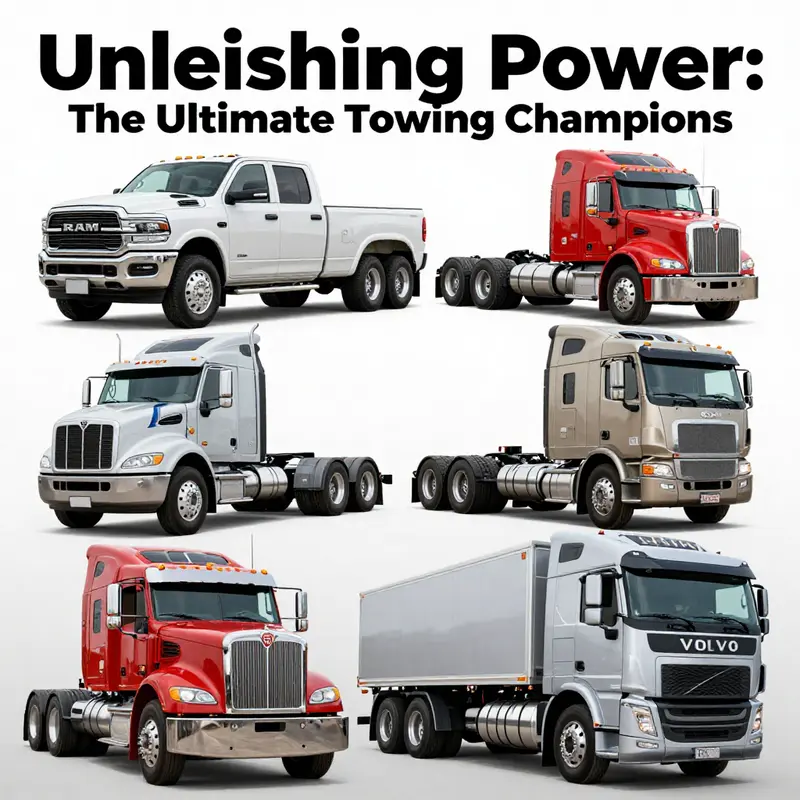
Towing capacity is a critical factor for drivers, businesses, and property managers, impacting how vehicles are chosen and utilized. Understanding which trucks lead the way can help consumers and professionals alike make informed decisions. This exploration dives into the exceptionally capable RAM 3500, which stands out in the consumer truck segment, as well as the specialized heavy rescue models like the Iveco X-Way and Peterbilt. Finally, we will examine the extraordinary towing power of the Volvo FH16.8×8, designed for extreme heavy hauls. With this comprehensive overview, you’ll gain the insights needed to select the right towing vehicle for your needs.
Consumer Heavy-Duty Champion: Anatomy and Reality of a Top-Tier Tow Rig
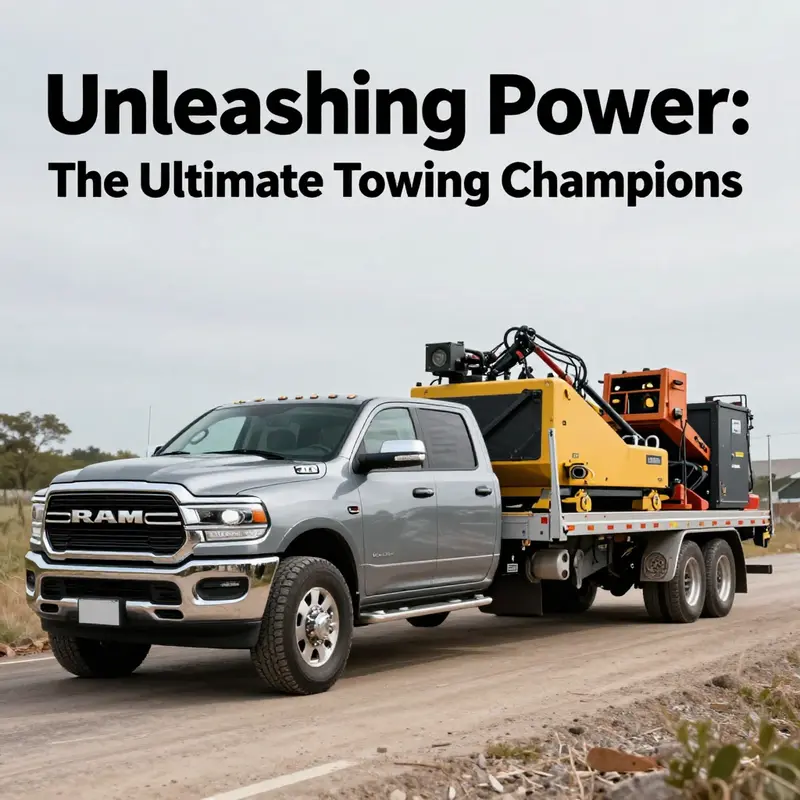
Understanding the top consumer tow rig means separating marketing from engineering. A heavy-duty pickup that claims class-leading towing figures must translate that claim into real-world capability. Towing numbers are useful, but they do not tell the whole story. Capacity, reliability, ease of operation, and the tradeoffs a buyer accepts are all part of the picture. This chapter examines what makes a best-in-class consumer pickup excel at towing. It explains the engineering, the operating limits, and the practical decisions that determine whether a heavy pickup can safely and repeatedly move the loads owners expect.
A consumer heavy-duty pickup is a bridge between personal and commercial capability. It is built on a stronger frame than light-duty pickups. It has beefier axles, bigger brakes, and cooling systems designed for extended stress. The vehicle is offered in many configurations. The same model can be ordered with different cabs, bed lengths, axle ratios, and drivetrain choices. Each configuration changes towing performance. Manufacturers quote maximum towing figures for the most favorable configuration. Those figures establish headline numbers. Buyers must understand the assumptions behind them.
Maximum towing ratings for top consumer heavy-duty pickups commonly exceed twenty thousand pounds when properly equipped. In some configurations, manufacturers advertise figures above thirty thousand pounds. These numbers result from a combination of factors: a high gross vehicle weight rating (GVWR), a high gross combined weight rating (GCWR), suitable axle ratings, a robust cooling and transmission package, and factory-installed towing features. But raw numbers do not reveal the compromises required to reach them. To achieve the top rating, owners often must choose a lower cab weight, specific rear axle ratios, a particular hitch interface such as a fifth-wheel or gooseneck, and heavy-duty towing packages. These choices often limit passenger or payload capacity.
The foundation of towing capability starts with the chassis. A heavy-duty pickup uses a reinforced ladder frame. That frame resists bending under long tongue or trailer loads. The rear suspension is calibrated for payload and towing stability. Some models offer dual rear wheels for improved load distribution and narrower sidewalls to reduce stress. A higher-capacity axle with larger ring and pinion gears handles torque and heat better under load. The axle housing and bearings are sized to survive repeated heavy use. A truck with an impressive advertised tow number will have these features as standard or available options.
Powertrain design is equally critical. High torque at low rpm matters more for towing than peak horsepower. A turbocharged diesel inline-six or a high-displacement gasoline V8 with a strong torque curve gives the truck the grunt to move heavy trailers from rest and keep them moving uphill. Transmission selection matters. Heavy-duty automatic transmissions for towing often include additional cooling circuits and a torque converter sized for heavy towing. They have gearsets calibrated to hold lower gears longer and to manage heat. Proper transmission cooling prevents bakeouts during long climbs. A top-rated consumer tow rig uses a combination of torque-rich engines, durable transmissions, and drivetrain components rated for higher loads.
Thermal management separates a good tow rig from a great one. Cooling systems for engine oil, transmission fluid, and differential oil are upgraded. An auxiliary transmission cooler and larger radiator are common. Even the steering system may have an oil cooler to avoid fade during prolonged heavy operation. A truck that is designed to tow large fifth-wheel trailers includes factory-calibrated cooling so the vehicle can sustain high loads for hours without derating or risking damage.
Brakes and driver controls are essential for safety and compliance. Integrated trailer brake controllers allow modulation of trailer brakes directly from the cab. This feature improves stopping performance and reduces wear on the tow vehicle brakes. Some systems sense trailer wheel speed and provide proportional braking. Electronic stability systems and trailer sway mitigation use chassis sensors and the anti-lock brake system to keep trailer and truck aligned. Tow-mode calibrations alter shift points and throttle response to reduce surprise movements and help maintain control. Larger brake rotors, stronger calipers, and better friction materials are part of heavy-duty packages.
Hitch design and load distribution form a practical management layer. Fifth-wheel and gooseneck hitches transfer tongue weight differently from a standard ball hitch. They move the pivot point nearer the axle line, increasing stability and allowing higher legal towing capacities. However, using a fifth-wheel or gooseneck reduces bed utility and changes how loads are managed on the truck. Weight-distribution hitches and sway bars can improve stability for conventional towing but have limits. Correct hitch selection and setup are key to achieving advertised towing numbers safely.
Payload capacity deserves attention because it directly affects towing capability. A heavy truck must carry vehicle occupants, cargo in the bed, and the hitch assembly. Payload adds to the truck’s curb weight and reduces the amount a trailer can weigh before exceeding GVWR or GCWR. A truck that reaches its maximum towing rating usually does so with a light cab and minimal bed load. Buyers who need both heavy towing and heavy payload must understand that compromises are inevitable. Specifying the right combination of options is a balancing act.
Tire selection is often overlooked but critical. Tires rated for higher load indexes and higher-speed ratings handle the demands of heavy towing better. They resist overheating and maintain sidewall stiffness under load. For trucks expected to tow near their maximum capacity, matching the tire rating to the expected loads prevents failure and improves stability. Dual rear wheel setups spread the load across more rubber, increasing safety margins and reducing contact patch temperatures.
Durability and maintenance must be part of the ownership plan. Routine inspection of brakes, cooling system, and drivetrain components is non-negotiable after towing heavy loads. Changing transmission and differential fluids on a schedule that reflects heavy use will extend component life. Using manufacturer-recommended lubricant grades and monitoring for signs of overheating or abnormal wear is prudent. A truck capable of moving the heaviest trailers in the consumer market still requires disciplined maintenance to remain reliable.
Real-world operation shows how advertised numbers translate to daily use. Many heavy towing applications involve hills, mountain passes, and high ambient temperatures. On long uphill grades, engine power and transmission cooling determine sustained speed. Heavy trailers increase braking distances and heat up brakes on long descents. Engine braking, downshifting using the transmission, and engaging auxiliary braking systems help maintain safe control.
Drivers must plan for legal and permit realities. Different jurisdictions have gross weight limits and axle load restrictions. A trailer that meets a truck’s towing rating could still create axle loads that violate local limits. For exceptionally heavy loads, oversize and overweight permits might be necessary. Knowing the local rules and arranging permits before transport avoids fines and unsafe situations.
Choosing the right configuration requires a pragmatic approach. Buyers should start by calculating the heaviest trailer they expect to tow. Then add the payload the truck will carry in normal operation. Check the GVWR and GCWR ratings for the chosen configuration. Confirm that the hitch and rear axle choices align with those ratings. If the goal includes repetitive heavy towing, opt for packages that include better cooling, stronger axles, and upgraded brakes. If payload is equally important, recognize that achieving the maximum tow rating may not be possible while carrying heavy loads in the bed.
Another operational factor is the trailer itself. Trailer weight distribution, brake condition, and suspension tuning affect how the combination handles. A trailer with well-sprung axles, properly adjusted brakes, and a low center of gravity is easier to control. An improperly loaded trailer can overload the tow vehicle’s rear axle or create dangerous sway. Regular trailer maintenance matters as much as truck maintenance when operating near the machine’s limits.
Safety technology has improved towing confidence. Camera systems that show the trailer connection, blind-spot monitoring, and integrated trailer camera feeds reduce guesswork during maneuvers. Hill-start assist and adaptive cruise control features reduce driver workload on long hauls. While electronics add convenience, they are not replacements for correct loading, sound judgment, and conservative operation near rated limits.
Cost and ownership considerations influence decisions as well. Heavy-duty options increase initial price and fuel consumption. Diesel-powered heavy-duty trucks offer better low-end torque and typically greater fuel efficiency under load. They also carry higher maintenance costs for certain components and fuel. Buyers should weigh operational savings against acquisition and upkeep expenses. For buyers who tow occasionally, a moderate-capacity configuration may offer the best value.
Practical use cases highlight the differences between the top consumer tow rigs and specialized commercial equipment. Heavy contractors, horse owners hauling large trailers, and owners of large fifth-wheel RVs often choose trucks with the highest consumer tow ratings. These vehicles handle demanding loads while retaining passenger comfort and daily usability. For moving specialized industrial loads or performing heavy rescue, commercial-grade wreckers and tractor units exceed consumer capabilities by wide margins. Those machines require specialized operators and different regulatory frameworks.
Choosing a top consumer tow rig also depends on long-term plans. If towing needs are likely to grow, select a configuration with room to upgrade. A stronger rear axle, a diesel powertrain, and factory towing packages will preserve resale value for buyers who need higher capacity later. If towing needs are stable and moderate, a lighter configuration reduces cost and improves efficiency.
A final point concerns responsible operation. Hitting the maximum advertised number may be appealing, but it should be treated as a limit, not a target. Operating consistently near the limit increases component stress and reduces margins for error. Conservatism in loading, respect for thermal limits, and conservative driving techniques extend component life and improve safety.
For readers who want manufacturer specifications and the precise conditions under which towing numbers are measured, consult the manufacturer’s official towing capacity documentation. Those documents list the exact configuration required to reach a given rating, including axle ratio, frame, hitch type, and other options. For practical towing guidance, and to read general industry and operator guidance, see the Santa Maria Tow Truck blog for relevant articles on towing best practices and fleet considerations: https://santamariatowtruck.com/blog/.
For official towing capacity data from the manufacturer referenced in this chapter, see the manufacturer’s published towing guide: https://www.ramtrucks.com/.
Pushing the 100-Ton Benchmark: How Heavy Rescue Tractors Reach Extreme Towing Capacities
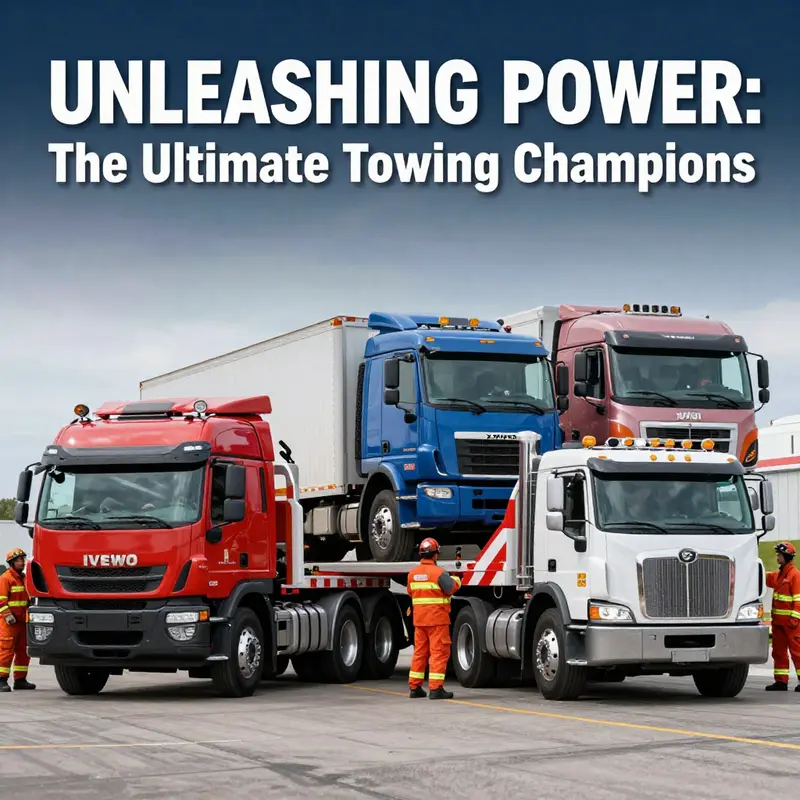
When the call comes in for the most demanding recoveries, operators reach for heavy rescue machinery that stands apart from standard tow trucks. These machines are not merely bigger versions of everyday wreckers; they are purpose-built systems whose value is measured not only in horsepower but in the precise orchestration of weight, traction, leverage, and hydraulics. In this landscape, two designs have become focal points in the race to higher towing capacities: a European-built heavy-recovery chassis that sits at the upper edge of the 80-ton class, and a forthcoming 8×4 configuration that escalates capability to the 100-ton threshold. Together, they illuminate how modern heavy rescue operations balance raw capability with stability, control, and safety under extreme loads. They also illustrate why the towing capacity conversation, in practice, often sits within a spectrum rather than a single number, with 80 tons serving as a robust baseline and 100 tons as a new frontier for specialized recovery missions. The discussion here is anchored in real-world engineering choices rather than marketing claims, and it recognizes that extreme capacity is only as useful as the system’s ability to deploy it safely and predictably on the road, off the road, and in the most challenging recovery environments.
At the heart of the 80-ton class is a chassis-based heavy recovery setup designed for high stability when lifting or towing heavy trailers, wrecked vehicles, or other substantial loads. This category has long represented a workhorse for critical recoveries, where steadiness and controlled application of force are as important as the sheer magnitude of the pull. The 80-ton specification emerges from a careful integration of frame strength, axle configurations, and hydraulic reach, all wrapped in a stability envelope that keeps outriggers planted and tires from slipping under load. In practice, crews rely on outriggers and stabilizers that extend beyond the wheelbase, creating a wide, stable footprint that dampens dynamic forces as winches engage or as a disabled vehicle begins to move under external pull. The reason 80 tons remains a common benchmark is straightforward: it is high enough to handle the heaviest single-vehicle recoveries and multi-axle loads, yet conservative enough to keep the vehicle manageable in a variety of environments, from wet industrial yards to uneven rural roads.
What distinguishes the next leap, the 100-ton class, is not merely a larger number on the side of the truck but a rebalancing of the entire system to exploit an 8×4 drive configuration. The 8×4 arrangement refers to eight wheels with four driven axles, a setup that multiplies traction where it matters most: on slick surfaces, loose debris, or on slopes where control is paramount. An enhanced powertrain—engine torque, transmission geometry, and gearing—works in concert with a longer wheelbase and a refined chassis layout to distribute the load more evenly across the contact patches at the ground. The result is more than just a stronger pull; it is a more predictable pull, with reduced tendency for wheel spin or rear-end instability as a heavy load is stabilized and moved. The shift from an 8×4 to a 100-ton-capable configuration indicates a broader design philosophy: that the critical constraint in extreme towing is not only the force that can be applied but how that force can be applied safely and in a controlled manner over a range of road conditions and operational tasks.
The practical implications of reaching the 100-ton benchmark unfold in the way crews approach a recovery mission. In theory, a 100-ton capable unit can address a broader spectrum of heavy-duty scenarios, from stalled multi-axle heavy throughloads to the recovery of large, immobilized assets. In practice, the operator must assess a host of factors before attempting a move. Road grade, surface condition, ambient temperature, tire load ratings, and the condition of the load all influence whether the full capacity is appropriate for a given task. Even when a vehicle is rated at 100 tons, the operator may choose to work well within that limit to maintain a higher factor of safety. The presence of an advanced hydraulic system, precise winching, and controlled anchor points become essential in ensuring that the full capacity is not only available but also usable without compromising the stability of the recovery platform.
The technical logic behind the 100-ton variant goes beyond more powerful torque alone. It involves a coherent package: a longer wheelbase to keep the center of gravity within a favorable range, multi-axle support to distribute the load across more contact points, and a stabilization system that resists lateral sway during a lift or tow. The hydraulic powertrain must deliver sustained force without overheating, and the mechanical systems must tolerate sustained, high-load operation with minimal wear. As a result, the 100-ton class is not just about raw pulling power; it is about a harmonized system where structure, hydraulics, driveline, and stabilizing mechanisms work in concert under demanding conditions. This is why the emergence of the 8×4 configuration is often celebrated as more than a spec upgrade; it signals a matured approach to extreme recovery that prioritizes reliability and safety as much as peak numbers.
In comparing these two trajectories—80 tons and 100 tons—it is useful to consider the different roles they play in rescue and recovery operations. The 80-ton class remains a robust, versatile option for a wide array of incidents where speed of response and consistent performance are paramount. It handles the bulk of heavy recoveries with a strong safety margin and is well-suited to environments where maneuverability and ease of deployment matter as much as lifting capacity. The 100-ton class, by contrast, carves out a niche for the most challenging scenarios: where a single vehicle or a compact piece of equipment weighs several tens of tons, or where a bus or a large trailer is immobilized in a way that conventional rigs cannot safely address. In these situations, the 8×4 design provides traction and stability that make the difference between a successful recovery and a complex, multi-vehicle operation that could require additional equipment or staged moves. This is not simply about lifting more mass; it is about enabling a more controlled sequence of actions under high load, which reduces risk to personnel, bystanders, and nearby infrastructure.
The reporting around these capacities often benefits from cross-referencing independent test and industry analyses. One takeaway across reliable sources is that the 100-ton class represents a near-term target for many emergency fleets that need to balance speed, safety, and capability. The practical reality is that operations rarely push to the architectural limits of the equipment unless the situation demands it. Yet having the option to deploy the full 100 tons can be a decisive factor when time and safety margins are on the line. The key lies in the readiness of the system to respond, as well as the expertise of the operators who understand how to leverage the design without compromising control. The ability to place a heavy load, distribute it across multiple axles, and maintain steady traction on uneven terrain hinges on a synergy of components—engine torque curves, transmission, hydraulic pumps, winch systems, outriggers, and the manner in which load mass is engaged and restrained during the mission. In other words, reaching 100 tons is as much about how the system is used as it is about what it can theoretically lift.
A broader perspective helps situate these capabilities within the wider landscape of towing and recovery. In the same family of heavy-duty machines, there are devices engineered for different kinds of extreme tasks, including multi-unit towing solutions that can resemble a large-scale convoy of recovery assets. These configurations illustrate that there is a continuum—from 80-ton models that excel in fast, reliable heavy recovery to 100-ton units that excel in the most demanding, static, or semistatic recovery scenarios where absolute stability is non-negotiable. For operators, that continuum informs job planning, crew training, and the allocation of resources in a fleet. It also underscores the importance of standardization, a theme that applies across many fleets and is essential for ensuring that crews can rapidly and safely deploy the most appropriate tool for a given challenge: one capable of delivering a controlled, steady pull, with the vehicle remaining under control even when it must move a heavy, resistant load.
The larger context of these numbers is that while the extreme end of towing capacity is often framed as a competition of “who is strongest,” the more meaningful question for most operations concerns reliability, predictability, and safety under the specific conditions the crew expects to encounter. This is why, beyond the raw figures, operators assess a system’s response characteristics: how quickly it can set up outriggers, how smoothly it applies winch force, how the traction system handles a heavy, partially immobilized payload, and how well the weight distribution behaves on different surfaces. It is this combination of system design and operator proficiency that determines whether a given unit truly delivers on its maximum capability in the field.
For readers who want to delve deeper into standardization in heavy-duty rescue operations and how fleets organize training, equipment checks, and mission planning around these capabilities, a useful resource outlines how standardized procedures can streamline decision-making and improve safety during high-load recoveries. You can explore that discussion here: standardization in heavy-duty rescue operations. This reference helps connect the hardware talk with the process discipline that makes extreme capacity usable in practice.
As we reflect on the relative standing of the 80-ton and 100-ton designs, it becomes clear that the headline numbers convey intent and capability but not the full story of what makes them practical. The true value lies in how they are deployed: how teams assess the scene, decide which vehicle to move next, and coordinate with other responders to execute a controlled, safe recovery plan. In many incidents, the difference between a successful outcome and a setback hinges on the crew’s ability to translate rated capacity into reliable real-world performance. The chapter that follows will carry this thread forward, examining how fleet operators balance readiness, standardization, and performance in real-world emergency response, including how these powerful machines fit into broader emergency-response strategies and the constraints that shape decision-making in the field. For now, the takeaway is clear: the 100-ton class represents a meaningful advancement in extreme rescue capability, expanding the envelope of what is recoverable while reaffirming that safety and stability remain non-negotiable prerequisites for any high-load operation.
External resource: https://www.autocar.co.uk/
Beyond Conventional Towing: How the FH16.8×8 Rewrites Heavy-Haul Limits
Engineering and operational realities of extreme heavy haul
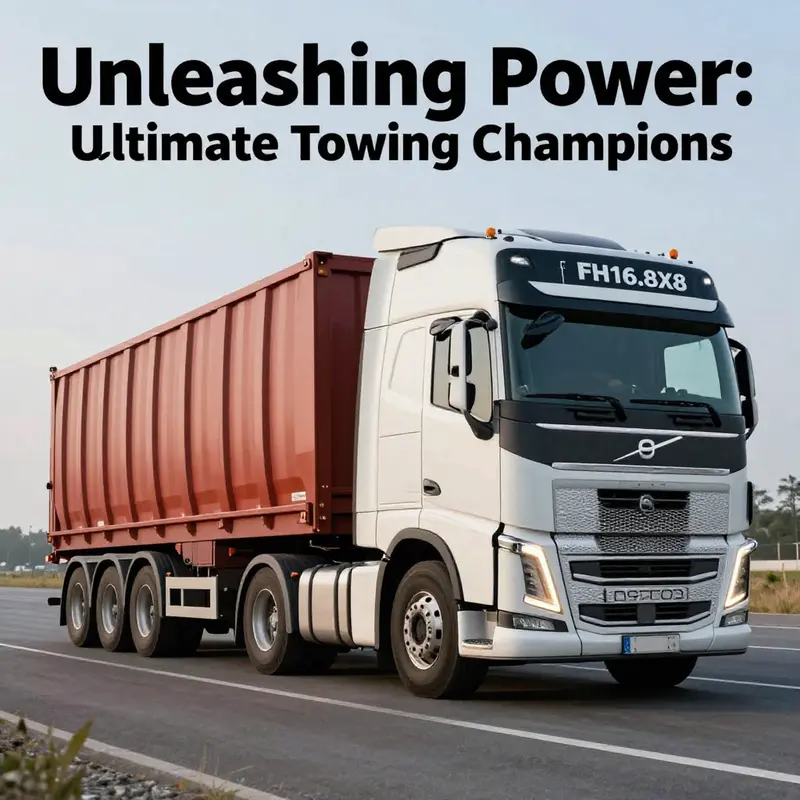
When discussing which truck has the highest towing capacity, the conversation must move beyond familiar consumer pickups. The FH16.8×8 sits in a different category entirely. It is a purpose-built heavy-haul tractor engineered to move extraordinarily large, heavy loads on roads and specialized routes. Its rated maximum gross combination weight of 912 metric tons places it at the top of road-capable towing units. That figure represents the combined weight of the tractor unit and one or more fully loaded trailers, not the hitch rating of a consumer pickup. Understanding how that number is achieved requires a look at design, powertrain, axle layouts, and the logistics that make such moves possible.
At first glance, 912 metric tons is an abstract number. Put plainly, it means this tractor can be part of a vehicle combination that weighs roughly two million pounds. Achieving such capacity begins with a chassis built to distribute and carry enormous loads. The base frame is heavy, reinforced, and engineered to accept multiple axles. These axles spread the load over a wider contact patch, reducing per-axle stresses and meeting legal limits for road travel. A single rigid frame or standard tandem axle could never carry such mass. Instead, the FH16.8×8 uses a multi-axle, multi-drive configuration that blends traction and load distribution into a single platform.
Power and torque follow the frame. Engines in this class produce immense torque at low rpm, enabling movement of massive weights from a standstill and control on gradients. The powertrain pairs those engines with heavy-duty gearboxes, often with multiple reduction stages, and robust driveline components. Braking systems are similarly scaled up. Conventional air brakes are augmented with retarder systems and electronic controls that modulate braking effort across numerous axles. For extreme loads, engineers design braking strategies that synchronize tractor, trailers, and auxiliary braking units. This coordinated approach reduces the risk of runaway trailers and manages heat across multiple systems.
Suspension is another critical element. Traditional leaf springs alone cannot handle the dynamic loads of ultra-heavy hauls. Advanced suspension designs, often a combination of air and hydropneumatic technologies, allow for controlled ride height and load transfer. They keep axles grounded to maintain traction, while also protecting cargo and the vehicle from shock loads. During slow, heavy moves, suspension settings differ from typical highway travel. Teams adjust pressure and damping to accommodate weight, route profile, and trailer configuration.
Beyond mechanical robustness, the FH16.8×8 and similar extreme-haul tractors rely on electrical and electronic control systems. Modern vehicle electronics monitor axle loads, engine torque, brake temperatures, and steering angles. Driver aids help manage the slow, methodical maneuvers common to heavy haul. Electronic systems can limit torque to prevent wheel slip, sequence braking across axles, and assist with low-speed control to prevent oscillation of long trailer trains.
Real-world applications prove that these capabilities are not theoretical. Specialized contractors deploy such tractors for infrastructure projects and industrial moves. Examples include transporting power plant components, oversized bridge sections, and large industrial presses. Each move is planned in detail. Teams assess route clearances, road strength, bridge capacities, and overhead obstacles. They obtain permits and coordinate with municipal, state, or national authorities. Escorts, temporary road closures, and structural reinforcements are commonplace. Nothing about a 900-ton haul is ad hoc.
Comparing classes clarifies perspective. High-capacity consumer pickups top out in the tens of thousands of pounds of towing capacity. Heavy rescue and recovery trucks increase that capacity to the tens or low hundreds of tons, enough to drag or upright large tractor-trailers or buses. The extreme heavy-haul tractor transcends both. It is not designed for daily towing chores. Its mission is to move singular, massive objects that exceed conventional vehicle capabilities.
Operating such a vehicle demands expertise and planning equal to its mechanical might. Drivers working these assignments hold specialized certifications. They understand the dynamics of multi-axle trailers, articulation points, and the effects of center-of-gravity shifts. Support crews handle route surveys, temporary infrastructure adjustments, and real-time communications with traffic control. Local governments and utility companies often collaborate to lift power lines or modify signs for passage. This level of coordination ensures safety and legal compliance during movement.
Legal and regulatory factors shape the execution of extreme hauls. Most regions impose axle load limits, bridge ratings, and road-use restrictions. Obtaining a permit for multi-hundred-ton transport usually involves submitting engineered route plans, load calculations, and timetables. Authorities scrutinize how the load will cross sensitive infrastructure. In many cases, the vehicle combination moves at walking speeds, under escort, and during predetermined windows. Failure to comply can result in fines, delays, and structural damage. Consequently, logistics specialists factor in contingency plans, alternate routes, and load adjustments.
The economics of extreme heavy haul are also notable. Specialized tractors, trailers, and crews represent significant capital and operating expenses. Insurance for oversized loads is higher than for routine transport. Projects that justify such expense typically involve one-time moves of extremely valuable or irreplaceable equipment. The cost per mile, when spread across the 900-ton capacity, can be economically rational for certain industrial clients. However, the complexity and risk mean these tractors are rarely part of a standard rental fleet.
Safety remains paramount. Engineers design redundant systems and fail-safe mechanisms into both tractors and trailers. Load-securing practices use industry-approved hardware and frequent inspections. During transit, teams continuously monitor for signs of structural stress, overheating, or shifting cargo. Because a failure at extreme scale can cause catastrophic damage, safety margins are conservative. Even with robust design, operations rely on human oversight and strict adherence to procedure.
Technology continues to push the limits of what road-going tractors can achieve. Innovations in materials reduce the weight of auxiliary components while increasing strength. Advances in powertrain efficiency allow engines to deliver higher torque without excessive fuel penalties. Electronic control systems improve precision during slow maneuvers. Combined, these developments enable safer and more efficient extreme hauls than were possible decades ago.
Yet the highest rated capacity does not mean limitless application. Practical constraints include route geometry, bridge load ratings, permit windows, and public safety considerations. A tractor may be rated for an enormous gross combination weight, but if the local route includes a bridge designed for much less, operators must find alternatives. Often, cargo owners engage structural engineers to assess and, if necessary, temporarily reinforce infrastructure along the route. Sometimes, the only feasible option is to dismantle the cargo into smaller pieces or use alternative transport modes.
Another reality is modularity. Many extreme hauls rely on modular trailers capable of rearranging axles and load-spreading components. These modules allow teams to tailor axle counts to specific moves. The tractor provides motive power and steering, whereas modular trailers handle load distribution. This approach yields flexibility, enabling the same tractor to support different configurations while remaining within legal limits for individual roads.
Training and human factors deserve emphasis. A highly rated tractor requires a driver who understands low-speed handling of very long combinations. Drivers practice synchronizing throttle, brake, and steering inputs to avoid trailer sway or jackknifing. Communication between the driver, ground crew, and escort vehicles is continuous and precise. Teams rehearse maneuvers in controlled environments prior to moving through populated areas. When unexpected events occur, the crew follows predefined escalation protocols to minimize risks.
Maintenance of these tractors and their trailers is intensive. Every component that touches high loads undergoes regular inspection. Bolts, pins, and load-bearing plates receive non-destructive testing. Hydraulics and suspension components are serviced on strict schedules. Even minor wear can escalate under extreme loads. Preventive maintenance minimizes the chance of a failure mid-move.
The presence of extreme-haul tractors also influences industry standards. Contractors, equipment manufacturers, and regulatory bodies exchange data and develop best practices. Standardization in certain operational protocols helps expedite permitting and improves safety. Fleet operators often codify these practices to ensure consistent execution across teams. For more information on fleet procedures and readiness, consult resources on fleet standardization and emergency readiness.
From a broader perspective, the FH16.8×8 and similar machines illustrate the intersection of engineering ambition and logistical craft. Their existence allows industries to tackle projects once considered impossible or prohibitively expensive. Moving a massive power transformer, for example, becomes a financed and scheduled activity rather than an insurmountable logistical challenge. The tractor is a tool in an ecosystem that includes engineers, local authorities, modular trailers, and careful planning.
Finally, the highest towing capacity is a headline number that must be interpreted within context. It defines what a vehicle can help move under idealized and approved conditions. It does not imply a casual owner can hitch a 900-ton trailer to a roadside pickup. It also does not eliminate the need for comprehensive planning, skilled personnel, and regulatory compliance. The vehicle is a keystone in orchestrated moves that span weeks or months of preparation.
Those seeking the capability to transport exceptionally heavy, oversized cargo will find that the FH16.8×8 embodies the necessary combination of strength, control, and system integration. It stands apart from consumer pickups and recovery vehicles because it occupies a niche defined by scale. When an operation requires the uppermost bounds of road-going capacity, this class of tractor is the logical choice. It is the product of decades of engineering refinement and operational learning, built to answer the unique demands of extreme heavy haul.
For detailed technical specifications, axle configurations, and manufacturer-supplied documentation, see the official product page.
Detailed technical information and product page
Learn more about fleet standardization and emergency readiness
Final thoughts
Understanding which trucks provide the highest towing capacities can significantly influence your choices, whether you are a local driver, manage property, or work in automotive repair. The RAM 3500 stands out in the consumer category with an impressive capacity, while the Iveco X-Way and Peterbilt models excel in heavy rescue scenarios. Most noteworthy is the Volvo FH16.8×8, capable of handling extreme loads with ease. Selecting the right vehicle not only ensures efficiency but also enhances safety and reliability in all your towing needs.