
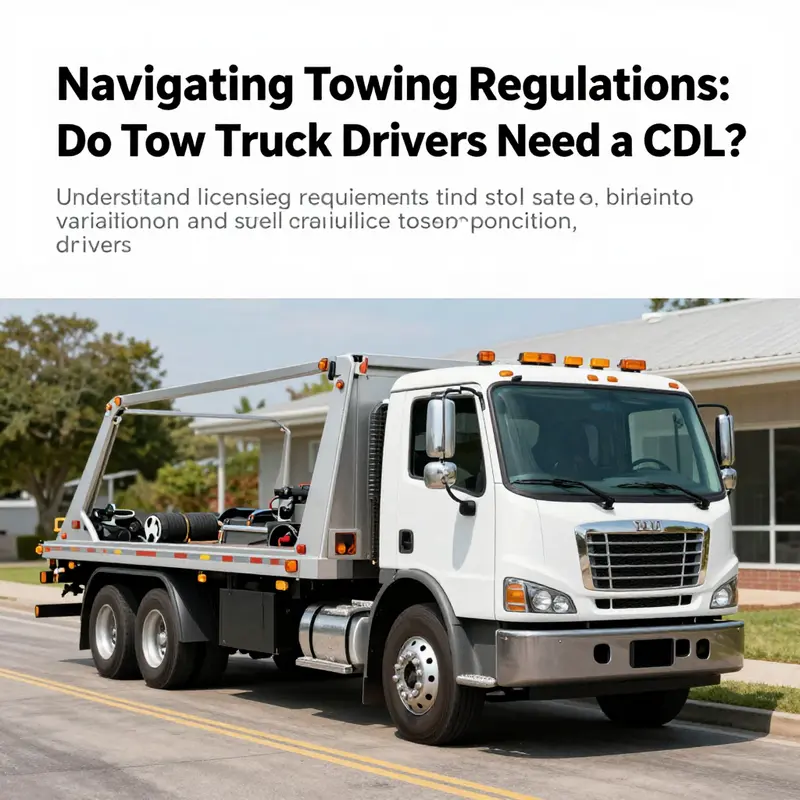
Understanding the licensing requirements for tow truck drivers is essential not just for operators but also for businesses and communities that rely on towing services. The necessity of a Commercial Driver’s License (CDL) hinges on various factors, including vehicle size and the transportation of hazardous materials. Local drivers, auto repair shops, property managers, and more will find relevant insights throughout this article. Each chapter will dive deeper into state regulations, weight classifications, and the significant implications of transporting hazardous materials, ensuring you have a comprehensive view of the requirements in your area.
null
null
Tow on the Line: How State Variations Shape the CDL Requirement for Tow Truck Operators
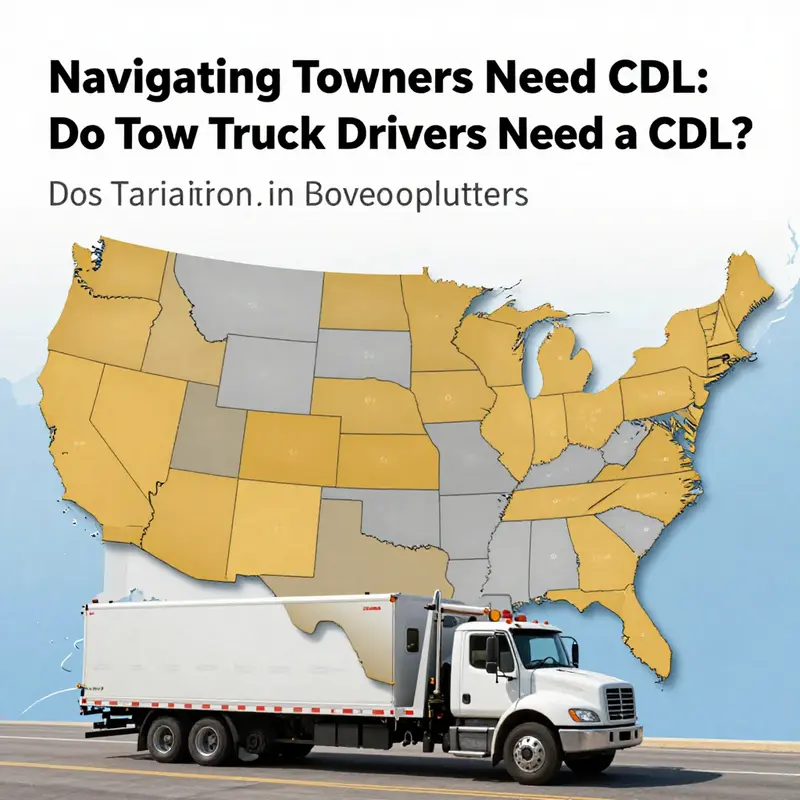
Every tow job begins with a question that can shape a driver’s career, insurance costs, and even truck design: does this operator need a CDL? The short answer is not universal. In the United States, CDL requirements hinge on how much weight is being moved and what is being moved, rather than the act of towing itself. At the center of the rulebook is the 26,001-pound threshold set by the FMCSA, which looks at the combined weight of the tow truck and the vehicle it carries. If that total crosses 26,001 pounds, a CDL becomes a practical necessity for safety and regulatory compliance. If the combined weight stays at or below 26,000 pounds, more situations vary by state. Some jurisdictions allow a standard driver’s license for basic towing operations, while others classify any commercial activity around towing as requiring a CDL. Additionally, certain tasks—such as transporting hazardous materials or towing a trailer with a GVWR above 10,000 pounds—trigger CDL requirements regardless of the tow vehicle’s raw weight. The upshot is that the licensing landscape is as dynamic as the road itself, and drivers must look beyond the truck’s own heft to understand the real licensing demands of their day-to-day duties. For many operators, the conversation begins with a careful audit of weight, cargo, and the scope of service, then moves to the precise rules that apply in their state.
Weight remains the decisive lens through which licensing decisions are made. The GVWR of the tow truck is only part of the equation; what matters is the total gross weight of the combination when the truck tows a disabled vehicle, a retrieval, or a transport job. If a heavy flatbed tows a car, or a wreck removal unit carries a vehicle plus the vehicle it’s moving, and the combined weight tips past the 26,001-pound line, the operation often falls under CDL territory. And when a trailer with its own GVWR—such as a heavy trailer that accompanies the tow—pushes the total higher, the clock may tick toward CDL requirements even if the tow truck by itself would not require one. States sometimes treat this differently; some recognize the towing of minor non-commercial loads as not needing a CDL if the business is limited and the driver’s duties are narrowly defined, while others view any commercial towing activity as a commercial motor vehicle operation warranting licensure. The theory behind this approach is safety and accountability: larger weights demand training, vehicle inspection discipline, and regulatory oversight that a CDL is designed to provide.
Take California as a representative example of how one state interprets the rule. In practice, California tends to require a CDL when the total combined weight of the tow truck and the towed vehicle exceeds 26,000 pounds. Yet there is a meaningful exception in moments of necessity—emergency towing when a disabled vehicle must be moved to a safer place on a public road. In those situations, state law provides space for maneuvering the scene without a CDL, recognizing the urgent public safety imperative. The distinction is not mere theory; it affects who can respond to accidents, who holds the license as a driver and as a company, and who is financially protected by insurance and liability coverage. The California picture illustrates a broader theme: the line between emergency, routine, and commercial towing can shift based on context, and the same operator may face different licensing expectations depending on whether they are performing a rapid roadside recovery or a scheduled transport from a shop to a lot.
Across the state line in Texas, the licensing equation changes again in ways that can surprise newcomers. The rule, somewhat simplified, allows tow truck operators who move disabled vehicles from the roadway to a repair shop to operate without a CDL—so long as the operation stays within defined boundaries. Crucially, those boundaries typically mean the driver is not transporting passengers and is not carrying other cargo beyond what is essential for the disabled-vehicle move. In practice, this provision can enable smaller, independent towers to respond quickly to incidents without the administrative burden of a CDL. But it also creates a potential gap in coverage if a job grows beyond those parameters, or if a dispatcher routes a tow with extra passengers or multiple towed vehicles. The Texas approach highlights the tension between flexible, on-demand service and the rigor of licensing that aims to standardize safety across the industry. Operators and fleets must keep a close eye on the exact criteria characterizing their work to avoid a late-night regulatory red flag.
States like New York and Illinois generally take a tighter stance. In those jurisdictions, the definition of a commercial motor vehicle is broad enough that many tow truck operations trigger CDL requirements more often than not, regardless of whether the towed vehicle is heavy or light. The practical effect for drivers in these markets is a higher bar for entry, not just in terms of the license but also in the training and testing that accompany it. The result can be a more uniform safety culture across towing operations in these states, with standardized expectations about driver qualifications, vehicle inspection routines, and incident reporting. For fleets that operate regionally in multiple states, the patchwork can feel especially thorny: a truck that qualifies for a CDL in one state may be ineligible to operate without one in another, affecting how a company allocates assets, schedules jobs, and manages risk. In these contexts, the duty of the operator is not simply to follow a weight threshold; it is to map the exact regulatory landscape for every planned route and every shift, a task that often drives the decision to pursue CDL training even when a particular day-to-day job might fall under a state’s looser reading.
While state rules dominate the licensing decision, federal rules remain the umbrella that governs cross-border and interjurisdictional movement. The FMCSA sets standards for interstate commerce and certain activities—such as moving vehicles across state lines for commercial purposes or operating fleets that regularly engage in interstate transport—can fall under federal oversight. Federal rules tend to reinforce the principle that larger operations, more complex equipment, and broader service areas require formal training and professional oversight. Even in states with more permissive interpretations of the weight threshold, the crossing of a state line or the involvement of a commercial carrier may necessitate CDL status. Violations carry penalties for drivers and for the operators who dispatch them, and they can also trigger insurance considerations that affect premiums and coverage. The upshot is that the licensing equation is not a simple binary; it is a spectrum shaped by weight, function, geography, and the regulatory frameworks that govern how fleets are mobilized to respond to road hazards. For drivers, the lesson is practical: when a move has the potential to become interstate or commercial, assume CDL obligations unless a DMV or FMCSA official confirms otherwise.
Beyond weight and geography, there are subtler determinants that many operators overlook but that regulators consider crucial. The purpose of the tow operation—whether it is to remove a vehicle from a dangerous roadway, tow it to a shop for service, or relocate a vehicle within a private property—can tilt licensing requirements. The presence of passengers, the nature of the cargo (even something seemingly small, like a spare tire or a bag of tools that accompanies the tow), and the combination of a tow truck with a trailer all contribute to the picture. If a tow truck is pulling a trailer with a GVWR over 10,000 pounds, a CDL is typically required regardless of the truck’s own weight. Hazardous materials add another layer of complexity, pushing many operators into CDL territory due to the added safety training and the stricter regulatory controls that accompany hazardous load handling. These considerations are not mere bureaucratic trivia; they shape the daily decisions of fleet managers and field crews. They also underscore why many experienced operators advocate for proactive licensing: it reduces risk, streamlines dispatch, and aligns with the training and maintenance regimes that elevate safety on the road.
For drivers who want clarity without endless paperwork, the practical approach is to start with the DMV. The exact rules exist state by state, and even a single misinterpretation can lead to penalties, insurance issues, or a driver being deemed unfit to operate a heavy vehicle on public roads. A good rule of thumb is to map out the typical weight profile of the fleet: the GVWR of the tow trucks, the average weight of the towed vehicles, the presence or absence of trailers, and any planned cross-border operations. Then, compare this profile against the state’s CDL exemptions and requirements. Many operators find it helpful to document scenarios in which a CDL would be triggered, and to keep a running log of training courses, endorsements, and medical requirements that would be needed to stay compliant as duties evolve. Keeping clear records also makes it easier when changes occur in state law or when an operator takes on a new line of work—such as a higher-weight towing job or a long-haul dispatch that edges into interstate commerce. In the long run, clarity about licensing translates into faster, smoother deployments and a stronger safety culture across the fleet. And for operators who want to explore how to tighten up fleet readiness and standardization, there is a useful resource on the topic that ties directly into how crews are trained, equipped, and dispatched: fleet standardization and emergency readiness.
As a final reminder, the exact licensing rules are not a matter of opinion but a codified set of rules that can change with regulatory updates. Those who work in towing often benefit from maintaining ongoing conversations with their local DMV offices, attending refresher courses, and participating in safety-focused programs that reflect the latest standards. For individuals new to the field, starting with a conservative assumption—that a CDL is likely required for anything heavier than a small car towed by a standard truck—can prevent costly mistakes and ensure readiness for more demanding assignments. For seasoned operators, staying current isn’t just about avoiding penalties; it enables expansion into more complex work, such as heavy-to-heavy recoveries or coastal operations that demand compliant, well-documented practices. This approach aligns well with broader strategic goals in the industry, including fleet standardization, emergency readiness, and robust risk management. In short, CDL requirements for tow truck operators are not a fixed label but a continually evolving framework driven by weight, task, and jurisdiction. The better you understand that framework, the more confidently you can plan, service, and protect your crew on the road.
External resource for further reading: For a state-level perspective with detailed guidance, see the California DMV approach to tow truck driver requirements, which illustrates how exemptions can apply in emergency situations and how weight thresholds are interpreted in practice. This resource complements the discussion here by offering concrete, state-specific language that drivers can translate into day-to-day decision-making. https://www.dmv.org/us-ca/tow-truck-driver-requirements.php
Weight Rules on the Road: How CDL Requirements Shape Tow Truck Careers
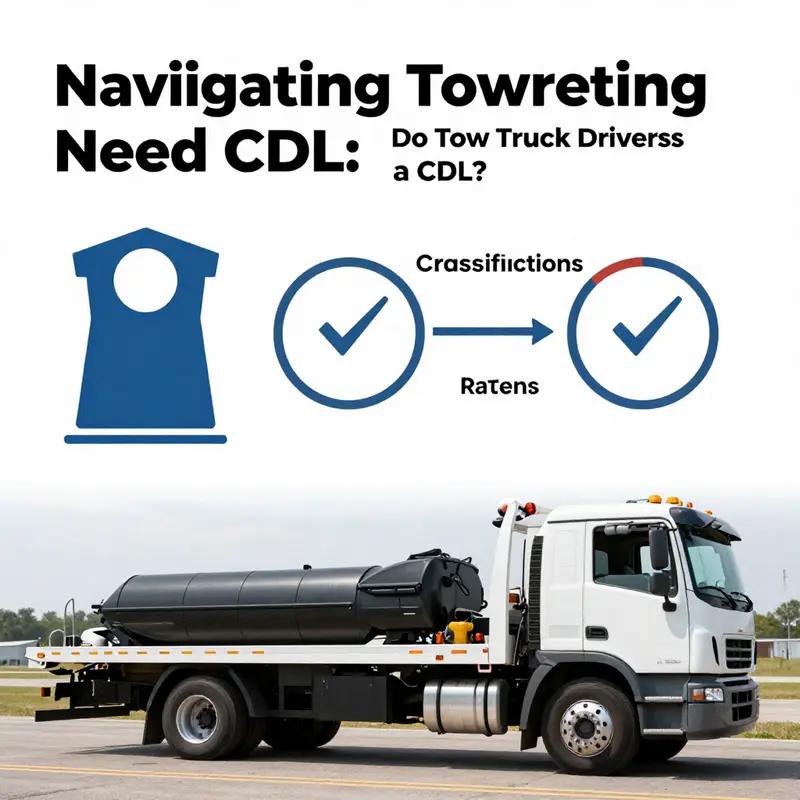
Tow work sits at the intersection of service, urgency, and regulation. When a driver arrives on scene to recover a disabled vehicle, every decision about what vehicle to operate is not just a question of horsepower or reach but of weight, distance, and the licenses that grant access to the road. The central question—do tow truck drivers need a CDL?—has a straightforward answer in many circumstances, yet it becomes more nuanced as the realities of the job expand. The Federal Motor Carrier Safety Administration, the agency charged with overseeing CDL standards, clarifies that the requirement hinges on how much weight the vehicle is rated to carry and how that weight is used. In practical terms, if the tow truck has a gross vehicle weight rating, or GVWR, of 26,001 pounds or more, a CDL is required. This threshold, which falls under the Class B category when a single vehicle meets or exceeds it, marks a boundary between conventional license rules and commercial driver licensing. It is a rule designed not to complicate routine light-duty towing but to ensure that operators handling heavier, more complex machines meet higher standards of testing, training, and medical fitness. As with many regulatory questions, there are important exceptions that force drivers and operators to map their specific duties to the rulebook rather than rely on a blanket answer.
The first layer of nuance comes from identifying the vehicle itself. Light-duty tow trucks—those designed for local roadside assistance, simple recovery, or the routine haul of a single disabled vehicle—often sit under the 26,001-pound GVWR threshold. For these machines, the standard state driver’s license is typically sufficient. In practice, this means a driver who stays within the weights of a light-duty tow truck can operate legally with a noncommercial license, provided their state’s rules align with that general framework. Still, the states do not always follow the federal line to the letter. Some jurisdictions impose additional requirements for specific operations, even when the truck is under the GVWR boundary. The takeaway is simple but critical: before assuming the license you hold covers every towing scenario you might face, check with the state department of motor vehicles and read any local guidance on weight classifications and performed duties.
When weight crosses the GVWR threshold, the chapter of the rulebook opens wider. A Class B CDL becomes necessary for a tow truck with a GVWR of 26,001 pounds or more. This threshold is not just about the truck alone; it matters how the weight is used on the road. If the operation involves towing a trailer that has its own GVWR over 10,000 pounds, a CDL is required regardless of the tow truck’s own weight. This is an important nuance for operators who may be called to move heavier towed loads or carry larger gear on a trailer. The implications extend beyond the classroom and the testing grounds. The day-to-day reality of a Class B licensed operator may involve more rigorous safety protocols, more stringent medical qualifications, and a broader set of endorsements that can include commercial endorsements tailored to passenger transport or hazardous materials in some contexts.
For the more weighty end of the spectrum, when the vehicle combination—comprising the tow truck plus the towed load—exceeds the limits for simple operation, a Class A CDL may come into play. In practice, this typically means that the combined weight of the towing apparatus and the towed vehicle surpasses the threshold at which the separate GVWRs matter. The guidance suggests that Class A is appropriate for those scenarios where larger, heavier, or more technically demanding towed configurations are routine, such as towing very heavy vehicles on long hauls or operating specialized wreckers that must handle high-weight crashes and complex recoveries. The key idea is that the CDL system scales with the scope and risk of the operation. It is designed not as a punitive barrier but as a way to ensure operators who work in high-stakes conditions are prepared, tested, and certified to handle those conditions.
Another layer of complexity that drivers often encounter concerns the nature of the job and the types of loads. The simple act of recovering a stray vehicle from a roadside should not automatically trigger a CDL requirement for every operator. Yet, when the job involves hazardous materials, the rules shift. If a tow operation includes transporting hazardous materials, a CDL is required. The presence of hazardous materials, even if the vehicle itself is not heavy, imposes additional endorsements and safety protocols, including storage, handling, and route planning considerations. In such cases, the license becomes a door to a broader family of responsibilities and professional opportunities, but it also anchors the operator to a stricter regulatory framework. The same logic applies to the scenario of towing a trailer with more than 10,000 pounds of GVWR, where the CDL becomes mandatory regardless of the weight of the tow truck. In short, the job’s risk profile, not just the truck’s weight, dictates licensing needs.
The practical implications of these rules extend into the daily life of a tow operator. For many, obtaining a CDL opens doors to more specialized work—highway emergencies, major vehicle incidents, or long-distance recoveries that demand more powerful equipment and greater logistical coordination. The path to those opportunities, however, is not merely about showing up with a larger truck. It involves passing both the knowledge and the skills portions of the road test, maintaining a valid medical certificate, and meeting ongoing requirements such as hours of service and safety training. In some cases, the road test may be taken in an automatic transmission vehicle, which can lead to an E restriction on the license. That restriction prevents driving manual transmission vehicles, a constraint that can limit future equipment options unless the driver seeks a separate manual transmission road test to lift the restriction. The nuance matters because a driver who could otherwise advance into heavier, more capable tow units may be constrained by a single test decision—unless they actively pursue the necessary training and testing paths to remove it.
The landscape of CDL requirements also invites a broader reflection on how the industry organizes its fleets and its response to emergencies. Heavier tow trucks and specialized wreckers carry responsibilities beyond the vehicle’s weight class. They influence response times, the scope of on-scene safety measures, and the coordination with other responders on highway incidents. A driver who holds a CDL may be more adaptable to a wider range of assignments, particularly those that demand longer hauls or rapid, large-scale recoveries after accidents. Yet with that broader capability comes heightened responsibility: the necessity to stay current with regulatory changes, to maintain medical certifications, and to ensure equipment is compliant, well-maintained, and operated within the operator’s training and endorsement levels. It is a career path that rewards careful planning and ongoing education as much as it rewards operating a larger truck.
This is where the practical, on-the-ground realities intersect with policy. Tow operators often begin their careers by mastering basic vehicle handling and emergency response within the bounds of light-duty deployments. As they accumulate experience and their operations demand more power, heavier vehicles, or longer distances, the CDL question naturally surfaces. The decision to pursue a CDL should be rooted in an honest assessment of the work one actually does and the hours and routes one envisions, not simply the most dramatic-looking fleet upgrade. It is also wise to recognize that many states may impose additional restrictions or require specific endorsements for certain kinds of towing work, so a road to compliance is not a one-size-fits-all journey. A driver can mitigate this uncertainty by consulting state DMVs and recognizing that the federal framework provides the backbone of the licensing structure while the state adds its own clarifications.
From the perspective of long-term career development, even for those who operate under the light-duty threshold, pursuing CDL readiness can be a strategic move. It broadens the horizon of opportunities, increases the range of equipment a driver can operate, and reduces the risk of needing to turn down a job because the vehicle type exceeds what a standard license allows. It also aligns with standard professional expectations in the field, where continuous improvement and readiness to handle high-stakes scenarios are valued. A driver who has pursued and earned a CDL, including any mandatory endorsements relevant to the work, positions themselves to respond to a wider set of incidents and to adapt to evolving fleet needs without being constrained by licensing limitations. To stay aligned with professional standards, operators should routinely verify weight classifications for their fleet and confirm whether any new assignments would necessitate upgrades in licensing, training, or endorsements. This vigilance protects the driver, the employer, and the public, particularly on congested highways or during severe weather conditions when recoveries demand swift, safe, and compliant action.
For readers who want to explore practical, field-oriented perspectives on towing regulations and readiness, the broader industry conversation is captured in conversations and analyses hosted by respected industry blogs. These resources often discuss how fleets standardize equipment, prepare for emergencies, and implement procedures that reflect the weight and licensing realities described above. In addition to official guidance, such discussions can help a practitioner map the licensing landscape to their own career plan. If you want a practical touchstone while you’re navigating this topic, you can visit a relevant industry blog for reflections on fleet readiness and standardization, which can complement the federal framework described here. For example, see the general guidance and insights at a well-regarded industry resource Santa Maria Tow Truck blog.
Ultimately, the CDL decision for a tow truck operator generates value when it is approached as a tactical choice about capability and responsibility. The weight classifications—GVWR thresholds, trailer GVWR, and the possibility of weight combinations that push into Class A territory—are not abstract numbers but gatekeepers that connect a driver’s daily duties with a license that certifies their competence to perform them. The rulebook’s design is to ensure that when a heavy truck or a heavy load sits on the highway, the operator behind the wheel has demonstrated the necessary knowledge, skills, and medical fitness to manage the vehicle safely and effectively. It is not a matter of carving out exceptions to make work easier; rather, it is a framework that matches the performance expectations of the job with the training and verification required to meet those expectations under real-world conditions.
For those seeking the most up-to-date, authoritative guidance, the federal government offers clear directions on CDL rules and classifications. The DOT’s official site provides the baseline standards, while state DMVs translate those standards into licensing pathways and prerequisites. Keeping abreast of both layers helps ensure that a tow operator can move between jobs and jurisdictions with confidence, knowing they are operating under the right license and within the appropriate weight and equipment categories. In this way, the DOT’s framework serves as a steady compass for a profession that blends service, safety, and logistical precision on every shift. For the official federal guidelines, you can consult the DOT’s guidance directly at the federal site: https://www.dot.gov.
Hazardous Loads and Heavy Licensing: Tow Truck CDL Realities in a HazMat World
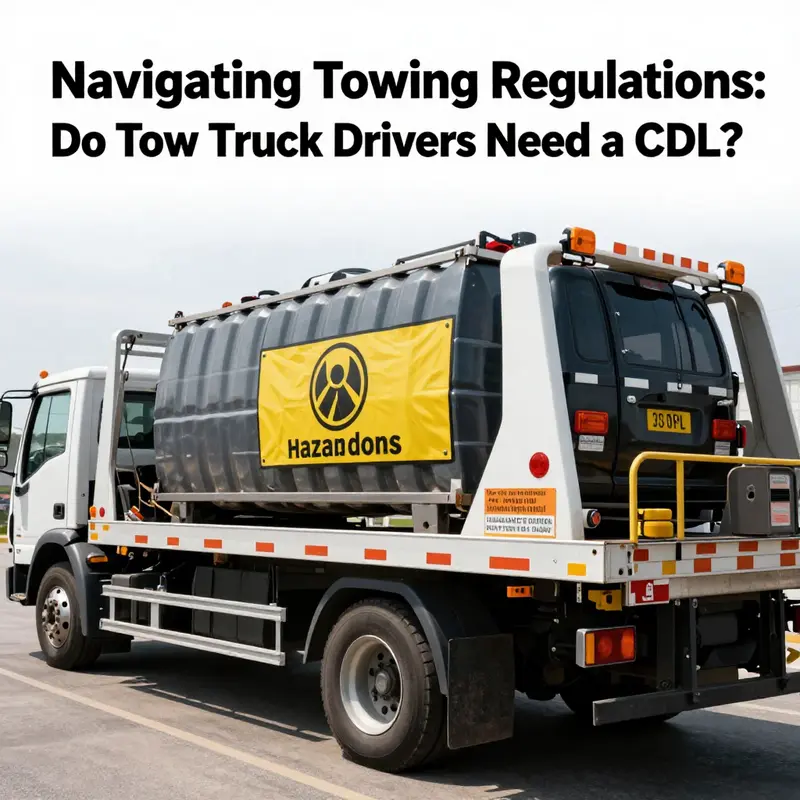
The question of whether tow truck drivers need a Commercial Driver’s License (CDL) sits at a practical crossroads of weight, responsibility, and safety. It’s not a simple yes-or-no query because the answer changes with what the tow operator is moving, how heavy the vehicle is, and whether the work ever touches hazardous materials. In the United States, the Federal Motor Carrier Safety Administration (FMCSA) sets the framework, but state rules and the realities of daily wreck recovery add layers that can surprise even seasoned operators. The core rule is straightforward: a CDL is required for tow trucks that have a gross vehicle weight rating (GVWR) of 26,001 pounds or more, or when a tow truck is used to pull a trailer with a GVWR over 10,000 pounds. Yet the moment hazardous materials enter the picture or a trailer overhangs a heavy weight threshold, the licensing path shifts decisively toward the CDL and beyond, into endorsements and stringent background checks. This layered regulatory landscape means that licensing decisions hinge on the specifics of the vehicle in operation and the nature of the cargo, not merely on the act of towing itself. In practice, many tow operators who handle standard passenger-vehicle recoveries can operate with a regular driver’s license, provided the tow truck remains under the GVWR threshold and the operation does not involve hazmat transport. But when the job scales up—whether the truck itself is a heavy tow unit or it regularly hauls trailers carrying hazardous materials—the CDL becomes not just a credential but a guardrail for safety and compliance that protects the driver, the public, and the operation’s long-term viability.
A useful way to think about the CDL requirement is to visualize the weight classes and the public-safety purposes behind them. A tow truck with a GVWR of 26,001 pounds or more is considered heavy enough in many jurisdictions to demand the skill set that accompanies a CDL. The idea is simple: heavier vehicles demand greater braking power, wider maneuvering margins, and more nuanced understanding of weight distribution and vehicle dynamics. The CDL, in its different classes, codifies the training needed to manage those realities on the road and on scene. A tow operator who regularly handles heavy wrecks or operates a fleet of heavy-duty rigs is unlikely to avoid a CDL for long, because the job demands both practical competence and a formalized safety framework. Conversely, smaller, lighter tow trucks performing roadside assist or local recovery operations may legally operate on a standard license, though this is not universal; some states impose stricter rules that narrow the line between what counts as a “truck” and what qualifies as a standard passenger-vehicle license. The FMCSA rule is the anchor, but the shoreline shifts with state practice and the precise duties assigned to a particular position or fleet.
Hazardous materials change the equation in a way that renders the rest of the discussion moot for many operators. When a tow truck is involved in transporting hazardous materials—whether fuels, solvents, or other dangerous goods—the vehicle itself must be registered to carry such cargo, and the driver must hold a CDL with a HazMat endorsement. The HazMat endorsement is not optional; it is the credential that unlocks the legal ability to transport hazardous materials. The endorsement process is not a mere formality. It involves a rigorous background check, a written examination, and compliance with federal security standards designed to prevent misuse and ensure that carriers and drivers who handle dangerous goods meet high security and safety expectations. The security requirements include fingerprint-based background checks and a threat assessment conducted through federal channels. These steps reflect a broader national priority: hazardous materials require heightened scrutiny because the potential consequences of mishandling are severe, affecting not only the driver but also onlookers, responders, and communities along the route.
Alongside the HazMat endorsement, the licensing path for drivers who handle large towed units often maps onto the broader Class A or Class B CDL framework. A Class A CDL covers combinations of vehicles with a large towed unit, typically when the towed vehicle exceeds ten thousand pounds GVWR. This mirrors the practical realities in heavy towing where a carrier might pull a wrecked car, a tractor-trailer, or a heavy equipment trailer. The more common Class B CDL applies to a single heavy vehicle or a combination where the towed unit’s weight remains under the ten-thousand-pound threshold and the overall vehicle still exceeds 26,001 pounds GVWR. The nuance matters on the ground because every fleet and job description may tilt toward one class or another depending on the composition of the fleet and the typical load. For the driver, the path includes not only the CDL but sometimes additional endorsements, medical qualifications, and ongoing compliance checks that ensure the license remains active and aligned with the scope of work.
Practically, this regulatory framework translates into a set of expectations that shape daily operations. For a tow operator who rarely encounters hazardous materials and who mainly works with standard passenger-vehicle recoveries, the threshold is often determined by the truck’s weight rather than its cargo. If the truck’s GVWR stays below 26,001 pounds and the operator does not haul hazmat or a heavy trailer, a standard state driver’s license is generally sufficient. Yet many workplaces prefer to align with best practices by pursuing a CDL anyway, even when not strictly required. The reasons are twofold: first, it expands job opportunities by opening the door to heavier equipment and higher-paying assignments; second, it elevates the operator’s training, reinforcing a culture of safety that reflects how the industry responds to larger and more complex scenes. Even when a CDL is not mandated, many operators undertake formal training programs that cover practical on-scene safety, vehicle handling, and the legal responsibilities that accompany heavy towing. These efforts often become a differentiator in a competitive market where clients seek partners who demonstrate a mature, safety-first approach to every call.
The decision to pursue a CDL or a HazMat endorsement often turns on a few concrete questions: Will the work require heavy-duty tow capabilities, a combination vehicle, or a trailer that could push the weight over the threshold? Is there any chance the operation will involve transporting hazardous materials, even if infrequently? Does the fleet plan include trailers or towed units that exceed 10,000 pounds in GVWR? The answers to these questions are rarely static; they evolve with contracts, fleet expansion, and changes in the types of incidents the company responds to. This fluidity is why many operators consult state DMV resources and, when in doubt, err on the side of licensing rather than risk noncompliance. It is also why the broader safety culture in towing emphasizes ongoing education, regular equipment inspections, and a thorough understanding of the regulatory map that governs every job. The practical upshot is that licensing decisions are not just about qualifying for work; they are about ensuring that a business can respond quickly and safely to the most demanding scenes while maintaining compliance with federal and state standards.
To connect the licensing narrative with on-the-ground practice, consider how a body of standards and procedures emerges within a fleet. A disciplined operator will maintain an inventory of vehicle configurations and associated licensing requirements, mapping each scenario to the corresponding Class A or Class B CDL, and identifying when a HazMat endorsement would be necessary. This strategic alignment helps prevent situations where a driver arrives on scene with an appropriate truck but the wrong credential, risking delays, penalties, or worse. It also supports a safer, more reliable response to emergencies, where the priority is rapid, secure, and compliant recovery. In contexts like heavy-duty rescue operations or standardized response protocols, fleets increasingly emphasize uniform licensing frameworks as part of broader operational readiness. For readers seeking practical implications tied to fleet-wide standards, a closer look at how standards influence rescue and recovery operations can illuminate how licensing choices shape day-to-day decisions on the road. standardization in heavy-duty rescue operations
The conversation about HazMat and CDL relevance is not just about licenses; it’s also about the processes that support safe and compliant practice. Before any HazMat transport occurs, the vehicle must be properly registered, and the driver must carry the HazMat endorsement in addition to the CDL. The endorsement entails ongoing compliance with security and training protocols designed to deter misuse and to prepare drivers for the heightened responsibilities that accompany hazardous materials. Even though the paperwork can appear burdensome, it serves a critical function: it ensures that operators who move dangerous goods have the knowledge, discipline, and accountability required to manage risk on highways, on ramps, and at accident scenes. The broader takeaway is not fear of regulation but appreciation for how licensing acts as a framework within which responsible towing and recovery can operate, safely and predictably. For the industry, this implies that standards for licensing, training, and on-the-job practice are not mere hurdles—they are the backbone of professional credibility and public safety.
Of course, licensing is iterative. Requirements can vary by state, and state DMVs provide the definitive guidance for any given job. The safest path for any tow operator or employer is to review the current state rules, confirm whether the work involves any heavytowing or hazmat transport, and then align staffing and training plans with those findings. This careful, proactive approach helps prevent missteps on the road and supports a culture of compliance that clients and regulators both expect. In practice, that means ongoing education on weight classifications, endorsements, medical qualifications, and the administrative steps needed to keep credentials valid. It also means maintaining a clear internal map of who is authorized to operate which equipment and under which conditions, so responses remain swift without compromising safety or legality. The end result is a towing operation that can meet the full spectrum of demand—from routine roadside aid to complex, hazardous-material transports—without sacrificing speed, trust, or accountability.
For readers who want a broader view of the employment landscape in transportation and licensing, the Bureau of Transportation Statistics provides a wider frame for understanding how licensing interacts with work availability and safety expectations in the industry. See external resources for context and trends in transportation employment. https://www.bts.gov/content/transportation-employment
In sum, the CDL question for tow truck drivers is not a single checkbox but a spectrum tied to vehicle weight, the presence of trailers, and whether hazardous materials are part of the operation. The mechanics of the license—Class A versus Class B—and the HazMat endorsement become central when the job involves heavy tow trucks, large towed units, or dangerous goods. When the work stays within the lighter end of the scale and avoids hazmat, a standard license may suffice, but many operators adopt CDL training as a forward-leaning strategy to expand capabilities and improve safety on every call. The most reliable path forward is to assess the job duties with precision, consult the state DMV for the latest rules, and, when in doubt, pursue the CDL and HazMat endorsement to ensure readiness for the full range of towing scenarios. By anchoring licensing decisions in weight thresholds, cargo type, and regulatory standards, tow operators can maintain both compliance and competitive edge in a field where every scene demands swift, skilled, and safe action.
Weight, Rules, and Road Time: Navigating State CDL Guidelines for Tow Trucks
A concise overview of how CDL requirements apply to tow trucks, focusing on GVWR thresholds, state variations, and practical licensing paths. The federal standard uses a GVWR of 26,001 pounds as a general marker for CDL eligibility, but states may add requirements or endorsements for local operations, heavy payloads, or hazardous materials. The key takeaway is to verify with the state DMV and consider how the intended duties—local, light towing vs. highway-heavy contracts—shape the licensing plan. Even when a CDL isn’t immediately required, obtaining one can expand job opportunities, training, and safety practices across fleets.
Final thoughts
Tow truck drivers must navigate a complex landscape of licensing requirements that varies by state and the vehicle’s specifications. Whether you are a local driver, an auto repair shop owner, a property manager, or a dealership administrator, understanding these regulations can significantly impact safety and compliance in towing operations. As always, consulting your specific state’s guidelines and the Federal Motor Carrier Safety Administration will provide clarity to your unique situation. Empower yourself with knowledge to ensure your towing services are efficient and compliant.