
Towing services play a vital role in keeping our roads safe and functional, whether it’s vital road recovery or transporting vehicles. However, one critical question surfaces often among local drivers, auto repair shops, dealerships, property managers, and HOA administrators: Do I need a CDL to drive a tow truck? This article delves into various aspects of driving a tow truck, focusing on the need for a Commercial Driver’s License (CDL) based on vehicle weight, hazardous materials, passenger transport, and varying state regulations. By exploring each facet, you’ll gain clarity on the circumstances that necessitate a CDL and ensuring compliance with the respective transportation laws.
Weight on the Tow Path: Understanding CDL Requirements for Tow Trucks
The question of whether a CDL is needed to drive a tow truck hinges on weight, but it is not a simple yes-or-no answer. It is a careful reading of the numbers on the door placards, the labels on the vehicle, and how those numbers combine when the tow truck and the vessel it is hauling share the road. In practical terms, a tow operator must understand not just the weight of the truck itself, but the total weight that may be on the highway at a given moment. The federal baseline is clear enough: once the vehicle’s weight, or the weight of a combination that includes a towed unit, pushes past certain thresholds, a Commercial Driver’s License becomes a necessity for safe, legal operation. The way those thresholds apply, however, can vary by state and by the specific duties of the job, so the careful reader should treat the rule as a starting point rather than a static decree. The heart of the matter is simple in form and complex in application: weight determines licensing, and weight is not a single number but a relationship between a tow vehicle and its payload, together with the intended use of the equipment. The nuance matters because tow trucks are not ordinary passenger vehicles; they carry equipment, they may tow other vehicles, and they frequently operate in environments that demand a level of professional credentialing beyond the basics of a regular driver’s license.
To grasp the practical implications, one must become comfortable with two core concepts that recur in licensing discussions: the GVWR, or gross vehicle weight rating, and the GCWR, the gross combined weight rating. The GVWR is the upper limit the manufacturer assigns to the tow truck itself. It is fixed on a plate or plaque on the vehicle and reflects what the truck is built to carry, factoring in the weight of the vehicle and its maximum payload, fuel, and fluids. The GCWR, on the other hand, is a broader ceiling used when a vehicle tows another vehicle or a trailer. It represents the maximum weight permitted on the road for the combination of the tow truck and the towed unit. These numbers are not mere technical trivia; they are the anchors for licensing thresholds. When the operator’s license needs to rise from a standard Class D to a CDL, the change follows a clear pattern: the higher the weights involved, the higher the class of CDL required, and the more careful the compliance regime becomes.
Across many communities, the most cited rule anchors the decision around a 26,000-pound mark. If the tow truck’s GVWR alone exceeds 26,000 pounds, the operation typically falls under a Class B CDL requirement. The distinction for many fleets is practical: a single heavy vehicle that weighs more than 26,000 pounds, by itself, usually necessitates a Class B license to operate legally and safely. But the picture shifts when the vehicle is not traveling alone. If the tow truck is actively towing another vehicle or a trailer, the combined weight becomes the deciding factor. In such cases, if the combined gross weight of the tow truck and the trailer or towed vehicle exceeds 26,001 pounds, a CDL is typically required. The result is a simple but crucial rule of thumb: heavier equipment on the move, especially when paired with a towed load, brings CDL requirements into play. The exact numbers and the precise threshold can vary by state, which is why many operators start with the federal baseline and then check their own DMV or state transportation authority for any local nuance.
To illustrate how this works in real life, consider a tow truck that weighs 20,000 pounds on a light day. If that truck is used to tow a vehicle weighing 10,000 pounds, the total is 30,000 pounds on the road. That 30,000-pound figure is well over the 26,001-pound threshold and thus pushes the operation into CDL territory, regardless of the tow truck’s own weight being under the 26,000-pound line. The reverse can be equally true: a very heavy tow truck, one that itself weighs more than 26,000 pounds, may require a Class B CDL even if it is never towing anything else at the moment. In both cases, the driver’s credential follows the vehicle’s destiny on the road, not the absence of a trailer on a given trip. It’s a consistent logic that serves safety, accountability, and the orderly management of road space in a way that regular passenger car licenses cannot guarantee.
The rules also extend beyond weight alone. CDL requirements can be triggered by the intended use of the equipment in certain circumstances. If the tow operation involves transporting hazardous materials, or if the vehicle is configured to carry more than 15 passengers including the driver, CDL credentials become necessary as well. These conditions are not mere add-ons; they reflect the broader mission of CDL programs to ensure that operators handling vulnerable cargo or large groups have specialized training in safety, handling, incident response, and regulatory compliance. The fact that these additional triggers exist underscores a central point: CDL eligibility is not a one-size-fits-all label. It is a dynamic status that depends on how the tow truck is built, how it is used, and the regulatory environment in which it operates.
Because the licensing landscape is not universal, the precise requirements can differ by state. Some states align tightly with federal standards, while others have more granular rules that couple the GVWR and GCWR with the type of service, the nature of the load, and the specific endorsements necessary for certain tasks. This is why the most reliable path to clarity is to consult the state’s DMV or other official transportation authority. Those inquiries keep the practice aligned with local enforcement and ensure that the fleet remains in compliance during inspections, weigh-station stops, or roadside audits. It also matters for insurance and liability planning. The road that leads to misunderstanding is paved with assumptions; the road to compliance is paved with officially issued numbers, labels, and authority documents.
The federal backbone to all of this guidance comes from the Federal Motor Carrier Safety Administration (FMCSA), which outlines the baseline criteria that states use to shape their own rules. The FMCSA framework gives operators a common language for discussing weight, licensing, and safety practices, while still allowing for state-specific variations that reflect local road networks, traffic conditions, and enforcement philosophies. In practice, this means that an operator cannot rely solely on a generic statement such as “CDL is not needed.” Instead, one should engage a careful evaluation process: verify the tow truck’s GVWR on the manufacturer’s plate, confirm the GCWR for any towing configurations, and cross-check the combined weight of the vehicle and its load against the state’s thresholds. If there is any doubt, a call or visit to the DMV or a licensed compliance consultant can save days of misinterpretation and the risk of penalties.
For readers who manage a fleet or operate with a team of drivers, the question often broadens beyond the individual vehicle into the operational policy. A robust fleet policy acknowledges the weight thresholds, but also codifies how drivers verify the weight before trips. It builds in pre-trip checks for the towing configuration, ensures that correct licensing and endorsements are current, and creates a standard process for documenting compliance. Such a policy not only reduces the risk of a roadside stop turning into a regulatory headache, but also strengthens the reliability of service, which is a critical factor in emergency and recovery operations. In practice, this can translate into a straightforward habit: before every tow, confirm the GVWR of the tow truck, confirm the weight of the vehicle being towed, calculate their sum, and decide whether a CDL is required for the trip at hand. If the sum sits above the threshold, the driver should operate under a CDL with the appropriate class and endorsements. If there is any ambiguity, the safe choice is to treat the load as CDL-required and proceed with the required licensing rather than risking penalties or service interruptions.
The practical implications extend into training, hiring, and even insurance considerations. A tow company’s training program should incorporate weight calculations as a core skill. New drivers should learn how to read the weight labels, understand the difference between GVWR and GCWR, and recognize the circumstances that trigger CDL requirements. When a fleet hires new drivers, the onboarding process should verify that each driver has the appropriate license class for the work they are expected to perform. Insurance coverage often scales with risk, and heavier, more complex towing operations require more comprehensive coverage plus clear documentation of licensing status. In this sense, licensing becomes a cornerstone of professional practice, directly connected to safety performance, regulatory compliance, and the company’s ability to fulfill contracts that involve heavy-tow or multi-vehicle recovery operations.
This is where the narrative naturally expands from a solitary driver’s license question into a broader picture of industry standards and best practices. Weight thresholds do not exist in isolation; they inform how a tow operation is planned, how routes are chosen, and how the crew is configured for a given mission. In emergency-readiness contexts, where time is of the essence and the load may be unpredictable, the discipline of correct licensing becomes part of standard operating procedure. The discipline also resonates with the broader themes that guide modern towing fleets: consistent equipment standards, standardized procedures, and a shared language among operators, fleet managers, and enforcement officers. For readers who want a window into the broader context and industry perspectives, the Santa Maria Tow Truck blog offers a practical resource that captures how operators approach routine compliance in the daily grind of tow work. Accessing this resource can help ground the license conversation in real-world practice and is a useful companion to the regulatory overview presented here. SANTA MARIA Tow Truck blog.
Ultimately, the key takeaway is not that the 26,000-pound threshold is an arbitrary number, but that it serves as a meaningful threshold for safety, control, and professional accountability on the road. Whether a tow truck falls under a Class B license due to its own weight, or under a Class A license because the combined weight with a towed vehicle exceeds the threshold, the result is the same in spirit: a licensing standard that aligns with the risk and responsibility of controlling heavy, potentially hazardous, or multi-vehicle configurations on public highways. The rule also acknowledges that there are legitimate variations by state, and it encourages drivers and fleet managers to verify locally. In practice, this means making the licensing decision a deliberate part of the trip planning process rather than a peripheral afterthought. It means treating the weight numbers as live data that travels with every dispatch and every load, guiding the driver’s licensing class, the required endorsements, and the safety practices that accompany heavy-vehicle operation.
For readers seeking authoritative information beyond the general framework, federal guidance remains the baseline. The FMCSA underpins these standards and provides the official reference for national policy on commercial driving and vehicle combinations. In parallel, state DMVs offer the local implementation that accounts for regional differences and enforcement priorities. Taken together, the path to compliance is navigable when approached with careful measurement, verified documentation, and a clear understanding of how weight translates into license requirements. The practical outcome is straightforward: know the weights, calculate the totals, and license accordingly. The road ahead for tow operators who want to stay compliant and safe is to build weight-awareness into every dispatch, to train drivers in the practical application of the rules, and to maintain a culture where licensing is treated as a fundamental element of professional practice, not an afterthought during registration or renewal. As the industry continues to evolve, the best practice remains consistent: measure, verify, license, and operate with a clear understanding of what the numbers demand.
External resource for authoritative guidance: https://www.fmcsa.dot.gov/
Tow Truck Licensing Reality: CDL Thresholds You Must Know
The core rule starts with GCWR. If the combined weight of the tow truck and the vehicle it is towing—the gross combination weight rating—meets or exceeds 26,001 pounds, a CDL is typically required. In practice, states may interpret this differently, but GCWR is the common baseline. A second factor is passenger capacity: if more than 15 people, including the driver, are transported, a CDL is generally required regardless of the tow truck’s weight. Hazmat adds a further layer: if you tow or carry hazardous materials that require placarding under 49 CFR Part 172, you must have a CDL with the Hazmat endorsement. The HazMat endorsement requires a fingerprint-based security background check (STA) by FMCSA, plus training and ongoing compliance obligations. Placarding and routing rules influence whether Hazmat is triggered, and state regulations can augment the federal baseline. Practically, begin by calculating GCWR for your heaviest expected setup, confirm whether you will ever exceed 15 passengers, and assess the likelihood of hazmat work. Then coordinate with the state DMV and FMCSA guidance to determine the exact license class and endorsements you need. If hazmat is a possibility, include Hazmat readiness in your planning and budget. Remember that licensing is a function of operation, not merely truck weight, and that federal standards provide the floor while states add the ceiling.
CDL Thresholds for Tow Trucks: Weighing Weight, Passengers, and State Variations
Determining whether a CDL is required for a tow truck hinges on weight and passengers, not on appearance alone. The federal baseline comes from FMCSA rules that use vehicle GVWR and GCWR to decide licensing needs. GVWR is the maximum weight the vehicle is built to carry, including its own weight. GCWR combines the tow vehicle and the towed load as a single system. If the combination weighs 26,001 pounds or more, a CDL is typically required for the operator. This threshold can apply even when the tow truck’s own GVWR sits below 26,000 pounds. For example, a 20,000-pound tow truck towing a 10,000-pound car yields a GCWR of 30,000 pounds, triggering CDL requirements.
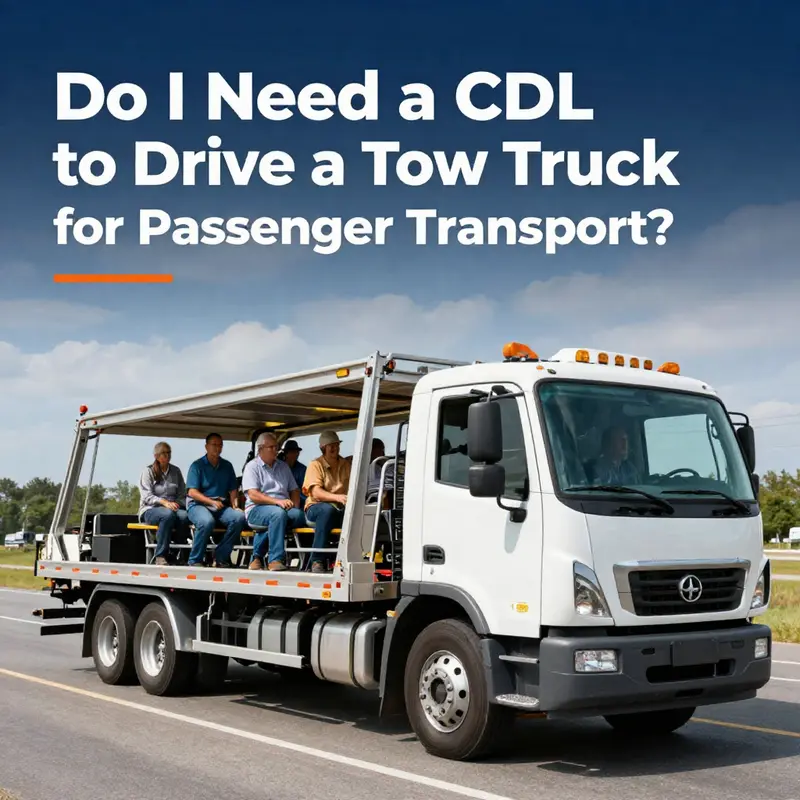
Separately, if a tow truck is designed to carry 16 or more passengers, including the driver, it becomes a passenger carrying vehicle. In those cases, the CDL can be required even if the GVWR is under 26,000 pounds.
States vary in implementation. The federal standard provides a baseline, but states tailor requirements for licensing and enforcement. Operators should check their state DMV or licensing authority for the exact rules for their configuration and use case. Even when a CDL is not legally required, some fleets adopt CDL level training for safety, insurance considerations, and customer expectations.
The practical steps are: locate the GVWR on the door jamb or owner manual, calculate GCWR for typical duties, assess seating and whether 16 or more passengers could be present, and confirm state requirements. If the calculation suggests CDL is needed, obtain licensure and align training accordingly. If not, still verify insurance and safety policies.
Finally, remember that the line between towing and transporting is about design intent and operation. When passengers are involved, risk management and regulatory oversight grow. For fleets, the prudent path is to perform an internal desk audit of GVWR, GCWR, and seating, and to document decisions so the fleet remains compliant and safe. For authoritative guidance, consult the FMCSA guidelines and your state DMV.
Tow Truck CDL Rules Decoded: Weighing the Truck, the Load, and the State Line
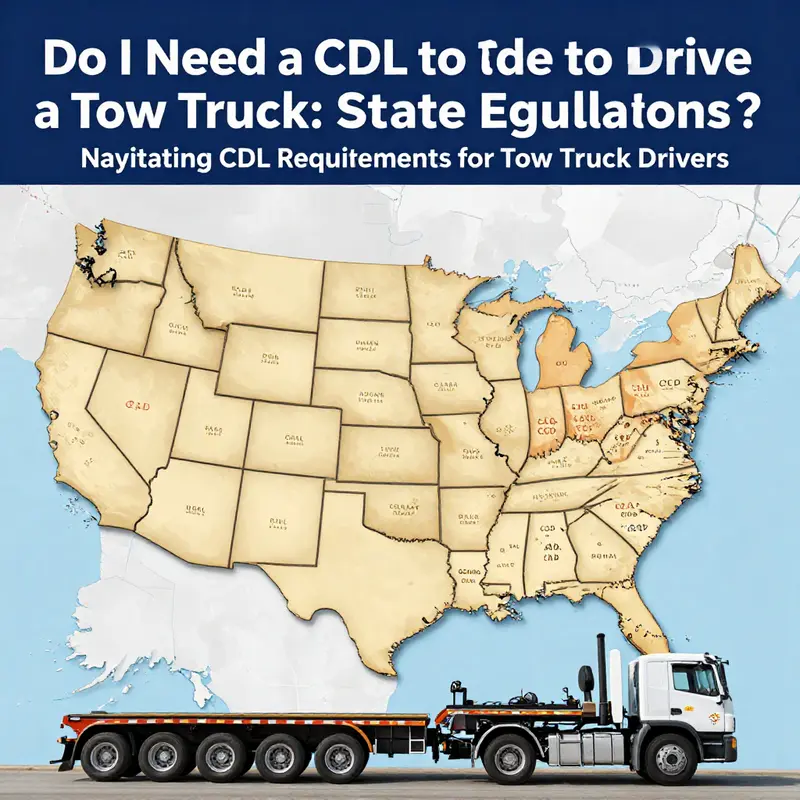
Understanding whether a tow truck needs a CDL starts with weight, use, and location. The federal baseline from FMCSA provides a framework, but states tailor the rules to their roads and operations.
The commonly cited trigger is 26,001 pounds gross vehicle weight rating (GVWR) or gross combined weight in some states. In practice, if the tow truck weighs 20,000 pounds and tows a 10,000-pound trailer, the total is 30,000 pounds, which many jurisdictions treat as CDL territory.
Some states count the tow truck’s own weight toward the threshold even when no trailer is in tow, while others look only at the combination when there is a tow. Some jurisdictions differentiate private noncommercial use from highway service.
Beyond weight, factors such as hazardous materials or transporting more than 15 passengers can require a CDL or additional endorsements regardless of the weight. The federal framework ensures safety, but the final word comes from state rules, so always verify with the state DMV or transportation authority for your exact scenario.
A practical approach: determine the tow truck’s GVWR and the GVWR of typical towed loads; if the sum exceeds 26,001 pounds, prepare for CDL considerations but confirm with the state. Check whether your operation might involve hazmat or passenger transport, and identify the CDL class and endorsements needed. Finally, review whether your state treats the heavy tow truck as a CDL vehicle on its own or only in combination. When in doubt, contact the DMV and document the decision to stay compliant.
Final thoughts
Understanding the requirements for a CDL when driving a tow truck is paramount for compliance and safety in the towing industry. As you’ve seen throughout this exploration, whether you’re looking at vehicle weight, hazardous materials, passenger transport, or state-specific regulations, the need for a CDL can vary widely. Make sure to remain informed about both federal and state regulations to ensure you’re abiding by the law. By doing so, you not only protect yourself but also contribute to the safety of the community at large.