
When emergencies strike and your truck needs a tow, understanding the costs involved can help you make informed decisions. Factors such as distance, vehicle type, and additional fees can significantly influence the final bill. Whether you are a local driver in need of roadside assistance, an auto repair shop looking to guide customers, or a property manager managing vehicle removals, knowing how much it costs to tow a truck is essential. This guide will explore the key factors affecting towing costs, including the implications of distance, vehicle weight, and those pesky hidden fees. Each chapter will dive deeper into these topics, offering clarity and actionable insights, empowering you to navigate towing services with confidence.
Distance as the Decider: Reading the Mile-By-Mile Cost of Towing a Truck
When a stuck or disabled truck needs help, the question in most drivers’ minds is not merely about getting back on the road, but about what it will cost to get there. The price tag that follows a tow is rarely the same from one job to the next. Yet one factor consistently carries more weight than any other: distance. Distance is the loudest bell in the pricing equation, and understanding how it shapes the bill helps you separate a fair quote from a guess. In practical terms, most towing companies structure costs around two common models: a base or flat fee for short hauls, and a mileage-based rate for longer ones. In rural areas, long hauls can be the norm, pushing the total higher simply because the service must cover more ground. In busy urban centers, drivers wrestle with traffic and longer wait times, which can drive up hourly charges even if the actual distance isn’t extreme. The simple math behind this is enough to convince any traveler that distance matters, but the real world adds more layers that shape the final number.
Short-distance towing, typically defined as under 10 miles, is where many of us first encounter the practical side of pricing. The cost range usually reported by reputable providers sits roughly between $50 and $125. This bracket reflects a bundle of basic services: securing the vehicle, transporting it a short distance, and getting it to a nearby shop or safe location. In these scenarios, the fee often covers the core labor and the use of the tow truck itself, with limited additional charges. The inclusions in this range tend to be straightforward: a standard flatbed or wheel-lift approach, minimal mounting time, and a quick handoff at the destination. The simplicity of a short tow makes the quoted amount easier to forecast, yet even here surprises can exist if the truck requires unusual attachments or if the destination imposes access limitations.
When the need stretches beyond the 10-mile mark, the conversation shifts toward mileage-based pricing or a higher flat-rate bracket. Long-distance towing, generally characterized as trips over 50 miles, tends to fall in the range of $1.50 to $3.50 per mile. This tier reflects a broader set of variables: the fuel consumption of the tow vehicle, the wear on specialized equipment, the time spent en route, and the logistics of maintaining safety over a longer haul. The per-mile figure can vary widely from one company to another, and even within the same company it may flex depending on the exact truck being moved, the route, and regional pricing norms. The upshot is clear: the longer the journey, the greater the opportunity for costs to accumulate, particularly if the trip crosses state lines or traverses regions with higher labor rates or stricter regulatory requirements.
Yet distance is only the starting point. Several additional factors actively shape the total bill, and savvy customers learn to account for them before agreeing to service. Time of day matters. After-hours or emergency service typically commands a surcharge, sometimes labeled as an after-hours or priority fee. It is not unusual for late-night or weekend calls to carry a premium, simply because the dispatcher and driver shift away from standard schedules while still meeting demand. The effect on the final invoice can be modest or meaningful, depending on the company’s pricing philosophy and the urgency you convey during the call.
Vehicle condition is another pivotal variable. A truck that starts and runs can be hooked up and loaded in a matter of minutes, while a non-running vehicle may require additional steps—manual winching, dollies, extra straps, or the need to stabilize a heavy frame. Each extra minute and each piece of specialized equipment translates into added labor and equipment wear, nudging the total upward. Heavier or more complex vehicles—full-size pickups, larger SUVs, or commercial vans—also trigger the use of larger tow rigs, which themselves carry higher hourly rates and greater fuel usage. The fuel price, in particular, can drift into the equation on longer tows, especially if the trip spans rural routes with less efficient efficiency or if the logistics call for multiple stops or repositioning of equipment.
Equipment needs form a distinct subset of distance-related costs. A basic tow might rely on standard wheel lifts and straps, but some scenarios demand specialized gear: heavy-duty dollies, multiple straps to distribute weight evenly, or winches designed for steeper inclines or precarious terrains. Each piece of gear adds a line item to the estimate, especially on a longer haul where safety and compliance become as important as speed. The presence of this equipment can be the difference between a smooth transfer and a tow that must be aborted for safety reasons or redeployed with more robust gear.
With these dynamics in mind, how should a consumer approach an estimate? The most reliable path starts with transparency: request an estimate that lays out the total cost in clear, itemized terms. A reputable provider will spell out the base or minimum fee, the per-mile rate (if applicable), any after-hours surcharge, and potential extras for non-running vehicles or specialized equipment. They should also confirm whether tolls, fuel surcharges, storage fees, or road restrictions could affect the final amount. This upfront breakdown is your best defense against sticker shock when the truck pulls into your driveway or, worse, when the invoice arrives later.
To bring these concepts into a practical frame, consider a few illustrative scenarios. If you need a short tow of 8 miles and the company charges a modest base of around $75 with a small per-mile component, your total might land near $75 to $125, depending on local rates and the specifics of the pickup location. If the truck is heavier or needs a non-standard setup, the base could creep toward the mid-range of that band, while the per-mile portion remains minimal because the distance is short. For a longer trip, say 60 miles, at a mid-range rate of $2.50 per mile, the distance-based portion alone would be about $150. Add a base fee of $75 and you’re up to roughly $225, with potential adjustments for after-hours service, highway tolls, or required equipment. If the tow involves a two-way trip, multiple stops, or specialized loads, the price can climb further, reflecting the complexity of the operation rather than the distance alone.
Prices can also diverge by region, reflecting local labor markets, regulatory environments, and the density of towing providers. Urban centers may see higher hourly rates due to traffic delays and a generally higher cost of doing business, while rural routes may involve longer trip times and greater fuel consumption. In both cases, the mileage-based component remains the core driver for long hauls, but the surrounding fees and surcharges can substantially tilt the final figure. For anyone planning ahead, this means a near-term price forecast is more reliable when you are dealing with longer distances in areas with pronounced pricing variation.
A practical approach to pricing is to compare quotes from several local providers and to ask for the same level of detail from each. If you are told one price but another provider breaks out a detailed, line-by-line estimate, you will be better positioned to judge value and avoid surprises. In some cases, online platforms can deliver instant quotes based on pickup and drop-off locations, leveraging current demand and regional pricing trends to yield a reliable projection. These tools can be helpful as part of a broader price-check strategy, but they should be complemented with a direct confirmation from the towing company to lock in the exact terms that will apply to your job.
In terms of navigation and context, a well-rounded understanding of these pricing dynamics can also empower better decisions when you’re in a taxing situation. If you’re stranded, the instinct to act fast is strong; still, pushing for a quick decision on price without a breakdown can backfire. The cost of haste often comes in the form of hidden fees or a lack of recourse if the tow needs adjustment later. By requesting a written estimate with a precise scope of work, including any potential extras for after-hours service, non-running conditions, or specialized equipment, you gain leverage and clarity. A few concise questions can save you money and stress: Is there a base fee? What exactly is the per-mile rate and how is it calculated? Are there surcharges for after-hours service? Will there be a separate charge for equipment or labor if the vehicle is not operable? Are tolls or road usage fees included in the estimate, or billed separately?
If you want to dive deeper into local considerations and read more nuanced discussions about pricing, you can explore broader conversations on the topic at santamariatowtruck.com/blog/. This internal resource provides context that aligns with the practical, scenario-based guidance described here. For readers who are evaluating pricing from multiple providers, remember that the distance-driven portion of the bill is typically the largest single contributor to the total, but it does not stand alone. The combination of distance, vehicle weight, condition, and equipment all converge to shape the final invoice, and understanding how they interact can prevent unexpected costs later.
External perspective can also be helpful. A widely cited reference in the industry notes the range of typical towing costs and underscores the importance of upfront estimates and itemized invoicing to avoid surprises. For a broader industry reference, see the external resource: https://www.aaa.com/automotive/towing-costs
How Vehicle Type and Weight Drive Tow Prices: From Compact Pickups to Semi-Trucks
The most reliable predictor of what you’ll pay to tow a truck is the vehicle’s type and weight. Those two factors determine what equipment the tow company must deploy, how many technicians are needed, and how long the job will take. A small, light pickup or a compact truck usually requires a simple flatbed or wheel-lift and a single technician. A heavy-duty commercial rig may require a specialty wrecker, additional crew, permits, and traffic control. Those distinctions translate directly into dollars, and understanding them helps you avoid surprises when you request service.
Light trucks and compact pickups sit at the low end of the pricing spectrum. For a short, local tow—generally 5 to 10 miles—you can expect a typical charge in the range of $75 to $125. Providers often combine a base hook-up fee with a per-mile rate that typically runs between $2.50 and $7 per mile. The towing process is relatively straightforward: position a flatbed or wheel-lift, secure the vehicle, and transport it. Fuel consumption, time on-scene, and the simplicity of rigging keep costs down. Even when a light truck needs a winch-out from mud or snow, the equipment and time required generally add only a modest extra charge compared with heavier rescues.
Once a vehicle exceeds certain weight and size thresholds, costs rise quickly. Trucks that exceed about 6,000 pounds—full-size pickups, heavy SUVs, and many commercial vans—fall into a middle tier where heavier tow trucks and sometimes a second technician are needed. The weight alone increases fuel consumption and wear on the towing rig. A vehicle with a long wheelbase or dual rear wheels can complicate loading and require dollies or specialty adapters. Expect per-mile rates to climb and the possibility of higher base fees. For mid-range tows of 20–50 miles, prices for these heavier pickups and vans can exceed several hundred dollars.
Large commercial vehicles and heavy-duty trucks form a separate pricing world. A fully loaded semi-truck, a bus, or a large box truck demands heavy-duty wreckers with capacities that range from 20 to 50 tons or more. These trucks are expensive to operate, require specialized training to handle safely, and are often in short supply. For short-distance moves or recoveries, costs for heavy-duty towing frequently begin near $300 and can stretch to $500 or more, even before adding distance charges, traffic delays, or complicated recovery operations. When distance grows, or when a vehicle is carrying cargo that must be offloaded or stabilized before towing, rates can escalate quickly.
The required equipment explains much of the pricing difference. Light-duty tows commonly use flatbeds, wheel-lifts, and small integrated units. Medium-duty jobs may require low-profile flatbeds, heavier dollies, or two-axle wreckers. Heavy-duty work calls for purpose-built, high-capacity wreckers, winches with long lead lines, and specialized rigging such as cradle assemblies or spreader bars to avoid damaging frames and axles. The larger the wrecker and the more complex the gear, the higher the operational cost for the tow company—and that cost shows up on the invoice.
Pricing models vary between companies but follow common patterns tied to vehicle type. Many providers use a base hookup fee plus a per-mile rate, with separate tiers for light, medium, and heavy-duty vehicles. Others employ distance brackets—flat fees for 0–10 miles, a higher flat fee for 10–25 miles, and so on—where a heavy-duty bracket will be markedly higher than a light-duty one. Then there are specialized charges: winching or recovery fees, storage and lot fees if the vehicle must remain in custody, and special handling fees when a truck is loaded or carries hazardous materials. For heavy trucks, permits for oversized or overweight moves and required pilot vehicles can further raise costs.
Time of day and location amplify the influence of vehicle type. A heavy truck that needs recovery in a rural area may be far from the nearest qualified wrecker, adding travel time and per-mile charges. Nighttime or weekend calls often carry surcharge rates because operators pay overtime or emergency premiums. Urban areas can be easier to service in terms of equipment availability but may impose higher hourly costs due to traffic, access issues, and local regulations. When a heavy commercial vehicle blocks a busy roadway, incident management labor—traffic control, police coordination, and scene lighting—becomes a necessary expense.
There are also specific technical details to watch for that affect cost estimates. Gross Vehicle Weight Rating (GVWR) and actual curb weight determine which wrecker is appropriate. A truck with dual rear wheels or an extended wheelbase changes how the vehicle must be supported. Whether the truck is on its wheels or overturned affects rigging complexity. A trailer attached to the truck multiplies the challenge: is the trailer empty? Is it connected? Does the load need to be transferred? A trailer may require a second wrecker or an escort to move safely, and those needs add fees.
Many operators charge separately for recovery versus towing. Recovery—getting an immobile truck out of a ditch, over embankments, or after a rollover—demands winches, specialized rigging, and extra hands. That work is both risky and time-intensive. For heavy trucks, recovery fees can exceed the base towing fee many times over. A seemingly modest cost variance often comes down to whether the truck can be towed conventionally or requires a recovery operation first.
Transparency when you call for service can cut your risk of unexpected charges. Provide the operator with the truck’s make, model, GVWR, whether it’s towing a trailer, and its current condition. Tell them the location specifics, such as whether the truck is in a ditch or on a slope, and describe any cargo or hazardous materials. Ask for a breakdown: base fee, per-mile rate, recovery or winching fees, after-hours or weekend surcharges, and possible storage charges. For commercial fleets, establishing relationships with tow providers and agreeing on standard service levels can stabilize costs and response times—see resources on standardization in heavy-duty rescue operations for guidance on consistent protocols: https://santamariatowtruck.com/standardization-in-heavy-duty-rescue-operations/.
Insurance and roadside assistance plans can shield owners from full out-of-pocket costs, but policies vary. Some plans cover only light-duty vehicles or limit the distance. For commercial truck operators, verify whether your insurer will authorize a specific heavy-duty wrecker and whether they will approve extra services like cargo offload or pilot vehicles. If a tow is an emergency and no prior authorization is possible, document the provider’s estimate and request an itemized invoice to submit to your insurer afterward.
Practical strategies can reduce cost. If a trailer is empty or can be detached, removing it before the tow can lower the required wrecker class. When safe and legal, moving the truck to a flatter, more accessible position can eliminate the need for an extensive recovery. For fleet managers, pre-planning routes with knowledge of local towing capacities and maintaining a list of qualified heavy-duty providers prevents long dispatch times and ensures correct equipment is used. In many cases, the cheaper immediate option—a small tow truck that drags a heavy vehicle a short distance—creates more damage and higher repair bills than calling the correct heavy-duty service from the start.
Finally, remember that availability affects price. Heavy wreckers are fewer in number. During storms, major incidents, or peak travel seasons, demand outstrips supply and costs rise. For commercial haulers operating in rural regions, consider contracts with geographically dispersed tow providers to guarantee faster access and avoid high travel surcharges. For personal truck owners, regular roadside assistance with clear heavy-truck coverage may offer the best balance of cost and reliability.
Understanding how vehicle type and weight shape towing fees gives you leverage when seeking service. Ask the right questions, provide accurate vehicle details, and request an itemized estimate before work begins. When in doubt, opt for the properly equipped heavy-duty provider; the upfront cost is often less than the cumulative expense of improper handling, damage, or repeated moves. For comprehensive industry guidance and standards that can help you evaluate providers, consult the National Towing Association at https://www.towing.org.
Beyond the Base Rate: Decoding Hidden Fees That Drive Tow Truck Costs
When a tow shows up on a crisis day, the base rate often feels like the obvious number. But the total you end up paying can drift far beyond that first quote as soon as a few supplementary charges are added to the bill. The price you see on the service page or the driver’s first estimate is usually a starting point, not the final tally. To understand what you’ll really owe for towing a truck, it helps to follow the thread from the moment a dispatch is made to the moment the vehicle is off the premises of a repair shop or onto your own driveway. This chapter examines the common add-on fees that consistently shape the final total and explains how, taken together, they can swing a tow from a manageable expense into a substantial one. It is a practical guide for drivers and fleet managers alike, designed to encourage proactive budgeting and clearer conversations with service providers. You’ll discover not only what each fee means but also how to spot potential overcharges and how to negotiate when the bill arrives. For a broader context on pricing factors, you can also explore more general guidance in the linked resources at the end of this chapter.
The first factor to acknowledge is that distance remains the dominant variable in most towing arrangements. The longer the distance, the more fuel, wear, and labor the operation consumes. Many companies structure their pricing with a base fee plus a per-mile rate, or they use brackets that charge different totals for ranges like 0–10 miles, 10–25 miles, and beyond. Yet in practice, the base rate and the per-mile charge are rarely the whole story. Even within the same distance band, the characteristics of the vehicle you need to move matter. A mid-size pickup with a moderate load might be fielded by a standard tow rig, while a heavy-duty truck, a large SUV, or a commercial van may require a heavier carrier, specialized wheel-lift or dolly equipment, and more fuel and manpower. These equipment and labor needs translate into higher operational costs, which show up as line items on the final invoice. A compact sedan or light car is typically less expensive to tow precisely because the equipment and energy required are lighter and more common. For truck owners, the discrepancy can be more pronounced because of the vehicle’s weight, axle configurations, and stability requirements during transport.
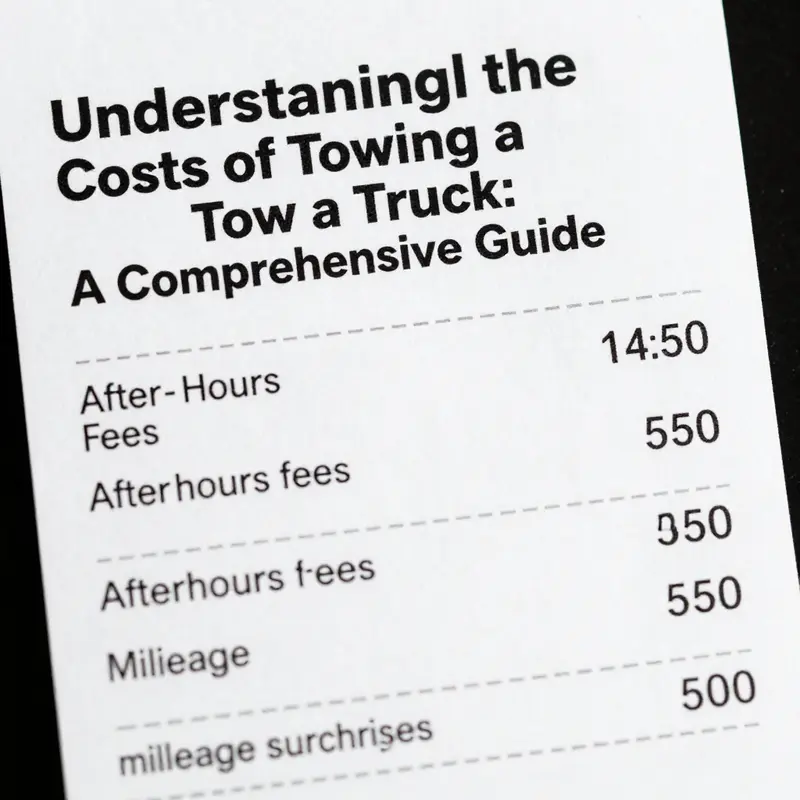
Beyond the distance and weight, the timing of the tow can influence pricing in predictable ways. After-hours or night-time service, weekend calls, and holiday dispatches are common flashpoints for additional charges. Companies that operate at times when demand is high and staffing is constrained frequently apply a premium to compensate for the challenge of securing skilled drivers and the reduced availability of nearby equipment. In practical terms, that after-hours surcharge can raise the bill by a quarter to half of the base price, or even more, depending on local market norms and the policies of the particular service provider. A tow that would cost a standard amount during regular business hours might be noticeably higher when you need help at 9 p.m. on a Sunday. The lesson here is straightforward: if you aren’t in a rush, asking for service during daytime hours can save a meaningful fraction of the total cost, and it gives you a safer window to compare quotes from multiple providers.
Another fee that often surprises customers is the short-distance or local tow surcharge. It may seem counterintuitive, since the work is abbreviated, and one might assume the shorter job is easier to complete. In practice, the dispatching and labor costs persist even for a short move. The result is a per-job surcharge that can nudge the total upward, especially if you’re asking the tow company to reposition the vehicle to a nearby shop, a parking lot, or a lot on the edge of town. This fee underscores a broader point about towing economics: the cost structure is not only about miles traveled but also about the operational overhead that remains steady regardless of how far the vehicle travels.
Storage fees are a further complication that can turn a single tow into a multi-day accounting exercise. If the vehicle can’t be retrieved immediately—perhaps due to an insurance claim, a lien hold, or a payment or paperwork snag—the tow yard will hold it. Most yards charge a daily rate for storage, typically in the range of $10 to $50 per day, with the lower end applying to longer-term, negotiated storage under certain terms and the higher end reflecting premium locations or climate-controlled facilities. Even a short delay can accumulate into a sizable bill after a few days or weeks, and the penalty compounds with time. Those storage costs are particularly consequential for fleets managing multiple incidents, as the inventory of towed vehicles can quickly become a bear to reconcile with the ongoing claims, inspections, and recoveries that accompany an incident.
Specialized equipment fees are the next category to watch. Not all tow jobs require the same gear, but trucks often do. A large semi-truck, a high-sided vehicle, or a vehicle with awkward dimensions may necessitate a flatbed tow truck, often called a rollback, which uses hydraulics and more precise handling to secure and transport a vehicle safely. The use of flatbeds demands more training for operators and more maintenance for the equipment, both of which raise the per-job cost. In some cases, the specialist equipment itself becomes a separate line item that appears on the bill. If your truck has an unusual height, width, or weight distribution, you might find the price climbs due to equipment complexity and the extra care required to avoid damage during loading and unloading. In all such cases, the expectation of careful handling underpins the pricing system; it’s not merely a luxury but a safety-driven necessity, especially when the vehicle cannot bear rough handling or impact during transit.
Towing destination fees also contribute to the final amount. When a tow involves transporting a vehicle to a distant location—perhaps to a preferred shop, an out-of-town claims facility, or a remote repair center—the bill will reflect the added fuel, driver wages, and duration of the trip. Long-haul towing, by its nature, incurs more direct costs that can be passed along to the customer. Some providers separate the destination charge from the base tow fee, while others roll it into a broader “long-distance” category. Either way, the further a vehicle must travel, the more likely the total will rise. This isn’t inherently unfair; long pulls require more planning, more fuel, and more time on the road for the crew, all of which must be compensated. The important takeaway is to ask for a transparent estimate that includes any destination-related charges before approving the service.
All these fees—after-hours surcharges, short-distance add-ons, storage costs, specialized equipment fees, and destination charges—together determine the total cost of towing a truck. Taken in combination with the base rate and any per-mile charges, they create a pricing mosaic that can differ widely from one incident to the next. That variability is why the practice of requesting a written estimate with a full breakdown is so valuable. When a dispatcher provides a line-by-line tally, you can see how much each factor is contributing to the total and whether certain charges appear disproportionate to the job at hand. It also gives you leverage in discussions about alternative arrangements, such as choosing a different route, requesting a different class of equipment, or negotiating a delay in pick-up to avoid after-hours pricing.
For anyone facing a tow, a practical approach is to gather as much information as possible at the outset. When you call for service, ask explicitly for a total estimated cost that includes all applicable fees and surcharges. Request a breakdown that separates the base rate, distance charges, and any add-ons. If the situation allows, compare multiple estimates side by side to identify any outsize or ambiguous line items. Keep a written record of all charges and the dates of each service interaction. If there’s a discrepancy or a fee that isn’t clearly justified, don’t hesitate to question it. A reputable operator will explain the line items and may adjust them if there has been a misunderstanding or a clerical error.
The complexity of towing costs becomes even clearer when you consider the potential interactions with insurance, law enforcement, or property owners. If insurance is involved, the insurer may require certain handling, storage, or transport conditions that trigger additional fees or reimbursements. If a vehicle is involved in an accident, the location of the crash, the need for securing the vehicle, or the disposition of the incident scene can add administrative tasks that show up as charges. These factors are highly situational, and their presence often signals that a straightforward, one-line bill will be insufficient to capture the full scope of work performed. In these cases, a well-documented invoice and a clear explanation of how each charge was calculated become essential for accountability and for ensuring you aren’t paying for services that weren’t rendered or necessary.
To deepen your understanding and to ground your expectations in broader industry practices, you may find it helpful to consult general guidance on towing costs and the factors that influence them. A widely cited reference outlines the core cost drivers and helps readers interpret price variations across regions and situations. For a broader context, see the external resource at the end of this chapter. In addition, for ongoing guidance and practical tips specific to the local environment and fleet operations, you can explore the Santa Maria Tow Truck blog, which often discusses pricing considerations, service options, and how to navigate the claims and repair process in ordinary and extraordinary circumstances. Santa Maria Tow Truck blog.
In summary, while the base rate and the distance traveled set the floor, the final tow bill almost always carries a handful of additional charges that reflect the realities of equipment, labor, timing, storage, and logistics. Being aware of these five fee categories—and knowing to ask for a detailed, itemized estimate before you approve any service—empowers you to manage your costs more effectively. It also gives you a framework for conversations with service providers that keep the process transparent and fair. The next time you face a tow, you’ll be better prepared to distinguish between essential charges and discretionary extras, and to make informed decisions that align with your budget and your vehicle’s needs.
External reference: AAA towing costs factors
Final thoughts
Grasping the complexities of towing costs not only prepares you for the unexpected but also helps avoid unwelcome surprises when faced with vehicle emergencies. From understanding the impact of distance to recognizing vehicle-specific pricing and additional fees, you can make empowered choices. This knowledge is invaluable, whether steering through a local auto repair shop’s services or managing vehicle removals for properties. Equip yourself with these insights, and you’ll navigate towing needs confidently.