

The world of towing is complex, governed by regulations that ensure safety on our roads. For local drivers, car owners, auto repair shops, dealerships, and property managers, understanding whether a Commercial Driver’s License (CDL) is needed to operate a tow truck is crucial. This article breaks down the essentials: from the specific requirements based on vehicle weight to how regulations impact daily operations. Each chapter builds a comprehensive understanding, fostering informed decision-making whether you are hiring a service, managing a fleet, or handling emergency towing situations.
The Weight of the Road: CDL Realities for Tow Truck Operators
For anyone considering a career behind the wheel of a tow truck, the question isn’t just about licenses; it’s about weight, momentum, and the responsibilities that ride along with the job. In the United States, the gateway to legally operating a tow vehicle and performing recoveries is a Commercial Driver’s License, or CDL. The rulebook is weight based and practical, focusing on the vehicle’s weight, the weight of anything it might tow, and how the vehicle is used on the road and at jobsites.
The federal baseline set by the FMCSA is straightforward in purpose: if the vehicle’s gross vehicle weight rating or the combination of tow truck and towed vehicle crosses certain thresholds, a CDL is required. Translating that into everyday practice means explaining what those numbers mean for the typical tow operator, as well as how the classes of CDL and state variations affect real work.
Most tow operators point to a Class B baseline for heavier single-unit tow trucks. If the tow truck weighs 26,001 pounds or more, a Class B license is usually needed to operate it safely and legally. When a second vehicle is being towed and the combined weight exceeds 26,001 pounds, the situation can push toward a higher class or different endorsements depending on the exact configuration and use.
Endorsements matter too. HazMat endorsements come into play if hazardous materials are part of the load, while Passenger endorsements can become relevant if a crew or multiple passengers accompany the operation. Endorsements tailor the CDL to the job, ensuring the driver has the appropriate training and testing for the tasks at hand.
Training and testing are more than a one-and-done hurdle. A CDL journey includes knowledge and skills exams, practical driving tests, and often medical clearance. A valid medical certificate is essential for maintaining the CDL and reflects ongoing fitness to operate heavy equipment on the road and at recovery scenes.
Non-compliance can carry serious consequences beyond fines. Driving a tow truck without the proper CDL exposes the operator and the company to liability, insurance questions, and the risk of greater penalties if an incident occurs. The CDL status signals a baseline of safety and professional capability that protects drivers, fleets, and the public.
State variations add another layer. While the FMCSA provides the federal framework, state DMVs translate that framework into local rules. Some states mirror federal thresholds closely, others require additional endorsements or different renewal procedures. Always check the requirements in each state where you intend to operate to stay compliant.
Viewed from a career perspective, the CDL pathway for tow truck operators is an investment in capability and safety. With the right training, testing, and ongoing medical certification, operators gain deeper knowledge of braking, weight distribution, tire management, and pre-trip inspections. That foundation supports safer recoveries, more efficient work, and a broader set of service offerings as fleets grow and adapt to new equipment and regulations.
null
null
Under the Weight of Regulation: How CDL Rules Reshape Tow Truck Work, Safety, and Trust on the Road
CDL rules affect tow truck operations in meaningful ways. The key threshold is GVWR 26,001 pounds: if the tow truck weighs that much, or if the combined weight of the truck and the vehicle it tows exceeds that figure, a CDL is required. This requirement influences training, testing, medical certification, and hours of service. As a result, tow operators move toward standardized training, written exams, and practical driving tests that reflect real roadside conditions. Fleets bear higher costs for training, licensing, and compliance, but benefits include safer operations, lower accident risk, and potentially lower insurance costs over time. The professional culture that CDL rules promote helps customers trust that drivers are prepared, disciplined, and legally compliant. The regulatory framework also connects state and federal standards through the FMCSA and state DMVs, creating a common language for licensing, recordkeeping, and safety management. In practice, CDL compliance shapes decision making about equipment, staffing, and service delivery, while technology such as electronic logs and telematics supports ongoing verification of training and adherence to hours-of-service rules. Overall, CDL requirements aim to balance the need for rapid roadside response with the imperative of safety, accountability, and public trust, forming a backbone for a more professional tow industry.
Across State Lines: Decoding CDL Rules for Tow Trucks and the Road to True Compliance
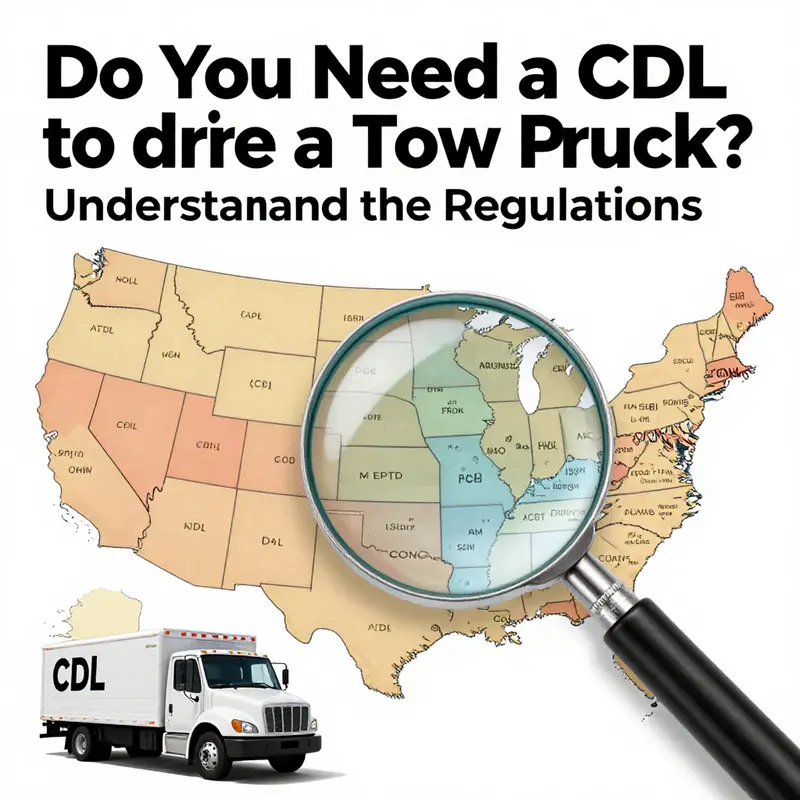
Tow trucks are among the most visible and time‑sensitive tools on the road. When a vehicle breaks down, a tow truck arrives under pressure, with lights flashing and a driver who must balance quick action with strict safety and legal standards. At the center of that balance sits a simple, sometimes overlooked question: do you need a CDL to operate a tow truck? The short answer, anchored in federal regulation, is yes in many cases. The longer answer, which matters to operators who move between counties or states, is that the exact licensing path depends on weight, configuration, and the state rules that apply where you drive. The federal baseline comes from the Federal Motor Carrier Safety Administration (FMCSA). If the tow truck itself has a Gross Vehicle Weight Rating (GVWR) of 26,001 pounds or more, or if the combined weight of the tow truck and the vehicle it tows exceeds 26,001 pounds, a Commercial Driver’s License (CDL) is required. This standard applies whether the work is done for a business, as part of a private service, or in an emergency response role. While this federal yardstick provides a critical framework, the practical licensing landscape grows more intricate once you step onto a particular state’s turf. States can tailor CDL classifications, endorsements, testing, medical requirements, and even background checks to fit local needs. The result is a patchwork where the same tow truck can trigger different requirements depending on where you operate. And when operators cross state lines, the overlap between interstate federal rules and intrastate state rules creates a new layer of complexity that must be understood to stay compliant and safe on the road. Across the country, a handful of core themes recur as drivers compare state expectations. First, the class of CDL required is not always uniform across all tow configurations. Some states treat a heavy tow truck as a Class B vehicle, while others classify it under a different framework based on how the vehicle is used or how it is configured for the towing operation. This matters because the class you hold determines not only what you can drive but what tests you must pass and what medical card you must carry. Second, endorsements—the added permissions embedded in a CDL—may or may not be required for tow work, and even when they are not common, they can appear in particular situations. The endgame for an operator who tows hazardous materials, even if only on occasional calls, is to be mindful of endorsements like “N” for tank vehicles or even “H” for hazardous materials. Those endorsements shape what loads you are legally allowed to haul and how you must credential yourself to haul them safely. Third, testing and training vary as much as the weather. Some states preserve a uniform, nationally aligned testing process for CDLs but add tow-specific practical skills tests to address the realities of hook‑ups, winching, brake systems, and handling a heavy vehicle in tight spaces. Others lean on general CDL testing with an expectation that employers provide hands-on training that aligns with the particular fleet’s equipment and procedures. Fourth, medical certification and driver fitness standards can diverge. The federal baseline requires medical certification, yet several states implement more stringent health evaluations, periodic rechecks, and sometimes additional vision or hearing criteria. Finally, background checks or motor vehicle record (MVR) reviews can differ in scope and depth. Some jurisdictions may require more robust checks for drivers operating heavy or specialized towing equipment, particularly if the work involves transporting passengers, hazardous loads, or routine operations across multiple districts. Taken together, these variances create a landscape where a driver who moves from one county to another may need a different document set, different endorsements, or a refreshed skill set to remain compliant. The prudent approach for any tow operator, therefore, is to anchor decisions in a two-part practice: first, verify the federal baseline and then confirm the exact state requirements where the vehicle is registered and operated. The DMV page for your state is the most reliable starting point, and most state agencies publish clear criteria on CDL classifications, endorsements, testing, medical criteria, and the process to obtain or upgrade a license. It is wise to cross-check these state resources with employer policies, especially if the company operates across multiple jurisdictions. Some fleets adopt internal standards that exceed legal minimums to simplify cross-state operations; those practices often promote safety, insurance credibility, and consistent training across drivers. In this context, a larger conversation about compliance and readiness emerges. Fleet operators who aim for consistent performance across diverse jurisdictions often benefit from aligning their training and documentation with broader industry standards. This is where a resource focused on fleet standardization and emergency readiness can play a valuable role. It provides a framework for ensuring that driver qualification, vehicle maintenance, and operational procedures stay synchronized as the regulatory environment shifts. For operators who want to explore these ideas in a practical, fleet-wide way, the accompanying guide on fleet standardization and emergency readiness offers guidance on how to translate broad regulatory concepts into everyday practice. See the linked resource for a centralized view of how readiness, training, and documentation interact across a fleet Fleet Standardization and Emergency Readiness. This connection helps frame licensing decisions not as isolated paperwork but as part of an integrated system that supports safe towing operations, consistent service delivery, and adaptability to changing rules. The real-world implications of state-by-state differences are tangible. A tow operator who works exclusively within a single state might become proficient at navigating that state’s unique rules, yet miss a subtle but critical difference when a move becomes interstate. Conversely, drivers who commonly cross borders can become fluent in the federal baseline, but still encounter friction when a state adds a more stringent medical standard or requires a specific endorsement that is not common elsewhere. The practical consequences go beyond paperwork. They influence scheduling, training budgets, and risk management. If endorsements are required for certain operations, drivers will need to pursue those endorsements, pass the associated tests, and carry the appropriate medical documentation to avoid delays on scene or penalties at weigh stations. If a state imposes additional testing for tow-specific skills, employers must integrate those requirements into their onboarding and ongoing training programs to maintain readiness. In the real world, the difference between a smooth call and a stalled response often comes down to how well a company and its drivers anticipate and respond to these regulatory nuances. That anticipation is not a matter of chasing every new rule but rather building a resilient foundation: a set of standard practices that align with the federal baseline while accommodating the state-specific variations. It means establishing clear, up-to-date checklists for CDL status, endorsements, and medical certification; maintaining meticulous records of all licensing and training; and ensuring that vehicle configurations and tow operations stay within the classifications defined by the relevant jurisdiction. It also means recognizing the limits of a single manual. When an operator is faced with a change of state rules—whether due to a move, a new assignment, or the expansion of fleet operations—the right instinct is to pause, consult the DMV, and confirm how the rules apply to the exact combination of tow truck and towed vehicle. The DMV website of the state in question is the authoritative source, but so too is the FMCSA’s central guidance, which outlines the baseline framework for CDL requirements and provides links to state resources. The FMCSA site can serve as a compass when you are comparing cross-state expectations, especially for operators who may consider interstate hauling or multi-jurisdictional service coverage. In practical terms, this means planning ahead: when you purchase a heavier tow truck, when your towing configurations change, or when you add a new service area, run an internal compliance check. Confirm the GVWR of the tow truck, the gross weight of typical towed loads, and the resulting classification that would be required under both federal and state rules. If the calculation suggests a CDL is required, map out the endorsement and testing pathway, and allocate time for training and medical certification to avoid last-minute delays. The goal is not to minimize paperwork but to minimize risk. A properly credentialed driver who understands the state-by-state contours of CDL requirements will be better prepared for urgent calls, safer on the roadway, and less susceptible to costly noncompliance penalties. In the end, the core truth remains simple: if you operate a tow truck under conditions that push the weight beyond 26,001 pounds, and you travel in a manner that engages a variety of state jurisdictions, you should pursue the CDL and relevant endorsements with a clear plan for ongoing compliance. If you stay within a single state, commit to mastering that state’s specific rules while maintaining awareness of the federal baseline. If you cross state lines often, build a crosswalk between the federal standard and each state’s nuances, and keep your documentation current so you can demonstrate readiness at a moment’s notice. The knowledge that compliance is a lived practice—embedded in training, recordkeeping, and day-to-day operations—transforms CDL requirements from a bureaucratic hurdle into a measurable component of professional towing. For further federal baseline guidance and state resource connections, consult the FMCSA’s official materials, which outline the general rules and link to state agencies. This approach helps ensure that every tow operator can deliver fast, safe service without risking regulatory missteps, even as state rules evolve. External resources such as the FMCSA site provide a central reference point to complement local DMV guidance and company policy. Access the federal framework here: FMCSA CDL Guidelines.
Final thoughts
Understanding whether a CDL is necessary to drive a tow truck is not just vital for compliance; it’s essential for operational safety and effectiveness. As regulations vary significantly by state and vehicle type, staying informed can help you navigate the complexities of towing. Whether you’re a local driver, auto repair shop, or property manager, knowing these requirements empowers you to make better choices—ensuring your towing operations are both legal and safe.