
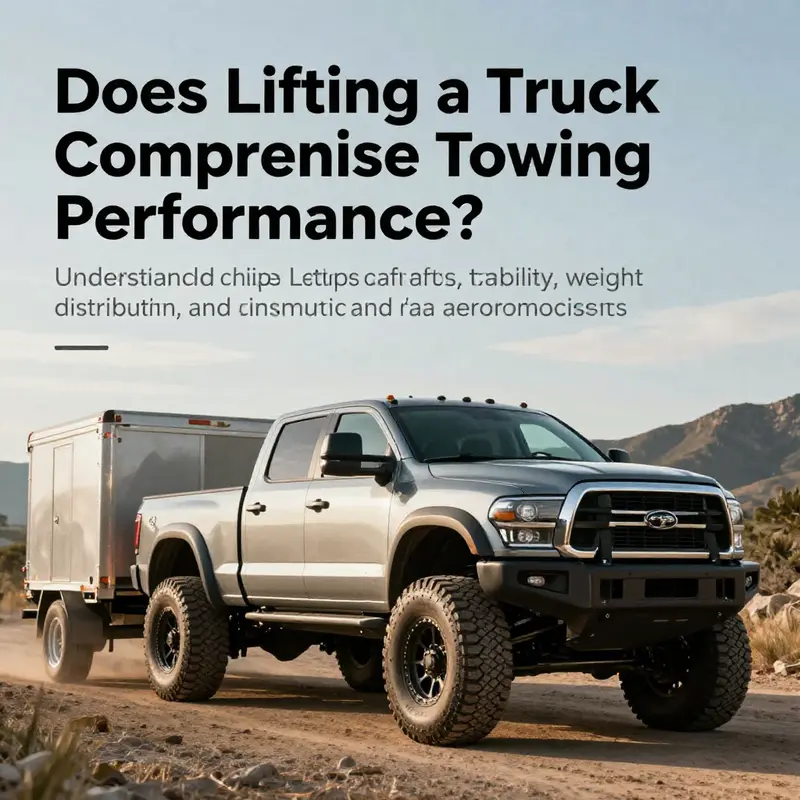
For many truck owners, lifting is more than just a trend—it’s a passion involving style, performance, and adventure. However, when it comes to towing, the ramifications of raising your truck are complex and significant. Elevated suspension alters fundamental characteristics of your vehicle, including its center of gravity, weight dynamics, and efficiency. In the following chapters, we will explore how these changes impact towing stability, the distribution of towing weight, and the aerodynamics involved, empowering you with essential knowledge for safe and effective towing.
Raised Rigs and Tow Hazards: Reassessing Stability When Lifting a Truck
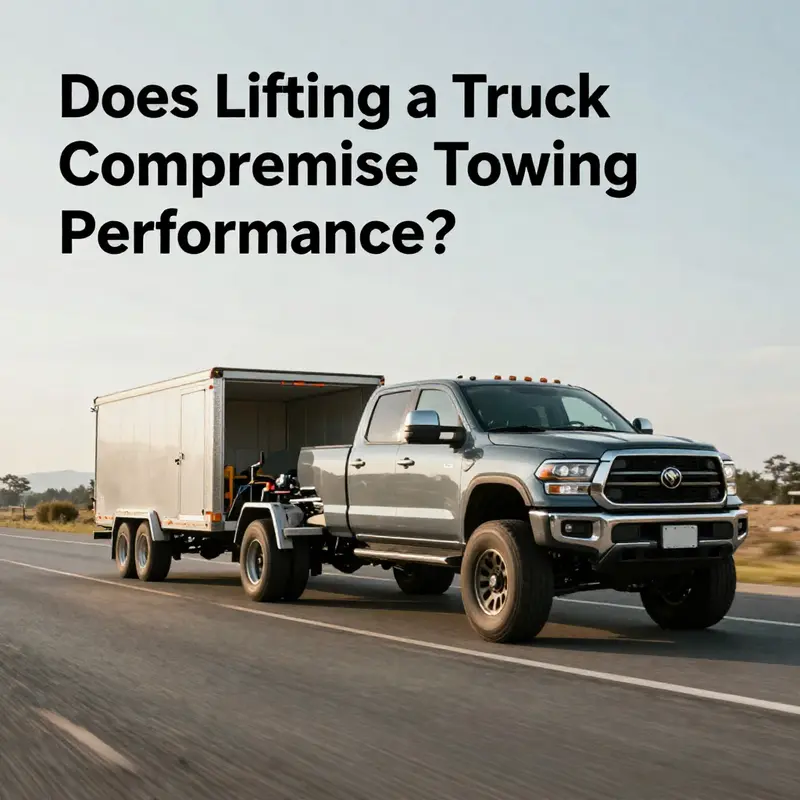
Raising a truck changes more than just its stance. It alters the physics of motion, the way weight shifts under load, and even how a vehicle communicates with a trailer behind it. When a truck sits higher off the ground, the center of gravity climbs as well. That simple fact—heightened center of gravity—begins a chain reaction that touches every aspect of towing, from steering feel at highway speeds to the likelihood of sway in gusty crosswinds and the sudden, destabilizing jolts of uneven pavement. To understand why lifting a truck can complicate towing, it helps to visualize how weight moves, how a trailer imposes different forces than a vehicle alone, and how even small changes in geometry can magnify risk on the road. The interplay of these factors is not merely academic; it translates into real-world safety margins, control authority, and, ultimately, the limits of what a given rig can tow safely when altered by a lift.
At the heart of towing stability is balance. Consider the vehicle, its trailer, and the road as a coupled system that must absorb bumps, wind, and steering inputs in a coordinated way. A lifted truck shifts the balance point upward. This elevation increases the pendulum effect of the trailer and, equally important, makes the truck themselves more susceptible to tipping moments during aggressive lane changes or evasive maneuvers. When the trailer is attached, the forces acting on the tow vehicle become more complex. The tongue weight—the downward force the trailer exerts on the hitch—interacts with the vehicle’s own weight and the dynamic load during motion. A higher ride height alters the leverage of that tongue weight and, in turn, the tendency of the combination to yaw or fishtail in adverse conditions. The resulting picture is one where even if the chassis, springs, and dampers are performing as designed, the fundamental geometry of the lifted configuration can erode the stability envelope that governs safe towing.
The center of gravity, a concept familiar to engineers and drivers alike, is not a single point but a distribution of mass that defines how a vehicle reacts to gravity, inertia, and road irregularities. When a truck is lifted, the vertical position of this mass rises. The consequences go beyond the obvious fact that the higher the cg, the easier it is for a vehicle to roll if the track tilts or if the driver makes a high-velocity change of direction. The roll moment created by wind gusts or the lateral pull of a passing truck or a heavy trailer can produce larger tilting moments when the cg is higher. The risk does not disappear at low speeds; it often becomes more pronounced on uneven surfaces where the suspension must absorb shocks while the trailer continues to push and pull on the hitch. In this context, the idea of roll stability becomes central. The higher the cg, the smaller the margin before the system enters a region where roll dynamics become unstable, particularly when paired with a loaded trailer that adds mass and length behind the vehicle’s rear axle.
There is a body of research that supports this mechanical intuition. In analyses of roll stability for trucks towing unsuspended trailers, surface roughness and dynamic loads are shown to erode stability margins significantly. The absence of suspension in such studies underscores how crucial a properly tuned suspension is to maintaining control. When a truck is lifted, the suspension geometry is altered in ways that can lessen the effectiveness of roll-stability enhancements found in modern systems. The practical takeaway is direct: the same advancements that help a stock truck manage sway and roll may be undermined if the vehicle’s fundamental geometry has been shifted through lifting. This is especially true when towing at higher speeds or when the towing configuration includes long, wide trailers that increase the moment arm and the lateral forces the tow vehicle must resist.
Suspension dynamics respond to more than a raised ride height. Lifting a vehicle typically changes camber, bump-stop positions, and the way load transfers across axles during steering, acceleration, and braking. A lifted configuration can aggravate the load transfer ratio (LTR)—the portion of load shifting from the axle to the tires and suspension as the vehicle negotiates turns and changes pitch. In practical terms, that means more weight may transfer to the outer tires during a turn, which can reduce the available traction at the inner tires and upset steering torque and feedback. If the suspension is tuned for a stock geometry, lifting can push it outside its optimal working range. At the same time, the static roll threshold (SRT)—the tilt angle a vehicle can tolerate before tipping—shrinks as the design assumptions built into the suspension are violated. In other words, the very limits engineers use to define safe operating areas are displaced when the rig’s height and geometry are altered without a compensating redesign.
This line of reasoning has clear implications for heavy-duty applications where stability is mission-critical. Rotator tow trucks and other industrial recovery vehicles are designed around low centers of gravity and strong, calculated weight distribution because their job is to maneuver heavy loads safely under demanding conditions. Lifting such a vehicle upends the very principles that these designs rely on, increasing the potential for accidents during towing or recovery tasks. The safety margins that allow a recovery operator to perform a lift-and-tow sequence in a controlled manner can be eroded if the vehicle’s lifted state does not receive accompanying adjustments to weight distribution, chassis stiffness, and control strategies. The general principle—raise the height, risk elevates—holds true across the spectrum of towing contexts, from routine trailer movement to complex recovery operations where precision and safety are non-negotiable.
The effect of a higher cg and altered suspension does not stop at steering and rollover risk. It also interacts with the drivetrain in ways that can affect towing efficiency and reliability. Lifting frequently changes the geometry of driveshafts and driveline angles. Even modest misalignment or increased U-joint angles can introduce vibrations, reduced efficiency, and added wear, all of which compound the cost of towing with a modified vehicle. The drivetrain is part of a tightly coupled system in which the engine, transmission, axles, and tires must operate in harmony with the suspension. When lift-induced geometry disrupts that harmony, the towing experience becomes less predictable. This is not merely a matter of comfort; it touches fuel economy, component longevity, and the risk of mechanical failure during long or demanding tow runs.
A further practical consideration concerns ground clearance and hitch geometry. Lifting a truck changes the relative position of the hitch and the bottom of the hitch area. It can reduce ground clearance under the hitch, making it easier for the hitch to encounter uneven terrain, driveways, driveway transitions, or off-road surfaces while pulling a trailer. When clearance is compromised, the likelihood of hitch contact increases, and with it the risk of hitch damage, trailer swaying, or uneven towing dynamics. Even if the lift is primarily cosmetic or for improved off-road appearance, the towing configuration introduces new constraints that must be addressed through careful assessment of hitch type, ball height, and tongue weight management. The practical implication is straightforward: the added height requires re-evaluating how the trailer is aligned with the tow vehicle, how the weight sits on the hitch, and how to manage the overall towing geometry to preserve stability and control on a wide range of road surfaces.
This is where the decision to lift should be weighed against the vehicle’s primary use. For some operators, towing remains a core function, and the preference for a lifted stance is tempered by the need for reliable, stable towing performance. In such cases, the prudent path often involves selecting lift kits that are engineered with towing in mind. These kits attempt to preserve or restore favorable weight distribution, maintain reasonable ground clearance at the hitch, and maintain steering and braking characteristics compatible with towing demands. Importantly, the engineering objective shifts from sheer height or aesthetics to a balanced combination of height, stiffness, and geometry that supports safe towing. It is a nuanced challenge because lift kits vary widely in how they affect suspension geometry, spring rates, and damping characteristics. A kit that lowers the center of gravity or one that preserves traditional suspension geometry while providing additional ground clearance can be more favorable for towing than a kit that simply raises the ride height without a comprehensive reconfiguration of the suspension and chassis dynamics.
Validation and testing become essential when modifications enter the towing domain. The analytical framework that underpins multibody dynamics models offers a powerful tool for predicting how a lifted truck will perform with a trailer under a spectrum of conditions, from calm highways to rough rural routes. Yet models are not substitutes for real-world testing. Simulations can guide design choices, but they must be complemented by physical tests that replicate towing scenarios. Only through a combination of both approaches can operators gauge how a lifted configuration affects roll stability, tire loading, steering behavior, and the overall handling envelope. Testing should examine not only steady-state towing but also how the system responds to dynamic events, such as lane changes, wind gusts, and sudden braking on uneven surfaces. The goal is to ensure that the modifications do not erode critical safety margins and that the vehicle continues to perform within acceptable limits when confronted with the demands of towing in daily operation or in recovery tasks.
For fleets and individuals who must balance capability with safety, there is value in looking beyond personal preferences and considering broader standards of practice. In the context of fleet management and emergency readiness, standardization and oversight play a central role in preventing unsafe configurations from proliferating. When a lift is contemplated, it is prudent to consult broader guidelines that emphasize consistency, reliability, and readiness for demanding scenarios. Fleet Standardization and Emergency Readiness highlights the importance of aligning modifications with fleet objectives, maintenance schedules, and operator training. This lens helps ensure that any lifting decision is weighed not only against towing performance in isolation but also against the collective needs of the fleet, including response readiness, maintenance overhead, and the potential warranty implications of aftermarket modifications. The message, in this sense, is clear: modifications should be integrated with a holistic view of operations and safety rather than pursued in isolation.
Beyond the engineering and fleet management considerations, the human factor remains central. A higher riding height can alter the feel of towing for the driver. Steering inputs may require greater anticipation, and the feedback through the steering wheel can change as load shifts during turns, braking, or lane changes. The driver’s situational awareness must extend to the engineered limits of the vehicle-trailer combination. Training that emphasizes how a lifted configuration behaves under various road conditions, the importance of maintaining appropriate speeds through curves, and the proper use of speed and braking to counteract any tendency toward sway becomes part of responsible operation. In practice, this often translates to choosing appropriate towing speeds, planning more conservative lane changes, and conducting longer-stopping-distance drills under supervised conditions. The takeaway is not to reject lifting outright but to embrace it with a structured approach that accounts for heightened roll risk, altered dynamics, and the realities of the road.
The decision to pursue a lifted truck for towing purposes should also consider the warranty and policy landscape surrounding aftermarket modifications. Many manufacturers reserve the right to void warranties if modifications are deemed to compromise the vehicle’s towing system or safety performance. While this is not an inevitability for every lift, it is a potential consequence that must be understood before a lift is installed. Additionally, some lift kits are not created with towing as a primary use case, which means they may not harmonize with the towing capacity rated by the manufacturer. The compatibility between the modified suspension, the towing package, the hitch, and the overall drivetrain must be validated to avoid a mismatch that could compromise safety or lead to unexpected mechanical failures during an important tow operation. In short, lifting a truck that is commonly used for towing requires a rigorous assessment of hardware compatibility, weight distribution management, and the ability to maintain control under critical towing scenarios.
From a research standpoint, the fundamental insight remains consistent: any modification that raises the center of gravity and disturbs the original weight distribution has the potential to degrade towing stability. The analytical and experimental investigations into roll stability for trucks towing unsuspended trailers anchor this conclusion in measurable terms. The evidence points to a clear caution: to maintain safe towing performance after lifting, operators should pursue a design and validation strategy that preserves or compensates for the factors that underpin stability. This means more than simply adjusting hitch height or adding anti-sway devices. It calls for an integrated approach that considers cg height, suspension geometry, weight distribution across axles, and the dynamic response of the entire vehicle-trailer system to real-world conditions. When such a comprehensive approach is employed, a lifted truck can still perform towing tasks with acceptable risk, but only if the modifications are harmonized with a holistic understanding of stability and control, and if they are validated through thoughtful testing and fleet-wide standards.
In sum, lifting a truck undeniably affects towing stability, with the center of gravity and suspension dynamics at the core of the changes. The implications ripple through handling, sway propensity, and the load-bearing behavior of the entire tow configuration. The practical path forward is clear and pragmatic: avoid lifting if towing is a primary use, or select lift configurations that are explicitly engineered with towing in mind. Pair those configurations with careful weight distribution strategies, appropriate hitching technology, and a disciplined testing protocol. And, when in doubt, consult the broader literature on roll stability and seek guidance from experienced engineers or professionals who can translate theory into safe, real-world practice. The road to safe towing in a lifted world is paved with careful design choices, comprehensive validation, and a willingness to adapt practices to the realities of vehicle geometry and road behavior.
For readers seeking additional empirical grounding, the ScienceDirect article on roll stability provides detailed analytical and experimental insights into how modifications like lifting can influence trucks towing unsuspended trailers. Access to this work offers a rigorous framework that complements the practical guidance offered here and helps frame future design and testing efforts in a way that prioritizes safety and reliability for towing operations. ScienceDirect article on roll stability.
Lifting the Load: How Raising a Vehicle Reframes Tow Weight Distribution
When a disabled vehicle is lifted off the ground by a rotator or lift, the weight distribution that once rested on four tires and two axles begins to move through the lifting system into the tow vehicle. The towed car becomes a suspended mass, and the center of gravity of the combined system shifts depending on lift height, boom angle, and where the load is attached. This alteration changes how much load sits on each axle of the tow truck, affecting steering, braking, and stability.
In practice, lift geometry and dynamic movements—from rotation to repositioning—drive the risk of overloading a single axle. Operators must assess the total suspended weight, verify attachment points, and plan the sequence of moves to keep the CG within a safe envelope. Multiaxle rotators help spread the load and provide greater stability; angle control and smooth, deliberate movements are essential to prevent sudden shifts.
Beyond the mechanics, heavy lifts require careful planning and adherence to standardized procedures. Outriggers, wheel chocks, and clear communication among team members prevent missteps that could amplify risk. The goal is to maintain control of the load path throughout lifting and moving, rather than relying on brute force. When properly planned and executed with appropriate equipment, lifting a vehicle can be performed safely, but the impact on axle loading and handling remains central to every decision on the scene.
Raising the Vehicle, Heightening the Stakes: Aerodynamics, Stability, and Towing in Lifted Trucks
Raising a truck changes more than the ride height; it shifts the whole physics of towing. In many fleets and with countless hobbyists alike, the impulse to lift a vehicle is driven by space, looks, or the belief that a bigger stance translates into better off-road capability. Yet when that lifted frame meets a trailer badly in need of being towed, the routine act of hitching and hauling becomes a study in high-stakes aerodynamics, balance, and mechanical strain. This chapter threads the practical implications of lifting a truck through the lens of towing performance, emphasizing how center of gravity, weight distribution, and airflow interact with the demands of pulling a load. It is not a downtrodden warning against modification but a sober, engineering-informed map of what actually changes when a truck stands taller and yet is asked to move a trailer with precision and reliability.
Even before the first mile of towing, the most conspicuous change is ground clearance. A lifted truck situates the chassis higher above the road, a design choice celebrated by enthusiasts for improved approach angles and rock-crawling capability. But the same height that helps clear rough terrain also alters the air flow surrounding the vehicle. The part of the truck that previously carved a relatively smooth wake now disrupts airflow in ways that are more pronounced at the back of the vehicle, especially when a trailer lingers behind. The underbody, once tucked away from direct contact with crosswinds and road surfaces, becomes a wider conduit for turbulence. This is not a cosmetic adjustment; it means the air that would otherwise negotiate a predictable path around the chassis now interacts with protrusions and a different underside geometry. The resulting turbulence inevitably increases drag, and with it, the energy the engine must supply to maintain highway speed, particularly when towing uphill or into gusting winds.
Drag is not merely an abstract percent in a spec sheet. It translates into real fuel consumption, longer trip times, and higher operating costs over the lifetime of a towing job. When the truck is stationary, you might assume the drag penalty disappears once you’re moving a trailer, but the two systems share energy budgets. A lifted frame draws more power to sustain the same speed with a given trailer in tow. This is because the lift modifies the vehicle’s frontal area and the rearward wake, which increases the form drag component. The consequence shows up in the lower efficiency of the powertrain, particularly evident in city towing or long highway hauls where steady-state power is essential for maintaining speed and stability.
Stability follows as a close second, because the dynamic behavior of a towed load is strongly dependent on the host vehicle’s geometry. The taller the truck, the greater its cross-sectional area that confronts wind. In crosswinds, a lifted vehicle experiences greater yaw moments that can transfer energy to the trailer. The trailer itself can amplify sway if weight distribution is off or if hitch geometry does not compensate for the altered lever arms created by a higher hitch point. Sway contributes to driver workload and, more importantly, to safety margins. When a trailer begins to wander, small steering corrections can become big, reactive inputs that risk a loss of control. The increased drag compounds this risk by magnifying gust-driven forces on the truck and trailer both. Even in calm conditions, the altered downforce distribution on a lifted chassis can influence tire grip and braking responsiveness if the vehicle has to slow down suddenly due to traffic or terrain.
The relationship between lift height and stability is not linear. A mild lift may have modest effects, while a substantial lift can produce noticeable changes in yaw stability and trailer tracking. The driver’s sense of control—the feel through the steering wheel, the way the trailer tracks behind, how quickly the combination responds to lane changes—changes with the vehicle’s height. The root causes are twofold. First, the center of gravity typically rises with a suspension lift. A higher CG height makes the system more prone to roll tendencies during cornering or evasive maneuvers when towing. Second, the location of the hitch relative to the trailer’s tongue weight shifts the leverage that the trailer exerts on the truck. If the tongue weight remains within recommended ranges but the hitch height changes in ways that alter the tongue angle, the trailer can ride with a less than ideal angle, which can increase vertical forces and create a subtle but cumulative drag mismatch. In practical terms, this means more careful attention to weight distribution between the trailer and the tow vehicle when a lift is installed.
The ride height also interacts with ground clearance in ways that may surprise owners. Lifts can inadvertently reduce clearance near the hitch area when a vehicle traverses uneven pavement, potholes, or driveway ramps while towing. Although the chassis is higher, the geometry of the rear portion can create a shallow clearance at critical points where the trailer’s hitch and the truck’s rear frame meet the ground. The potential for contact with uneven terrain increases the probability of hitch damage, trailer hitch components, and the undercarriage of the towing setup. In turn, such contact carries immediate risks—jolt-induced trailer sway or misalignment, which can quickly escalate into a hazardous situation in traffic. This is not merely a mechanical concern; it is a safety issue that underscores why many operators weigh the towing needs against the lift’s benefits.
Beyond the immediate dynamics of air and ground, there is the matter of drivetrain alignment and component stress. A lift often changes the angles of driveshafts, axles, and U-joints. These angle changes can magnify wear, particularly when towing heavy loads or when the vehicle pursues sustained high torque to maintain speed up grades. The driveshaft, for instance, must accommodate altered operating angles; if the angle exceeds what the drivetrain was designed to handle, premature wear or vibration can occur. Differential mounting and pinion angles are other focal points. The increased rear height can shift pinion angles in ways that demand compensating geometry in the axle housing or transmission output. Over time, such misalignments—if left unchecked—can lead to vibration, noise, and ultimately increased maintenance costs. The diagnostic footprint is not always immediate; the costs accumulate as the vehicle endures more towing cycles, each one applying additional stress to components that may already be near their limits for a given configuration.
Weight distribution plays a central role in towing performance with a lifted truck. A typical tongue weight target on a properly loaded trailer remains anchored to the trailer’s load and the hitch’s design. If a lifted truck’s hitch height is raised significantly, the angle at which the trailer’s tongue contacts the hitch changes. In practical terms, this can alter the way weight is transferred to the truck’s rear axle. The rear axle bears more than the obvious payload; it also carries aerodynamic loads and dynamic tire forces that are amplified by the higher hitch line. If the tongue weight is insufficient relative to the trailer’s gross weight, the rear of the truck can squat less than ideal, the trailer can push the tail of the truck around, and steering responsiveness can degrade. Conversely, if tongue weight is excessive or poorly distributed, the added load can overstrain rear suspension components and reduce ride quality. This balancing act clarifies why simply lifting a vehicle without recalibrating suspension tuning, hitch geometry, and load distribution strategies is rarely a recipe for seamless towing.
From a maintenance and warranty perspective, modifications that introduce a lift can complicate the relationship with the vehicle’s factory specifications. Many manufacturers clearly state that heavy modifications, including suspension lifts, can influence towing capacity and may void portions of the warranty related to towing systems and driveline components. The absence of factory guarantee coverage, when paired with the heightened stresses of towing, creates a layered risk profile. For fleet operators or commercial users, this means additional risk assessment before deciding to lift a vehicle that will routinely tow. The decision is not simply about whether the lift is aesthetically pleasing or functionally beneficial for off-road work; it is about whether the towing role remains within the redesigned vehicle’s safe envelope given the new geometry and load profiles. Operators must weigh whether the lift’s advantages in approach/departure angles or off-road clearance truly justify the added complexity of ensuring safe, efficient towing.
A key takeaway from the aerodynamic and towing performance lens is that lift kits are not universally designed with towing in mind. Some lifting components may offer handling gains in specific conditions, but many standard lifts were developed with off-road travel as the primary objective. That mismatch means standard lifts can leave a towing system suboptimal or even unsafe without careful integration work. In practice, this translates into a recommended approach: if towing is a primary use case, either avoid a lift or opt for a kit that is specifically engineered to address towing needs. The engineering ecosystem around lifted trucks has begun to incorporate considerations such as weight-distribution optimization, compatible hitch geometry, and aerodynamic adjustments in the design of more towing-conscious lift solutions. Without these refinements, a lifted truck’s performance when towing will be shadowed by higher drag, reduced stability margins, and increased component wear.
The literature and field experiments suggest an interesting dual path forward for those who wish to lift while still towing effectively. On one side, there is relentless work toward aerodynamic optimization for lifted configurations. Even if the baseline lift does not incorporate the full spectrum of aerodynamic refinements, there is increasing emphasis on undercarriage shaping and rear-end treatments to manage the wake behind the vehicle. The aim is to reduce drag penalties borne by the lifted chassis while preserving the geometry that provides off-road capability. While a dramatic drag reduction may not be achievable across all lift designs, modest gains can be realized with careful attention to airflow management, smoother underbody panels, and wake-friendly geometries at the rear. On the other side, there is a trend toward towing-focused kit options that add versatility: better weight distribution strategies, hitch-height compensation, and suspension components tuned to handle trailer loads more predictably. These advances acknowledge that lifting and towing are not mutually exclusive, but they require a considered design approach that aligns lift intent with towing safety and efficiency.
From a practical viewpoint, the core questions revolve around how much more fuel you are willing to burn to preserve the lift you desire and how much risk you are willing to accept in exchange. If a vehicle is not intended for frequent long-haul towing with a trailer in tow, lifting may be more compatible with occasional towing in moderate conditions. However, when the mission calls for reliability, repeated towing, and a predictable fuel budget, the math often points away from substantial lifts. It is possible to strike a balance: a moderate lift paired with an appropriately engineered towing package, careful tongue-weight management, and periodic alignment checks can offer a reasonable compromise. The objective is a towing operation whose performance reflects the vehicle’s core capabilities without exposing the operator to excessive drag penalties, stability risks, or unexpected mechanical wear.
The deeper engineering takeaway emerges when considering the broader operational context. For a lifted truck to tow effectively, the system must be understood as an integrated whole: the air around the vehicle, the hitch and trailer geometry, the weight distribution on both ends, the drivetrain angles, and the thermal and mechanical stresses that accumulate over hours of operation. Each piece influences the others. A marginal improvement in one area, such as slightly better airflow near the rear or a more favorable hitch angle, can yield meaningful benefits in stability or fuel economy when tethered to a trailer. Conversely, a large lift with no corresponding adjustments to these connected subsystems can magnify aerodynamic penalties and destabilize the overall towing dynamics. This interconnected view clarifies why the decision to lift is rarely about a single performance metric but about an ecosystem of attributes that determines whether a lifted truck can tow safely, efficiently, and predictably.
For fleets that must balance readiness with performance, the question often becomes one of process: what steps can be taken to minimize the towing penalties of a lift? The answer lies in an integrated approach. First, assess the trailer profile and tongue weight in relation to the lifted truck’s new geometry. Second, ensure the hitch system and suspension work in harmony with that profile, including revisiting suspension damping and anti-sway considerations when feasible. Third, invest in aerodynamic refinements that specifically address the lifted configuration, particularly underbody shaping and rear-end wake management where possible. Fourth, maintain rigorous maintenance routines for the drivetrain, driveshaft angles, and steering linkages to minimize wear that could otherwise be accelerated by higher operating angles. Finally, educate operators about the new dynamics—how wind, speed, and road grade interact with a lifted tow—and provide training for handling sway and stability challenges in a controlled environment before tackling real-world towing tasks.
In this context, the social and logistical side of towing with a lifted truck matters. For fleets engaged in emergency response or service operations, the ability to reach a scene quickly with essential equipment is non-negotiable. The towing considerations described here are not merely academic; they translate to response times, reliability, and safety on the road. For fleets that rely on rapid deployment, it may be prudent to align vehicle configurations with mission-critical demands by adopting a towing-focused approach to lifting. In those cases, the policy surface includes weight distribution standards, hitch compatibility, and a disciplined maintenance program designed to keep the towing system within its safe operating envelope even when the vehicle’s stance has been altered.
To connect this discussion to practical planning and broader industry considerations, observe how fleet operators and individual users approach lifting in contexts where towing is common. The decision-making process often involves a trade-off analysis: what is gained in off-road capability and ground clearance versus what is sacrificed in towing economy and stability? How much does the lifting configuration alter the lifecycle cost of the vehicle, including fuel, wear, and potential warranty implications? The answers depend on the specifics of the lift height, the trailer’s weight and tongue geometry, the typical travel speed and terrain, and the maintenance discipline of the operator. In short, lifting a truck changes the towing equation, but with careful engineering, thoughtful weight management, and disciplined maintenance, it is possible to preserve towing reliability while still enjoying the lifted look and enhanced off-road performance.
The result, then, is not a universal decree against lifting for anyone who tows. It is a clear set of guidelines for integrating lift into a towing plan. If towing is a primary use case, many operators will find that the best path involves either avoiding a drastic lift or selecting a lift solution that explicitly accounts for towing needs. The focus shifts to aligning chassis geometry with trailer dynamics, ensuring the hitch height complements rather than complicates tongue-weight management, and deploying aerodynamic refinements that reduce drag without compromising the vehicle’s utility. It also means recognizing that real-world performance hinges on a holistic view of vehicle dynamics, where air, road, weight, and mechanics interact continuously. When treated as an interdependent system, lifted trucks can tow with a reliability that meets or exceeds user expectations under a wide range of conditions, provided that the lift is thoughtfully designed and expertly maintained.
This chapter, grounded in the understanding that aerodynamics and towing are inseparable in lifted trucks, closes with a practical reminder. For fleet managers and individual operators alike, the decision to lift should be anchored in a clear assessment of towing needs, a plan for weight distribution and hitching, and a commitment to maintenance and training that keeps the vehicle’s new geometry within safe, efficient bounds. In many cases, that means prioritizing towing efficiency and stability alongside off-road capability, and choosing lift configurations that explicitly facilitate both goals rather than treating them as separate, competing priorities. The framing of this issue in terms of air flow, center of gravity, and load management helps illuminate why some lifted setups perform robustly when towing, while others struggle to deliver the same level of predictability and efficiency. The underlying message remains consistent: lifting a truck changes the towing equation, and success lies in designing and operating the system as an integrated whole rather than as a collection of individual enhancements.
For readers who wish to see how these ideas translate into fleet-level considerations and emergency-response readiness, consider the broader operational guidance available at industry-focused resources. The handling, maintenance, and planning steps outlined here echo the practical attitudes found in fleets that must balance rapid response with safety and efficiency. In that spirit, the interplay between lift height, aerodynamic shaping, and towing stability becomes not just a mechanical concern but a cornerstone of dependable, mission-ready vehicle performance. This is the broader context in which lift becomes a decision about capability, reliability, and cost, rather than a mere aesthetic upgrade. By grounding lifting choices in towing realities, operators can maintain momentum on the road while keeping fuel costs, brake temperatures, tire wear, and driver workload within predictable bounds.
Internal reference for fleet operations and emergency readiness: Fleets Emergency Response. This resource provides a practical lens through which to view the implications of lift on towing in high-stakes environments, illustrating how the theoretical dynamics discussed here play out in real-world service and response scenarios.
As a closing note, the literature and evolving engineering practice suggest a constructive path forward for lifting with towing in mind. Aerodynamic improvements, even if incremental, can meaningfully offset drag penalties when paired with lift. And when alignment between lift design and towing requirements is achieved, the vehicle behaves with steadier tracking, more predictable trailer response, and a more resilient overall system. The dialogue between lift height and towing performance is ongoing, with researchers and practitioners continually refining the vocabulary and the tools we use to quantify and optimize the interaction between a lifted chassis and a towed load. In that sense, lifting a truck remains a dynamic design challenge—one that invites thoughtful engineering, disciplined operation, and a clear-eyed view of how air, weight, and motion come together on the road.
External reference for aerodynamic context and lifting surface forces: https://doi.org/10.1115/1.3261487
Final thoughts
Understanding how lifting affects a truck’s towing performance is crucial for safety and efficiency. Elevated suspension can lead to increased sway, altered weight distribution, and reduced aerodynamics, all of which can compromise your towing experience. If you prioritize towing in your truck usage, consider carefully whether lifting is the right choice for your needs. For those determined to lift, choosing a specialized lift kit designed for towing can mitigate some of these risks, ensuring a safer and more efficient towing experience.