
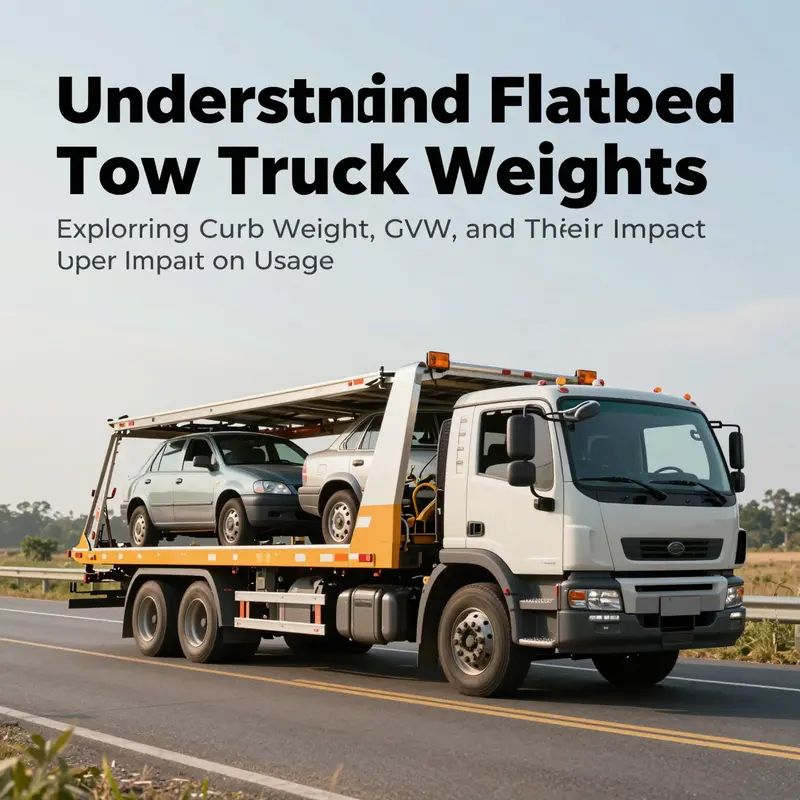
Flatbed tow trucks play a vital role in roadside assistance, vehicle recovery, and auto transport. Knowing how much they weigh is essential for various stakeholders, from local drivers needing towing services to property managers handling parking enforcement. This article explores the weight distinctions between curb weight and gross vehicle weight (GVW), highlights the variations among different tow truck models, discusses their importance in usage, and examines regulatory implications based on weight specifications. Understanding these factors equips individuals and businesses with the knowledge to make informed decisions regarding towing services and compliance.
Weight on the Bed: Reading Curb Weight, GVW, and What Flatbed Tow Trucks Really Carry
The simplest question about a flatbed tow truck—how much does it weigh?—unlocks a much more intricate conversation about design intent, safety, and real-world performance. Weight on a flatbed is not a single fixed figure; it’s the result of a careful balance between the chassis, the bed, the winching and recovery hardware, and the payload it is designed to carry. To understand what a flatbed tow truck can and cannot carry, it helps to start with two essential metrics that every operator and inspector relies on: curb weight and gross vehicle weight, commonly written as GVW or GVWR in manufacturer data. Curb weight is the truck in its standard state, with all the regular equipment, fluids, and a full tank of fuel, but without any load on the bed beyond the truck’s own components. GVW, on the other hand, marks the maximum permissible weight of the vehicle in operation, including all passengers, tools, fluids, and any payload carried by the truck. When a flatbed carries a vehicle on its bed, that towed vehicle’s weight becomes part of the truck’s payload and must be considered within the GVW limit. In plain terms, curb weight plus the weight of everything loaded on or in the truck defines the maximum safe operating weight. If you load a heavy car onto the bed, you are pushing the vehicle closer to its GVW rating.
The data landscape around these weights is broad. Some published figures point to curb weights as low as roughly 2,400 kilograms for lighter configurations and up to about 5,500 kilograms for heavier, more feature-rich designs. The corresponding GVW values can vary widely as well, with some sources showing GVW figures that stay in the mid four-to-five-ton range for standard-duty configurations and others reporting much higher numbers—up to around 8,000 kilograms or more—for heavier-duty, specialized tow trucks. This spread reflects real differences in chassis design, intended use, and the degree of equipment installed on the truck. It also underscores why operators must consult official technical documentation for any specific unit rather than assuming a universal payload capacity based on a generic category.
Consider the practical implications of these numbers in the field. A five-ton flatbed road recovery unit, for example, might exhibit a curb weight approaching 5,500 kilograms, indicating a substantial baseline mass even before any recovery gear is attached or a vehicle is loaded on the bed. On the other hand, a lighter four-ton class unit could show a curb weight around 4,100 kilograms, with a GVW that remains in the neighborhood of 4,500 kilograms. Such figures imply a payload margin of only a few hundred kilograms if the GVW numbers are interpreted strictly as the maximum weight the truck can legally carry on the road, including all load-bearing components and occupant weight. Yet another configuration might present a curb weight somewhere in the mid-5,000-kilogram range, paired with an GVW figure that climbs toward or beyond 8,000 kilograms for heavy-duty tasks and equipment loads. These examples illuminate a simple truth: weight in this sector is not a single line but a spectrum defined by chassis strength, bed construction, winching capacity, hydraulics, safety systems, and the heavy beef of the recovery gear. In this sense, the weight figures are less about a universal standard and more about the precise capability profile a given unit is designed to deliver.
Within this spectrum, a few representative touchpoints from diverse configurations help anchor the discussion. One instance describes a five-ton flatbed road recovery truck with a curb weight near 5,495 kilograms. This designation, often labeled in the public materials as a “5-ton” class, signals a substantial mass even before any payload is added. Then there is a four-ton class that presents a curb weight around 4,100 kilograms and an GVW that some sources list as 4,495 kilograms. The gap between curb weight and GVW in this example is relatively small, which means the truck’s payload allowance is modest. But even with a smaller payload, the situational usefulness of the unit arises from other design features—such as the strength of the bed, the capacity of the winch, and the stability of the overall platform during lifting and loading operations.
There are also cases that illustrate the upper end of the spectrum. A general flatbed wrecker might be cited with a curb weight around 5,250 kilograms and a GVW rated up to about 8,270 kilograms. That combination points to a machine built to handle not only heavier loads on the bed but also more robust recovery duties, potentially including heavier tow targets, more demanding terrain, or longer, more challenging recoveries where extra ballast and stronger driveline components are beneficial. In such configurations, the additional weight carried by the truck when it is loaded—whether in the form of extra fuel, ballast, or heavy-duty hydraulics and support gear—contributes to a higher GVW, enabling the unit to perform more intensive tasks with greater margin for safety. The takeaway is not that one weight is inherently superior, but that weight is a function of purpose: a unit designed for lighter, quick-response recovery will carry a different weight profile than a unit built for rugged, long-haul, multi-vehicle recoveries.
Alongside these examples, other data points provide additional nuance. A 4×2 light-to-midweight configuration with a 130 horsepower engine and a flatbed designed for four-ton operations might show a curb weight of around 4,100 kilograms and a GVW of roughly 4,495 kilograms. While the delta between curb weight and GVW appears narrow in this case, the actual payload capacity—the portion of the GVW available for the towed vehicle—depends on how a given operator configures the truck, including whether any additional ballast or heavy cab equipment is installed and how much fuel and other fluids the vehicle carries on a typical shift. Similarly, an example of a heavier, more robust 4×2 or 4×4 design could push curb weights toward 5,000 kilograms, with GVW values that make it feasible to load larger or heavier vehicles. These are not rigid ceilings; they are limits that the manufacturer defines to ensure performance, braking, steering, and overall stability stay within safe and reliable bounds.
The take-home message from these weight figures is simple, yet essential: the numbers you see for curb weight and GVW reflect the design envelope of the truck. The curb weight tells you how much the truck itself contributes to mass, while the GVW tells you how much weight the entire system can safely bear in operation, including the load on the bed and any interior occupants, tools, or ancillary equipment carried by the vehicle. When a towed vehicle sits on the flatbed, its weight is part of the payload counted against the GVW. If you’re evaluating whether a particular tow job is within a unit’s safe operating range, you subtract the curb weight from the GVW to estimate the available payload and then ensure that the towed vehicle’s weight plus any additional load does not exceed that payload capacity. Of course, in practice, you also must account for dynamic factors in the real world—tilt angles of loading ramps, the center of gravity of the loaded vehicle, and the weight distribution across the bed—that can affect stability and braking performance. These are not merely academic concerns; they translate into braking distances, cornering behavior, and the risk profile of every recovery operation.
The numbers also invite a practical caution: never rely on a single published figure as the sole basis for planning a recovery. Different configurations within the same class can vary by hundreds of kilograms. Heavier equipment, stronger hydraulics, more robust side rails, or a longer bed add significant mass. An operator choosing a truck for a particular duty cycle must weigh the benefits of added capability against the corresponding impact on payload margins and fuel efficiency. It is precisely this trade-off that makes the weight conversation so central to the daily life of a tow operator. When a fleet manager evaluates a potential new acquirement or a used unit, they weigh curb weight, GVW, and the implied payload against the typical vehicle mix they expect to encounter, the distance of the recoveries, and the climates in which the fleet will operate. This balancing act is not abstract; it informs maintenance scheduling, driver training, and even regulatory compliance, since vehicle weight interacts with road-legal limits, axle loads, and braking requirements.
For readers who want to explore broader fleet considerations—standardization, maintenance readiness, and emergency response practices—there is value in linking these weight considerations to the larger ecosystem of heavy-duty operations. A useful resource that discusses fleet standardization and emergency readiness can provide context for how weight planning fits into broader operational protocols. In particular, one can consult industry discussions that examine how weight and equipment decisions cascade into maintenance cycles, parts availability, and response readiness. This broader view helps translate the numbers into action on the ground, where every pound on the bed has implications for speed, safety, and service reliability. For further reading and practical context, see the Santa Maria Tow Truck blog, which covers a range of topics from standardization to emergency readiness, and illustrates how weight considerations integrate with real-world towing operations.
In sum, there is no universal weight figure that fits every flatbed tow truck. The spectrum—from roughly 2,400 kilograms up to and beyond 5,500 kilograms in curb weight, and from a few thousand kilograms to well over eight metric tons in GVW—reflects the diversity of chassis, bed designs, recovery gear, and intended tasks. The numbers you see in catalogs or on data sheets are signposts, not guarantees. They point you toward the operator’s true payload capacity and the truck’s performance envelope, but the only reliable way to confirm what a specific unit can safely carry is to consult official manufacturer specifications and to test within the limits defined by those specifications. For those who manage fleets or plan recoveries in variable conditions, this means treating weight as a live parameter—one that interacts with road conditions, weather, tire selection, braking systems, and driver skill to determine the safety and efficiency of every tow operation. And because the job of a flatbed tow truck is to recover and transport, often under pressure, keeping a clear understanding of curb weight, GVW, and payload isn’t merely academic; it is an operational necessity that protects people, vehicles, and the equipment that makes the work possible.
External resource: https://www.foton.com.cn/en/
Weighing the Spectrum: How Flatbed Tow Trucks Vary in Weight Across Models, Chassis, and Design

Weight is more than a number when you’re planning a flatbed tow operation. It is a defining constraint that shapes what a truck can lift, how it performs on the road, and what kind of licensing or regulatory compliance may be required in a given jurisdiction. The core truth is simple: flatbed tow trucks do not come in a single, uniform weight category. They span a broad spectrum, driven by differences in chassis, payload capacity, frame length, bed design, and the intended tasks they are built to perform. To understand how much a flatbed tow truck weighs—and, crucially, what that weight means for practical use—it’s essential to distinguish between two fundamental measurements and to see how these numbers shift across different market segments. The curb weight tells us what the truck weighs empty, yet fully provisioned with standard equipment, fluids, and a full tank of fuel. The Gross Vehicle Weight, or GVW, matters when the truck is loaded to capacity, including passengers, equipment, and, most importantly, the vehicle or load it is authorized to tow. In the broader sense, weight informs safety margins, fuel economy, road handling, and maintenance needs. It also offers a window into the deeper question behind the subtopic: variability. Across manufacturers and models, the curb weight and GVW can diverge substantially, reflecting the choices in chassis construction, axle configurations, bed mechanisms, and auxiliary heavy-lift systems that professional operators rely on during real-world recoveries. When we parse the numbers, a pattern emerges: weight scales with function, not just with size. A lighter, fleet-focused flatbed is built to move quickly, navigate urban streets, and perform routine towing tasks with efficiency. A mid-range unit is designed to balance weight and capacity for average road recovery, accident scene management, and multi-vehicle operations. The heaviest designs are engineered for high-load scenarios—construction fleets, bus or large truck recoveries, and other demanding jobs—where lifting gear, wheel-lift capacities, and specialized stabilization systems drive up mass as a necessary prerequisite for performance. And yet, even within these broad bands, the exact weight rests on a set of choices made in the design room: how robust the chassis must be to withstand torsional loads, how long the bed should be to accommodate different wheelbases, how the bed tilt or slide mechanism is implemented, and how much safety equipment is integrated into the frame to protect the operator and the towed vehicle.
From the data that practitioners often consult, curb weights can span roughly from the low 2,000 kilograms, through a mid-range zone around 3,000 to 4,000 kilograms, and up into the five-thousand-kilogram class for heavier duty configurations. GVWs can extend well beyond the curb weight, reaching into the upper single digits in thousands of kilograms when maximum payload and towing capacity are pressed to the limit. These figures are not arbitrary. They reflect the design philosophy that underpins each model: the curb weight represents the platform’s baseline, while the GVW embodies its ultimate working envelope. The same logic applies across markets where regional regulations, axle loads, and highway safety standards shape the final numbers. Yet in practice, the exact curb weight and GVW a given model will present in the field depends on several intertwined factors. The first and most obvious factor is the chassis. Flatbed tow trucks are built on varied chassis architectures, ranging from light-duty frames optimized for nimble handling and fuel efficiency to heavy-duty, reinforced platforms designed to carry substantial loads and to withstand demanding operating conditions. The chassis selection informs not only how much weight the vehicle can safely support but also how the weight is distributed across axles. A longer wheelbase can stabilize the bed during loading and lifting, but it tends to increase curb weight due to a longer frame and more material in play. A heavier-duty axle arrangement, with beefier housings and higher-rated bearings, adds mass while expanding the potential payload and towing capacity. In many configurations, the aggressive reinforcement required for wheel-lift systems, if included, is a substantial contributor to GVW. The second driver of weight is the bed design and the loading mechanism. Flatbeds can be partially inclined, roll-back, or fully fixed. A partially inclined bed—where the bed tilts and lifts to assist with loading—often adds mechanical complexity, alongside hydraulic pumps, winches, and rear-support structures. A rollback or sliding-bed design, which tilts backward and slides along rails to meet the ground, enhances loading ease and reduces drivetrain stress during towing but introduces additional hydraulic components and rollers, all of which contribute to curb weight and GVW. The third factor is the payload-related equipment installed alongside the bed. Tow trucks frequently house a suite of stabilization devices, winches with different lift capacities, wheel-lift attachments, and recovery gear. Each bolt, hydraulic accumulator, or rope adds weight. The fourth factor is the inclusion of specialized lifting and stabilization gear whose capacities are defined not merely by the lifting power but also by its integration with the chassis and bed. A unit designed to tackle heavier loads—heavy-duty or multi-vehicle recovery—will often incorporate heavy hydraulic systems, robust undercarriage protection, and high-capacity lifting mechanisms. This combination naturally drives GVW higher, sometimes dramatically, but it also expands the operational envelope.
Putting these design realities into a practical frame, we see a widely accepted taxonomy emerge. Light-duty flatbed tow trucks, typically intended for routine towing or fleet maintenance and often built on compact chassis, tend to offer payload capacities near the three-ton mark. These models emphasize compactness, ease of maneuverability, and efficient fuel consumption, making them well-suited for urban environments, quick-response calls, and standard vehicle recoveries where heavy lift isn’t required. Their curb weights cluster in the moderate 2,100 to 3,000 kilogram range, with GVWs that hover around the same ballpark plus a practical margin for a few passengers and minimal specialized equipment. Medium-duty models strike a balance. They occupy roughly the four-to-six-ton payload region, which translates into GVWs that commonly sit in the 6,000 to 8,000 kilogram range. These are the versatile workhorses in many fleets, capable of handling a wider variety of vehicles and incidents while still keeping a manageable footprint on the road and in the shop. The heavy-duty category, meanwhile, is built to handle demanding scenarios. Here GVWs often exceed eight tons, and the total curb weight may cross the five-ton threshold depending on the exact configuration. This class typically features high-capacity beds, stronger frame rails, and lift systems capable of managing larger vehicles, buses, or industrial equipment. In such configurations, the bed and chassis must be engineered to resist the combined effects of high loading, long operating hours, and the stress of frequent loading and unloading in challenging environments. The result is a heavier platform that demands more robust maintenance, more careful planning, and a different set of operational considerations.
Even within each category, variability persists. Two light-duty units may differ in curb weight by several hundred kilograms due to differences in bed length, the presence or absence of auxiliary tools, and the degree to which a vehicle’s standard equipment is loaded. A light-duty model with a shorter bed and minimal ballast might have a curb weight near 2,500 kilograms, while a counterpart with a longer bed and extra stabilization gear could be closer to 3,000 kilograms. The same kind of dispersion exists in the heavier segments, where the inclusion of more extensive wheel-lift systems, larger hydraulic pumps, and reinforced chassis components can push GVW well into the eight- and nine-thousand-kilogram territory. This is not just a matter of raw heft; it is a reflection of the performance envelope operators need. A heavier platform does not automatically translate to better outcomes in every situation. The extra mass can broadly affect fuel economy, accelerating wear on tires and brakes, and requiring more careful planning around loading, maintenance intervals, and licensing. In practice, fleet managers weigh these trade-offs against the demands of their most common recovery scenarios. If the job routinely involves heavy vehicles or asset-intensive operations, investing in a heavier, more capable unit may yield dividends in reliability and safety. If the job is more typical of city streets, an agile, lighter platform might reduce operating costs and improve response times without sacrificing essential capability.
Beyond the broad categories and the mechanical logic, design choices within a given model line also shape weight in subtle—but important—ways. Some flatbeds incorporate a partially inclined bed with a rear-mounted hoist or winch system. This configuration supports hoist-assisted loading, lifting the front or rear wheels just enough to minimize drivetrain stress during transport. The weight penalty for that convenience is borne by hydraulic components, additional actuators, and the structural reinforcement required to manage the torque and load transfer. Other models use a rollback or sliding-bed design that tilts the bed backward before sliding it to meet the ground. While this solution provides smoother, lower-angle loading and reduces the risk of undercarriage damage in delicate vehicle recoveries, it adds mechanical complexity and maintenance demands. It is not unusual for such beds to carry more weight on the bed itself and require stronger support structures, which in turn nudges curb weight upward and influences GVW ceilings.
All of these considerations matter when you’re choosing a chassis for a particular operation. For a fleet manager, the question isn’t simply “What is the heaviest model available?” but rather, “What is the right weight-for-purpose?” The right weight-to-performance ratio depends on the typical towing tasks, the mix of vehicles encountered, the driving environments, and the regulatory framework governing vehicle dimensions, axle loads, and braking requirements in the region where the fleet operates. It also depends on the anticipated maintenance footprint. Heavier platforms often demand more frequent inspections of hydraulic circuits, structural welds, and the integrity of the bed-to-chassis connections. Operators must balance risk, reliability, and cost across a lifecycle that can stretch over many years of service. The practical upshot is clear: numbers alone do not tell the full story. You need to read them in the context of the job the vehicle is designed to perform, the road and climate conditions in which it will operate, and the maintenance discipline that accompanies its use.
In the real world, the process of selecting a flatbed tow truck becomes a careful exercise in matching the spec sheet to operational reality. Fleet planners will review curb weight and GVW alongside payload capacity, bed length, winch power, and wheel-lift ratings. They will also consider the bed design’s influence on loading ergonomics, vehicle protection, and downtime during recoveries. A unit designed for heavy-duty service will likely include upgraded stabilization gear, a more robust hydraulic system, and protective guards that increase mass but pay dividends in durability and safety. The same logic applies to safety and compliance. Heavier platforms can demand different licensing classifications, maintenance intervals, or inspection requirements. Operators must also stay mindful of wheelbase, axle loading, and bed alignment with road regulations to ensure that their equipment remains within legal limits on public roads and at job sites.
As this breadth of variation demonstrates, the weight of a flatbed tow truck is a function of purpose, not just size. It reflects a system of tradeoffs: longer beds versus payload capacity, more complex loading mechanisms versus simplicity and lower maintenance, and the need for extra ballast to achieve stability in challenging conditions. This is why the market includes a spectrum of models and why the two numbers—curb weight and GVW—are critical anchors for every decision. For practitioners and managers who need precise guidance, the best practice is to consult manufacturer datasheets and product specifications that detail curb weights, GVWs, and the exact configurations included in a given model. Those documents are the roadmap for understanding how a particular flatbed fits into a fleet’s broader operations. They translate the abstract concept of weight into actionable decisions about loading limits, driving behavior, and the level of equipment required for a safe, efficient recovery operation. Complementing these technical resources, practitioners often turn to industry discussions and standardized criteria that help align expectations across teams and sites. For example, ongoing conversations about standardization in heavy-duty rescue operations emphasize harmonizing equipment profiles, including weight ranges, to support interoperability and rapid response across diverse teams. See more in the linked discussions on fleet-standardization-emergency-readiness. It is through this lens that weight becomes not a hindrance but a strategic parameter, guiding how a flatbed fits into a multi-vehicle recovery strategy, how work flows are orchestrated at incidents, and how responders plan for the unknowns of the road.
To round out this perspective with practical context, operators and buyers should also examine external sources that present real-world specifications and market options. A detailed product listing on an industry marketplace illustrates the broad spectrum of weight classes and bed configurations available in the market. While the exact numbers vary by region and whether a unit is configured for light, medium, or heavy-duty work, the pattern described here holds: weight scales with the job, not merely with the tool. For additional context on product specifications and to see how weigh-in considerations appear in markets outside your own, refer to the external resource linked here. External resource: https://www.alibaba.com/product-detail/5ton-to-8-Tons-Winch-Trucks-Wrecker-Body_1600792516767.html?spm=a2700.18921163.0.0.5a5c5e4dUQoKjS This listing provides a snapshot of the range of mid-to-heavy-duty flatbed configurations and their associated weight profiles, underscoring the practical reality that weight is a core design parameter across the spectrum.
Within the broader ecosystem of tow operations, the role of weight intersects with human factors, maintenance practices, and the operational tempo of the fleet. A lighter platform can be preferred when the emphasis is on rapid dispatch, reduced wear, and flexible deployment. In contrast, a heavier platform serves scenarios where higher payloads are routine, where the vehicle mix is diverse and includes large or heavy assets, and where the recovery process requires robust stabilization and higher torque reserves. The best choice is often not the most capable unit in theory but the one that aligns with the most frequent job types and the longest-term economic equation. It is a careful equilibrium—between lifting capacity, bed geometry, and the practicalities of daily use—that ensures the truck remains a dependable tool rather than a costly compromise. The discussion of curb weight and GVW thus becomes not only a matter of technical specification but a strategic decision about how a fleet can respond to the changing demands of the road and the jobsite.
In sum, the weight of a flatbed tow truck is an embodiment of purpose. It is a signal, written in metal and hydraulics, of how a company plans to recover, relocate, and protect valuable castings of mobility from the hazards of accidents and breakdowns. The spectrum from light to heavy is not a single line but a continuum shaped by chassis choices, bed mechanisms, and the demanding realities of fieldwork. The next time someone asks, with legitimate curiosity, “how much does a flatbed tow truck weigh?” the answer should be framed not as a single figure but as a narrative about design, duty, and the practical mathematics that guide safety, efficiency, and readiness on the road. To connect this understanding to broader practical planning and to explore related topics in fleet readiness and standardization, readers can explore resources that discuss how standardization and emergency-readiness considerations shape equipment profiles. See the internal link for deeper discussion on fleet-standardization-emergency-readiness. This framework helps ensure that weight is comprehended not as an isolated datum but as part of an integrated system that governs performance, safety, and operational resilience on every tow.
If you want to explore additional industry perspectives and practical considerations around the maintenance and lifecycle implications of heavier versus lighter configurations, you can consult the external resource noted above. It offers a concrete look at how manufacturers present weight and capacity in market-ready packages and serves as a reminder that the numbers on the page are connected to the real-world demands the equipment must meet on the job.
Internal resource for further reading: fleet-standardization-emergency-readiness
Weighing the Load: Understanding Flatbed Tow Truck Weights and Why They Shape Every Recovery
Weight governs not just capacity but how a flatbed tow truck behaves on a highway, in a recovery scene, or during routine service calls. When operators talk about a tow truck’s weight, they are really discussing a balance between capability and control. The weight of a flatbed tow truck is not a single figure but a spectrum that includes the curb weight—what the truck weighs empty but with standard equipment and full fluids—and the gross vehicle weight, which many sources describe as the maximum total weight the vehicle can safely carry, including occupants, fuel, equipment, and, crucially, the vehicle being towed. In practice, this means that the same basic chassis design can support markedly different towing and recovery profiles simply by configuring the drivetrain, the bed, and the auxiliary systems to meet different demands. For a technician planning a heavy-duty recovery, weight becomes a guiding principle that informs everything from bed type and winch capacity to tire sizing, axle strength, and even the choice of specialized recovery equipment.
To lay a solid groundwork, it helps to anchor the discussion in the two core weight concepts. Curb weight refers to the truck as built, loaded with standard features, fluids, and a full tank of fuel, but without a towed vehicle or additional payload. GVW, on the other hand, represents the upper limit of what the chassis and its suspension, frame, and drivetrain can safely bear when passengers, tools, fuel, and the towed vehicle are in play. In the body of practical field work, those numbers translate into real-world decision-making: the curb weight sets the baseline mass of the machine you’re operating, while the GVW marks the ceiling of what you may legally and safely haul in terms of combined load. The observed spectrum across flatbed configurations shows curb weights from roughly 2,400 kilograms to over 5,000 kilograms, with GVWs climbing toward 8,000 kilograms or more for heavier-duty builds. Those figures aren’t mere trivia; they directly influence loading geometry, braking distances, cornering stability, and the overall stress placed on the frame and hydraulics during lift and transport.
The practical implications begin with load distribution and stability. A rollback or tilt-bed design uses a combination of hydraulic tilting and a sliding bed to load and carry a towed vehicle. If the weight distribution is not properly managed, the stability window narrows. Too much weight on the bed or an imbalanced load can shift the center of gravity, threatening the operator’s control, particularly during the critical moments of loading, securing, and reloading. This is not a theoretical concern. On a real scene, an overloaded bed can reduce the efficiency of the stabilizing outriggers, stress the hydraulic pump beyond its intended duty cycle, and increase the likelihood of bed drift or bed buckle under dynamic loading conditions. Beyond the immediate risk to the operator, improper weight distribution can transfer harmful stresses to the towed vehicle’s undercarriage, potentially causing frame deformation, suspension wear, or wheel/tire damage at the mounting points. Consequences can range from accelerated wear to costly repairs and, in worst-case scenarios, to misalignment of critical mounting points that affect subsequent towing operations.
A sober reminder from weight-focused guidelines is that the GVW is not a floor to push against but a ceiling to respect. When a device carries a vehicle in tow, the combined mass becomes a factor in braking performance, steering feel, and tire loading. Heavier towed vehicles require that the tow truck’s frame, axles, and brakes be sized and rated to accommodate the added loads. It is common for operators to encounter a configuration where a mid-range curb weight sits around 3,000 kilograms, but the GVW rises toward seven or eight thousand kilograms when the bed, deck, winches, and protective equipment are included along with a typical towed vehicle. In heavier-duty setups, curb weights can exceed five metric tons, and GVWs approach or surpass eight metric tons. This spectrum is not arbitrary; it tracks the range of recoveries an operation might face, from routine roadside incidents to complex immobilizations at accident scenes or in challenging terrain. The message is simple but vital: weight differences are not cosmetic; they shape the entire approach to a given call.
From the standpoint of equipment selection, weight becomes the first filter. A lighter curb weight generally translates to greater fuel efficiency and better acceleration, with the trade-off of reduced stability margins when carrying heavy towed loads. Conversely, a heavier chassis may deliver enhanced stiffness and load-bearing capability but at the cost of higher fuel consumption, greater wear on components, and potentially larger turning radii and reduced maneuverability in tight spaces. The operator’s task, then, is to align the vehicle’s weight profile with expected use cases. Routine roadside recovery, accident scene operations, and long-haul transport of damaged or valuable vehicles all demand different configurations of bed length, winch capacity, hydraulic flow, and deck construction. Each choice carries consequences for maintenance workloads, component wear, and the capital cost of the vehicle. Heavier systems often require more robust maintenance programs, including more frequent checks of hydraulic lines, frame fasteners, and axle housings. The economic calculus is not only about purchase price; it extends to ongoing operating costs that scale with capacity and usage intensity.
The narrative around weight is also a narrative about value, especially when transporting high-value or classic vehicles. In such cases, weight specifications take on an extra layer of importance: a properly rated bed and a balanced load distribution minimize undercarriage stress on the towed vehicle, preserving its integrity and resale value. The importance of matching the equipment to the job is underscored by the reality that overmatching an operator with too much weight for the task can incur unnecessary wear and elevate risk, while undermatching can push the limits of what the setup was designed to handle, compromising safety and efficiency at the scene.
What this means in practice is that a single specification sheet cannot tell the whole story. Readings like curb weight and GVW must be interpreted in the context of the job plan. The bed’s geometry matters; a longer bed can distribute weight more effectively along the frame but may increase the vehicle’s overall weight and affect steering response at low speeds. Bed materials—whether steel or aluminum, their thickness, and reinforcement patterns—also influence the maximum payload the frame can bear without undesired flex or fatigue under repeated use. Then there are the auxiliary systems: hydraulic pumps, winches, and controls that add functional load. The combined effect of these elements shapes not just the static weight on the road but the dynamic behavior during loading and unloading, braking on grade, and cornering with the towed vehicle in tow.
Weight considerations also have legal and regulatory dimensions. Although terms and thresholds vary by jurisdiction, weight ratings anchor many compliance standards. Operators must be vigilant about staying within the manufacturer’s stated limits to avoid penalties and to ensure minimum safety margins are not compromised in daily operations. The broader legal landscape around weight and capacity intersects with insurance requirements, fleet management policies, and workplace safety obligations. When weight limits are respected, the likelihood of fines, liability exposure, and coverage gaps diminishes, and the organization upholds a standard of practice that supports consistent, predictable recoveries.
In addition to safety and legality, there is a practical, day-to-day dimension to weight awareness. The decision to deploy a lighter, more agile bed-wrecker for frequent urban responses versus a heavier, more capable unit for longer highway recoveries has ripple effects on scheduling, fleet utilization, and maintenance planning. Heavier configurations may require more frequent tire and brake inspections, more robust cooling provisions, and even different fuel strategies because fuel burn scales with overall mass and dynamic load. The operator’s mental model must incorporate these realities, translating abstract weight numbers into concrete field actions. A simple rule of thumb emerges from experience: always verify the expected GVW for a given operation, confirm the actual payload that will be carried, and then cross-check that the total remains within the vehicle’s legal and safe operating envelope before movements begin.
Within the ecosystem of weight-focused decisions, the topic of training surfaces as a critical element. Higher weight capacities and more complex bed systems demand greater operator proficiency and closer adherence to procedures. Rotator or advanced tilt-bed configurations, for example, introduce sophisticated hydraulic systems and more elaborate load paths. The learning curve is a safety factor, but it also intersects with cost considerations. More capable equipment, while offering broader recovery possibilities, tends to carry higher maintenance costs and specialized service requirements. Fleet managers must weigh these factors when planning standardization and readiness across operations, ensuring that crews receive not only initial training but ongoing refreshers aligned with evolving equipment and regulatory expectations. See the linked discussion on standardization in heavy-duty rescue operations for a broader look at how fleets align equipment, training, and procedures to common weight and load criteria.
A thread that runs through all these considerations is the relationship between weight specifications and the care of the vehicle being towed. Flatbeds are designed to minimize contact stresses on the undercarriage of the towed vehicle and to distribute weight in such a way that damage risk is minimized during loading, transport, and unloading. When a weight specification is respected, the flatbed can perform its primary purpose—providing full support for the towed vehicle—more consistently, reducing wear on suspension components and undercarriage points that are especially sensitive in high-value or vintage automobiles. When the weight ratings are pushed beyond their intended limits, the likelihood of unintended contact, misalignment, or frame stress on the towed vehicle rises. The result is not just a repair bill; it is a potential loss of value and a longer service cycle for the asset being transported.
While the numbers provide a framework, the take-home message is practical: match the truck’s weight profile to the job. A peace of mind approach begins with a careful pre-call assessment that includes the estimated weight of the vehicle to be towed, the bed configuration, and any ancillary gear that will be deployed at the scene. It continues with a disciplined check of the curb weight and the GVW, as published by the manufacturer, to ensure that the job will stay within safe bounds. It also means acknowledging that these are living numbers—the more weight you add, the more you change the dynamics of every turn, stop, and lift. The more you respect these dynamics, the more likely it is that operations will proceed smoothly, with reduced risk to personnel, equipment, and the vehicles they serve.
For operators seeking a concise anchor for best practices, the following takeaway can guide decision-making at the lot and on the road: know the curb weight of your configuration; know the GVW of your setup; know how the addition of passengers, fuel, and tools shifts that balance; plan for the heaviest probable towed vehicle, and ensure the combined figure remains within the safe operating envelope of the chassis and bed system. When in doubt, opt for a lighter configuration that still meets the scale of anticipated work, or invest in a heavier, more capable model only after validating the long-term maintenance and operational cost implications. The balance between capability and control is the essence of weight management in flatbed towing.
For further context on how weight specifications inform broader fleet readiness and standardization, you can read more through the linked resource on standardization in heavy-duty rescue operations. This broader discussion helps connect weight numbers to process, training, and equipment choices that fleets rely on to achieve reliable, repeatable outcomes on scene.
External resource for further context: https://www.nhtsa.gov/vehicle-safety/vehicle-weight-and-capacity-information.
Weight as Authority: How Mass Shapes Licensing, Training, and Safety in Flatbed Tow Operations
Mass is not merely ballast in flatbed towing; it is a live constraint that shapes licensing, routing, safety protocols, and the equipment crews rely on. When you look beyond chassis and crane, weight becomes a decisive factor that determines who may drive, where they may operate, and how they manage the choreography of loading a vehicle onto a flatbed, stabilizing it for transport, and delivering it to a shop or impound lot. The discussion about weight thus weaves together engineering design, regulatory structure, and on-the-ground decision making in a way readers can feel when watching a heavy tow rig move through traffic or during storm conditions.
Two core measurements anchor the regulatory conversation: curb weight and gross vehicle weight, or GVW. Curb weight is the truck in its standard, ready-to-run state—fluids, fuel, and all typical equipment in place, but without any payload. GVW is the maximum safe weight the vehicle can carry when fully loaded. In the world of flatbed wreckers, curb weight can vary widely because the chassis, axles, and optional equipment depend on the expected duty cycle. A lighter curb weight means a lower baseline mass, but the GVW can rise if the truck is designed to carry heavy loads or to tow a heavy vehicle. The numbers commonly surface in regulatory discussions show how much mass sits on the road before a tool or passenger is added. In typical configurations, curb weight may begin around 2,430 kilograms and can climb to around 5,250 kilograms for heavier duty, fully equipped platforms. GVW, the true ceiling, can reach roughly 8,270 kilograms or more in the heaviest models. Seeing these figures side by side makes one thing clear: a flatbed tow truck is a mass budget, and every extra kilo of payload is a decision with consequences for licensing, routing, maintenance, and safety.
The licensing implications flow directly from that mass budget. In the United States, the GVWR is the key indicator used to determine the appropriate license class for a vehicle and its operator. The GVWR reflects the maximum permissible weight of the vehicle when fully loaded, and sits at the center of deciding whether a Commercial Driver’s License is required. The threshold commonly invoked is 26,001 pounds (about 11,793 kilograms). When a vehicle’s GVWR, or the combination of the vehicle and its payload, exceeds that line, state and federal rules typically require the operator to hold a CDL. This boundary has particular weight in interstate operations, where crossing state lines with a heavy load triggers stricter licensing, testing, and record-keeping.
Interstate commerce, by its nature, complicates the licensing picture. The CDL requirement is designed to ensure operators possess the skill to maneuver large vehicles and the discipline to comply with a broader set of regulations that govern hours of service, maintenance logs, pre-trip inspections, and medical fitness. In the context of flatbed tow trucks, when the combined weight of the truck and the load exceeds the GVWR guideline, the operation moves into the CDL domain for interstate work. This is not mere formality; the CDL carries duties such as medical assessments, endorsements for air brakes or double-trailers where applicable, and more rigorous pre- and post-trip inspections. The regulatory framework helps prevent fatigue-related accidents and ensures drivers can respond to road hazards. A driver who lacks the required CDL may not legally move a vehicle across state lines, regardless of ability or urgency.
Alongside weight and licensing, age and medical standards create a multi-layered gate. In interstate operations, the standard age minimum is 21. This floor balances social responsibility with the experience needed to handle high-stakes roadway work. Some states permit younger operators to manage intrastate tasks within their borders, with state exemptions. This means a crew might include drivers as young as 18 or 19 for certain local tasks, but those operators would be restricted from crossing into another state with a heavy payload. The age rules reinforce the reality that heavy towing work unfolds in environments where the margin for error is slim.
Medical fitness forms the third axis of the licensing triad. The Department of Transportation (DOT) medical examination is a core safety measure. Commercial vehicle operators must demonstrate they meet health criteria suitable for long drives, demanding physical tasks, and the stress of recovery operations. The medical standard covers vision, hearing, cardiovascular health, and general physical ability. The DOT exam is coupled with ongoing compliance requirements: drivers must maintain medical certificates, renew them as required, and carry documentation proving they meet health standards in their jurisdiction. This emphasis safeguards the operator and others on the road.
To understand how weight shapes licensing, consider the role of vehicle weight in the broader performance envelope. GVWR is more than a number on a placard. It represents the maximum safe mass that the brakes, suspension, steering, tires, and frame are designed to handle under ordinary conditions. When a flatbed hauls a disabled vehicle, the towed vehicle’s weight is often not included in the GVWR calculation in a literal sense, but it contributes to the overall dynamic load the truck must manage. The combined weight, especially during acceleration, braking, or on an incline, affects braking distances, stability, and rollover risk if weight distribution is poor. In practice, operators must monitor load securement and weight distribution to avoid concentrating weight on the rear axle and compromising steering control. Fleets must also perform precise weight checks when planning long routes or routes with steep grades or limited safe stopping distances.
The regulatory implication of weight cascades into daily operations. Fleet managers align training, documentation, and maintenance with the reality that heavier units demand higher safety and compliance standards. Training should cover how to assess the weight of a towed vehicle, how to secure it to a flatbed, and how to monitor weight distribution during loading and transport. Operators must understand the importance of pre-trip inspections that check braking systems, suspension components, and tires for heavy loads. Maintenance planning becomes a weight management exercise: heavier vehicles place greater stress on components, requiring more frequent checks and budget-conscious planning to avoid breakdowns during critical recoveries. The interplay between weight and safety creates a feedback loop where licensing, training, and maintenance reinforce one another for safer, more reliable service.
Economic and logistical realities also flow from weight considerations. Heavier vehicles may incur higher insurance premiums, more frequent inspections, and stricter records to satisfy regulatory demands. When fleets plan staffing, they consider that a larger share of shifts could be governed by CDL requirements, influencing wage structures and scheduling. The weight profile becomes a strategic variable guiding fleet composition, maintenance cycles, and the geographic reach of service. Some operations may stay lighter to preserve flexibility across state lines, while others accept a higher regulatory load for greater lifting capability and broader coverage. In every case, weight determines freedom and constraint in equal measure.
Documentation and compliance are the quiet backbone of operation. Weight, licensing, and health status must be verifiable, auditable, and current. Operators maintain records of GVWR and any changes to a vehicle that could alter its classification. They track driver licensing, endorsements, and medical certificates, ensuring every vehicle, crew, and shift adheres to applicable rules. In inspections or audits, the ability to demonstrate clear, organized records about a truck’s weight, usage, and driver qualifications can differentiate a smooth operation from costly delays or penalties. The regulatory environment is not static; updates to standards or state rules can alter interpretation and enforcement. For practitioners in the field, staying current means building a culture of proactive compliance, not reactive checklists.
To ground this discussion in practical terms, consider the idea that weight management is collaborative. It hinges on engineers who design chassis with safety margins; it depends on fleet managers who translate weight data into plans; it relies on drivers who understand how their own weight, passenger load, and the weight of the towed vehicle interact with road conditions; and it rests on regulators whose framework aims to maintain safety without hindering legitimate towing work. The result is a system that adapts across scenarios—from urban recoveries after a collision to interstate operations involving long hauls and staged loading to avoid bridge or grade overloading. In all cases, weight acts as a constant reminder that this work sits at the intersection of engineering, law, and human judgment.
Final thoughts
Understanding the weights of flatbed tow trucks is crucial for ensuring safety and compliance in towing operations. By grasping the distinctions between curb weight and gross vehicle weight, drivers, auto repair shops, and property managers can make better decisions regarding vehicle transportation, regulatory compliance, and safety measures. As these vehicles vary significantly in weight depending on the model and manufacturer, stakeholders must stay informed about specifications to optimize their towing needs and adhere to local regulations. Being educated about these factors can ultimately enhance efficiency, safety, and responsibility in the towing industry.