
In today’s world, understanding your truck’s towing capacity is more crucial than ever for ensuring safety and efficiency on the road. Whether you’re a local driver hauling equipment for a weekend project, a property manager overseeing multiple vehicles, or part of an auto repair shop needing to guide your customers, grasping the nuances of towing capacity can save you time, money, and headaches. Factors such as the truck’s engine size, axle ratio, and even the type of hitch you’re using can impact how much weight your truck can safely tow. This article aims to provide reliable, actionable information that not only clarifies how much weight your truck can pull but also discusses the important specifications and regulations involved. By the end, you’ll be equipped with the knowledge to make informed decisions about your towing needs and ensure safe travels, whether on a leisurely road trip or managing a fleet of vehicles. Learn more about standardization in heavy-duty rescue operations or what to do when your truck is held hostage for thoughtful insights and preparedness.
Understanding Towing Capacity: What It Means and the Factors That Affect It
Towing capacity is a critical aspect to consider when assessing the capabilities of your truck. Understanding what it means can help you make informed decisions about your vehicle usage, especially if you plan to tow trailers, boats, RVs, or other heavy loads. Here’s a detailed explanation of towing capacity, including definitions and factors that affect it.
### Definition of Towing Capacity
Towing capacity refers to the maximum weight a vehicle can safely tow behind it. This number is crucial for vehicle owners who plan to use their trucks for transporting heavy loads. Overstepping this limit can lead to serious safety hazards, affecting the vehicle’s performance and your own safety.
Key Factors Affecting Towing Capacity
Several factors determine towing capacity, which include but are not limited to:
-
Truck Size: Generally, larger trucks with a full-frame construction have a higher towing capacity than smaller vehicles. This is because a bigger chassis provides more structural integrity to handle heavy loads.
-
Engine Power and Torque: The engine’s power output, especially low-end torque – crucial for moving heavy trailers – significantly influences towing capacity. More powerful engines can handle heavier trailers with better acceleration and hill-climbing capabilities.
-
Transmission Type and Gear Ratios: The transmission must be capable of managing high torque loads. Trucks with lower gear ratios can multiply the torque output, making it easier to tow heavy weights.
-
Brake System: A properly functioning and efficient brake system is essential when towing; it needs to handle the increased stopping force required for heavier loads.
-
Suspension System: Stronger suspension systems can manage the dynamic forces exerted by the trailer while in motion, ensuring a smoother and safer towing experience.
-
Axle and Frame Design: Robust axle and frame designs are critical for ensuring that the truck can safely bear the weight being towed.
-
Cooling System: Towing generates additional heat, so a well-designed cooling system is important to prevent overheating, especially during prolonged towing.
Average Towing Capacities of Popular Trucks in 2024
Here’s a quick overview of the average towing capacities for some of the most popular trucks as of 2024:
Truck Towing Capacities (2024)
| Truck Model | Average Towing Capacity (lbs) |
|---|---|
| Ford F-150 | 14,000 lbs |
| GMC Sierra 1500 | 13,000 lbs |
| Ram 1500 | 12,500 lbs |
| Chevrolet Silverado 1500 | 12,200 lbs |
| Toyota Tundra | 11,600 lbs |
Data source: Based on official technical specifications and industry reports.
Understanding towing capacity not only enhances your knowledge but also ensures safety on the road. Overloading your truck can lead to mechanical failures, reduced control, and increased accident risk. For more information on towing and vehicle capabilities, feel free to visit our blog.
In conclusion, whether you are transporting utility trailers, RVs, or boats, knowing your truck’s towing capacity is vital for ensuring safe and hassle-free towing tasks. Stay informed and make the best use of your vehicle’s capabilities!
How Much Weight Can My Truck Tow?
When it comes to towing, understanding your vehicle’s capacity is crucial. Whether you are an everyday driver, a property manager, or an auto dealer, knowing the specifications of various truck models can enhance your driving experience and assist in making informed decisions.
The following table provides a comprehensive overview of popular truck models and their towing capacities as of 2023:
| Make | Model | Engine Size | Maximum Towing Capacity (lbs) |
|---|---|---|---|
| Ram 1500 | Ram 1500 | 3.0L Twin-Turbo V6 (High Output) | 11,600 |
| GMC Sierra 1500 | GMC Sierra 1500 | 3.0L Turbo I6 Diesel | 13,200 |
| Ram 3500 | Ram 3500 | 6.7L Turbo Diesel I6 (Cummins) | 36,610 |
| Ford F-150 | Ford F-150 | 3.5L EcoBoost V6 Hybrid | 13,500 |
| Toyota Tundra | Toyota Tundra | 3.4L Twin-Turbo V6 | 12,000 |
| Chevrolet Silverado 1500 | Chevrolet Silverado 1500 | 3.0L Turbo I6 Diesel | 13,300 |
| Ram 2500 | Ram 2500 | 6.7L Turbo Diesel I6 (Cummins) | 20,000 |
| Ford F-350 Super Duty | Ford F-350 Super Duty | 6.7L Turbo Diesel (High Output) | 38,000 |
| Ford F-450 Super Duty | Ford F-450 Super Duty | 6.7L Turbo Diesel (High Output) | 40,000 |
| Ram 1500 Ramcharger | Ram 1500 Ramcharger | 3.6L V6 Hybrid | 14,000 |
| Great Wall Shanhai Pao | Great Wall Shanhai Pao | 2.4L Turbo Diesel | 7,275 |
| Wuling Longka | Wuling Longka | 2.0L Naturally Aspirated | 3,500 |
For more insights into towing operations, check out our blogs on emergency readiness or understanding towing regulations.
This information can help ensure you make the right choice for your towing needs.
How to Determine Your Truck’s Towing Capacity
Finding your truck’s towing capacity is vital for safe and effective hauling. Here are step-by-step instructions on how to accurately find this information:
- Consult the Owner’s Manual
- This is the most authoritative source for your truck’s specifications. Look for sections titled “Towing Capacity” or “Specifications”. The manual will provide crucial information such as the Gross Combined Vehicle Weight Rating (GCVWR) and the recommended maximum trailer weight.
- Check Manufacturer’s Guidelines
- Visit the manufacturer’s website for a towing guide. For example, Ford and Chevrolet provide online tools to calculate towing capacity based on your specific truck model and configuration.
- Understand Your Truck’s Configuration
- Consider factors such as engine type, drivetrain, and hitch class. Some trucks have different towing capacities depending on these variables.
Knowing your truck’s towing capacity ensures safe towing practices and prevents accidents or damage. Always follow the manufacturer’s specific guidelines.
Safety Considerations When Towing with a Truck
Towing with a truck requires careful attention to safety considerations to prevent accidents and ensure the well-being of all road users. Understanding brake strength, load distribution, and weight limits is critical in maintaining stability and control while on the road.
Load Distribution
Proper load distribution is fundamental to towing safely. Here’s why:
- Center of Gravity: Heavy items should be placed low and close to the axle centerline to maintain stability. Uneven load distribution can lead to swaying or jackknifing.
- Balanced Load: Ensure that the load is evenly distributed across all axles of both the truck and the trailer. Overloading one axle can compromise vehicle handling and increase the risk of accidents.
Brake Strength
The braking system must be capable of stopping the combined weight of the towing vehicle and trailer. Some essential points include:
- Matching Capacity: The brakes should be rated for the total weight of the combined vehicle. Insufficient brake strength can delay stopping distances, especially under heavy loads.
- Synchronization: It’s vital to ensure that the trailer brakes are properly synced with the tow vehicle’s brakes to achieve optimal stopping power.
Weight Limits
Adhering to weight limits is not only a safety measure but also a legal requirement. Be aware of:
- Gross Vehicle Weight Rating (GVWR): This is the maximum operating weight of a vehicle as specified by the manufacturer. Exceeding this limit can adversely affect performance and lead to brake failure.
- Gross Combination Weight Rating (GCWR): This refers to the maximum weight of the towing vehicle plus the trailer and cargo. Understanding these limits is crucial for safe towing operations.
Recommendations and Best Practices
- Regular Inspections: Conduct routine checks on brake systems, tires, and trailer hitch components to ensure everything is functioning properly. This helps prevent malfunctions that could lead to accidents.
- Training and Compliance: Ensure that all operators are trained and compliant with local towing regulations. Proper training can significantly reduce risks associated with towing.
- Pre-trip Checks: Before any towing operation, a thorough pre-trip inspection is essential to verify that brake functions, tire pressure, and hitch security are all in order.
For further insights on proper towing techniques and safety regulations, you can read more here and learn about emergency towing response procedures.
Conclusion
In conclusion, the complexities of towing require an emphasis on safety to prevent accidents. By understanding and implementing proper load distribution, ensuring adequate brake strength, and adhering to weight limits, drivers can tow efficiently and safely. Always prioritize regular vehicle inspections and maintain compliance to bolster safety on the road.
Understanding how much weight your truck can tow is crucial for both safety and performance. Whether you’re hauling a trailer for family outings or transporting goods for business, knowing your truck’s towing capacity can prevent accidents and ensure a smooth journey.
Many drivers often underestimate the importance of this factor, not realizing that overloading can lead to severe mechanical failures and dangerous situations on the road. The towing capacity varies significantly depending on the make and model of your truck, as well as its engine size and configuration.
To determine your truck’s specific towing capabilities, consult your owner’s manual or check the manufacturer’s specifications. Furthermore, consider visiting a professional towing service for expert advice. Raising awareness about towing limits can assist in preventing situations of illegal towing and ensure compliance with local regulations.
User Testimonials on Towing Experiences
Experiences from Truck Owners
Towing can be a daunting task for many, but hearing from fellow truck owners can provide not only insights but also reassurance. Here are some personal accounts that embody the triumphs and challenges faced during towing experiences:
- John from Texas shares, “I regularly tow my 10,000-pound boat with my Ford F-150. It handles the weight impressively, even on steep mountain roads! However, I do find backing up a little tricky. Visibility in larger trucks is a challenge, so I’m always taking extra caution.”
- Sarah from Minnesota recounts, “I bought my truck for its advertised towing capacity. It can tow 12,000 pounds which is fantastic! But honestly, I hardly use that capability. Most weekends I’m just hauling light loads, and sometimes I wish I opted for a smaller model that was easier to maneuver in tight spots.”
- They find that less than 15% of truck owners actually tow regularly, reinforcing the importance of understanding your own needs.
- Mike from California reflects on his first experience towing, “I took my new truck to tow a camper for the first time and was amazed by the power! It did consume a lot of fuel, though. I learned to keep an eye on my weight limits, as overloading can get dangerous.”
- This testament underscores why drivers should know their vehicle’s towing capacity thoroughly.
Key Advice
Based on various testimonials, here are some actionable insights:
- Ensure your truck is correctly matched to your towing needs and load.
- Invest in a quality hitch system for added safety.
- Regularly check your towing setup before each haul to avoid mistakes.
Understanding Truck Towing Capacities
When it comes to towing with trucks, knowing how much weight your vehicle can handle is crucial for safety and efficiency. Various truck classes have different towing capacities, which directly influence what you can safely haul. Whether you’re a local driver needing to transport a boat, a property manager requiring maintenance vehicles, or an auto shop dealer managing fleet vehicles, understanding these statistics will empower your decisions.
Average Towing Capacities by Truck Class
The towing capacity of a truck depends on its class, and here’s a breakdown of the average capacities:
| Truck Class | Average Towing Capacity Range (lbs) |
|---|---|
| Light-duty trucks | 10,000 – 14,000 |
| Mid-size trucks | 10,500 – 12,500 |
| Heavy-duty trucks | 16,000 or more |
As you can see from the table, light-duty trucks like the Ford F-150 generally have a towing capacity between 10,000 to 14,000 lbs. Mid-size trucks, such as the Toyota Tundra, can handle between 10,500 and 12,500 lbs. Heavy-duty trucks take the crown, with capacities exceeding 16,000 lbs, perfect for demanding tasks.
Visual Representation
To better illustrate these statistics, here’s a bar chart showing the average towing capacity for each truck class:
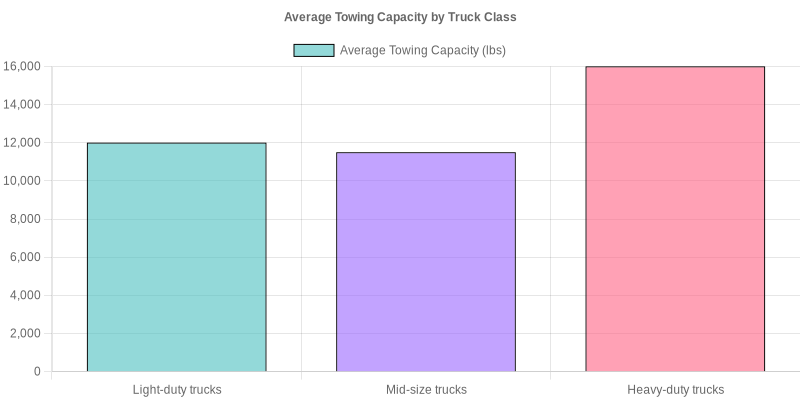
This visual representation emphasizes the disparities in towing capabilities among different truck classes, helping you make informed choices based on your specific towing needs.
Conclusion
Understanding the towing capacity of your truck is essential for safe navigation on the road and ensuring that you don’t exceed the limits set by the manufacturer. For drivers, property managers, and dealership experts alike, knowing how much weight your vehicle can tow will help in making better decisions.
For further insights and guidelines on towing operations, check our blogs here or learn about standardization in emergency operations here.
Conclusion: Towing Responsibly
In conclusion, understanding your truck’s towing capacity is vital for safe and efficient towing. As we’ve discussed, exceeding this limit can lead to serious consequences, including dangerous driving conditions and significant vehicle damage. Towing capacities vary greatly among truck models, influenced by factors such as engine performance and drivetrain configuration. For instance, while the Ford F-150 may tow up to 14,500 pounds with the right setup, a heavy-duty truck like the Ford F-350 can handle up to 31,000 pounds. Thus, it’s essential to refer to your truck’s owner’s manual or consult with the manufacturer to ascertain your specific vehicle’s limitations.
Moreover, regulations and safety guidelines, such as those emphasized by the National Highway Traffic Safety Administration, remind us that improper towing can lead to accidents, reduced vehicle control, and potential injuries. Always remember: checking your vehicle’s towing capacity isn’t just a precaution; it’s a responsibility.
Before you embark on any towing journey, double-check your truck’s specifications to ensure you’re within the safe limits. If you’re unsure of how to find this information, consider reading our guide on how to check your vehicle’s towing capacity and always prioritize safety for yourself and others on the road.
Take the time to be informed, be prepared, and if you need assistance, don’t hesitate to reach out to local towing experts or service providers who can help you on your journey. Safe travels!
Understanding your truck’s towing capacity is crucial not only for legal compliance but also for your safety on the road. As noted by experts, exceeding your vehicle’s towing limits can lead to serious mechanical failures and accidents. Here’s what one expert has to say:
“Exceeding a vehicle’s towing capacity is a leading cause of towing-related accidents. Drivers should always ensure they adhere to the manufacturer’s specifications to avoid dangerous situations and maintain vehicle control.”
In addition to safety concerns, understanding your towing capacity helps in choosing the right hitch and accessories to match your towing needs. For more information on this topic, you can explore our blog for additional insights and tips.