
When it comes to owning a truck, understanding its towing capacity isn’t just a matter of technical specifications; it’s a fundamental element that intertwines safety and capability. For local drivers, auto repair shops, and property managers, knowing your truck’s towing capacity can mean the difference between a routine job and a stressful emergency situation. Towing beyond the limits can not only place an undue strain on your vehicle but also pose serious risks to others on the road. Imagine the peace of mind that comes from knowing your truck is capable of handling your hauling tasks efficiently and safely. From transporting equipment for your business to ensuring that your family’s recreational activities are seamless, a clear understanding of your truck’s capabilities empowers you to make informed decisions. It instills confidence in your daily operations and fosters an environment of safety, both for you and those who share the road. Delving into the specifics of towing capacity can illuminate the importance of adhering to manufacturer recommendations, ensuring that your truck is equipped to handle whatever challenges may arise on the horizon. Join us as we explore the essential factors for calculating your truck’s towing capacity, allowing you to harness its full potential while prioritizing safety and efficiency in every journey.
Understanding Towing Capacity: Definition and Importance
Towing capacity is defined as the maximum weight a truck or vehicle can safely tow without risking damage to its components or sacrificing safety. This specification is critical for truck owners, as exceeding this capacity can lead to mechanical failures, safety hazards, and legal liabilities. The ability to safely tow is influenced by factors such as the vehicle’s engine power, braking system, frame strength, and suspension. Understanding one’s towing capacity helps ensure proper load management and enhances the truck’s performance during towing scenarios.
Importance for Truck Owners
For truck owners, knowing their towing capacity is essential for several reasons:
- Safety: Maintaining a safe towing capacity helps prevent accidents and mishaps on the road.
- Vehicle Longevity: Abiding by towing limits preserves the functionality and durability of the truck, averting costly repairs and replacements.
- Legal Compliance: Many jurisdictions have laws regulating towing capacities, and ignorance can lead to unfortunate legal consequences. For more on this, check out the role of towing regulations.
Impact on Property Managers and HOA Administrators
Property managers and HOA administrators should be mindful of towing capacity, particularly when managing community vehicles. Here’s why:
- Community Standards: Larger vehicles, such as RVs and heavy-duty trucks, often exceed standard towing limits. This can create issues in neighborhoods with strict vehicle policies, impacting aesthetics and property values. Learn more about HOA vehicle rules.
- Vehicle Regulations: Properly understanding and enforcing towing capacity in the community vehicle regulations can prevent damage to both the vehicles and the properties. This prevents operational complications and fosters a positive relationship within the community.
- Proactive Management: A proactive approach towards vehicle management-including monitoring towing and parking regulations-can enhance overall community satisfaction and property maintenance, ultimately leading to higher property values and a better quality of life for residents. For effective strategies, check out insights on effective HOA management.
In conclusion, understanding and adhering to towing capacity is crucial not just for personal safety and vehicle performance, but also for maintaining harmony within community settings. Property managers and HOA administrators play an important role in educating residents and enforcing regulations to ensure smooth operations in vehicle management.
Factors Affecting Towing Capacity
Understanding the factors that affect your vehicle’s towing capacity is essential for safe and efficient towing. Here is an ordered list of the key factors to consider:
- Engine Size and Power
- The engine’s horsepower and torque directly impact the towing capacity. More powerful engines provide greater towing capabilities.
- Axle Ratio
- The axle ratio influences how much load your truck’s drivetrain can handle. Higher ratios generally improve towing capacity but may affect fuel efficiency.
- Gross Vehicle Weight Rating (GVWR)
- This is the maximum weight your truck can safely carry, including the vehicle itself, passengers, cargo, and the trailer tongue weight.
- Gross Combined Weight Rating (GCWR)
- The total allowable weight of the vehicle and the trailer combined. Staying within this limit is critical for safety.
- Weight of the Trailer
- The trailer’s dry weight and cargo weight must be accounted for to ensure you do not exceed your truck’s towing capacity.
- Added Payload
- Any extra weight in the truck bed or cabin reduces the capacity available for towing.
- Hitch Type and Rating
- The hitch installed must be rated for the trailer’s weight to ensure proper towing safety.
- Transmission and Cooling Systems
- Transmissions with towing packages and adequate cooling systems help manage stress from towing heavy loads.
- Braking System
- Adequate braking power is essential; trailer brakes often supplement the vehicle’s brakes to maintain control.
-
Tire Load Capacity
- Tires must be rated to handle the increased weight to avoid blowouts or loss of control.
-
Suspension and Frame Strength
- A reinforced suspension and a strong frame help manage the stresses of towing heavy trailers.
-
Environmental and Road Conditions
- Uphill grades, high altitudes, and rough terrains can reduce your effective towing capacity.
Being aware of these factors ensures you choose a truck and trailer setup that is safe and compliant with manufacturer guidelines and local regulations. For more detailed insights on towing safety and regulations, you can explore unsafe towing insights in Santa Maria and understand how emergency response fleets prepare.
Safe towing starts with knowledge and the right preparation, so always assess these factors before hitting the road.
Comparing Towing Capacities of Popular Truck Models
Understanding the towing capacity of trucks is crucial for local drivers and auto repair shops. Here’s a comparison of the towing capacities, payloads, engine types, and axle ratios of some popular trucks for 2023:
| Truck Model | Max Towing Capacity (lbs) | Max Payload (lbs) | Engine Type | Axle Ratio |
|---|---|---|---|---|
| Ford F-150 | 14,000 | 3,325 | 3.5L EcoBoost V6 | 3.31, 3.55 |
| Ram 1500 | 12,750 | 2,300 | 5.7L HEMI V8 (w/ eTorque) | 3.21, 3.92 |
| Chevy Silverado 1500 | 13,300 | 2,260 | 6.2L V8 | 3.23 |
| Toyota Tundra | 12,000 | 1,940 | 3.4L Twin-Turbo V6 | 3.31, 3.73 |
| GMC Sierra 1500 | 13,000 | 2,240 | 6.2L V8 | 3.23, 3.42 |
For further insights about towing capacities, learn more here.
Here’s a visual representation of the towing and payload capacities for these trucks:
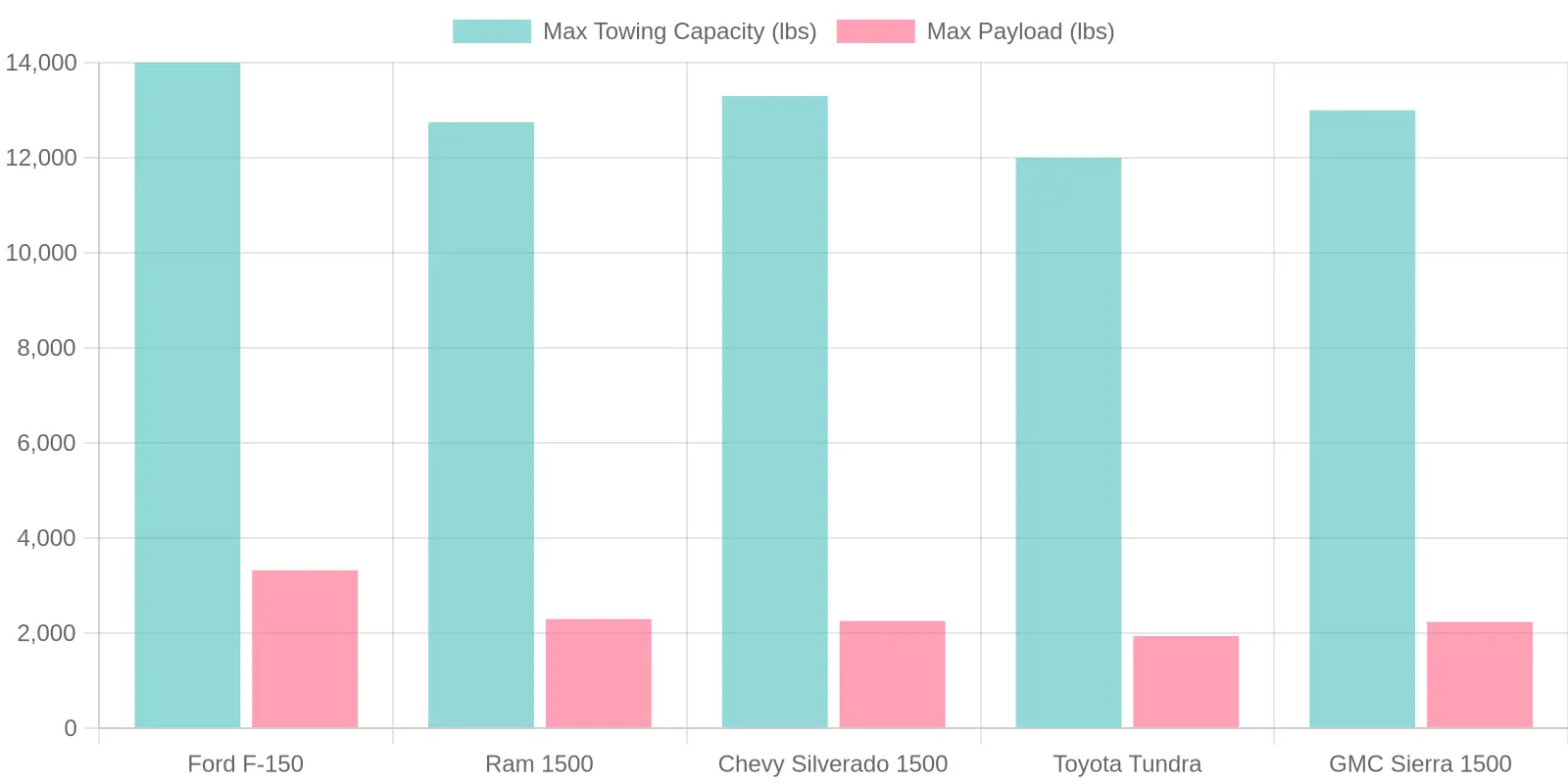
This comparison table and graph can help you evaluate which truck model suits your towing needs best.
How to Calculate Your Truck’s Towing Capacity
Calculating your truck’s towing capacity is essential for ensuring safe towing practices, especially for property managers and local drivers. In this guide, we will cover a step-by-step method to accurately determine your truck’s towing capabilities.
Step 1: Understand Key Terms
Before diving into the calculations, it’s crucial to comprehend some key terms:
- Gross Combined Weight Rating (GCWR): The maximum weight of the truck, trailer, and cargo combined.
- Curb Weight: The weight of your truck without any cargo or passengers.
- Payload: The total weight of cargo and passengers that can be carried in your truck.
Step 2: Obtain Necessary Specifications
To perform the calculation, gather the following information:
- Find Your Truck’s GCWR: This information is usually available in the owner’s manual or on the manufacturer’s website.
- Determine Curb Weight: Weigh your truck fully loaded with passengers and any cargo you frequently carry.
Step 3: Calculate Towing Capacity
Once you have the necessary weights:
- Use the Formula:
Towing Capacity = GCWR – (Curb Weight + Payload) - Perform the Calculation: Plug your values into the formula to calculate your truck’s towing capacity.
Step 4: Consider Additional Weight
Don’t forget to account for the weight of any trailer cargo. Always add this to your total to ensure you remain within safe limits.
Example Calculation
For instance, if your truck’s GCWR is 12,000 lbs, your curb weight is 6,000 lbs, and your payload is 1,000 lbs, here’s how you would calculate it:
Towing Capacity = 12,000 – (6,000 + 1,000) = 5,000 lbs
Safety First
When towing, always ensure you leave some buffer capacity for safety. Understanding your truck’s towing capacity informs better vehicle usage, promoting safe driving experiences. For additional insights, check out this detailed guide on towing from Kelley Blue Book.
By following these steps and utilizing the right calculations, you can confidently assess your truck’s towing capability for various applications such as property management or personal use.
Conclusion
Calculating the towing capacity of your truck is straightforward once you know where to find the necessary metrics and how to apply them. Always err on the side of caution and consult with professionals if unsure about the calculations.

Real-World Examples: The Importance of Knowing Towing Capacity
Understanding a truck’s towing capacity can significantly enhance safety and efficiency, particularly in professions relying heavily on towing. Here are a few real-world examples where this knowledge made a crucial difference:
Auto Repair Shops
-
Heavy Equipment Transportation: A local auto repair shop needed to transport a broken-down forklift to a construction site. The owner calculated the towing capacity of their truck, which was rated for 7,500 lbs. By confirming their truck could safely tow the 4,500 lb forklift, they were able to meet the client’s request without risking a mechanical failure. This ensured timely service and enhanced customer trust.
-
Vehicle Recovery Operations: During an emergency, a tow truck operator was dispatched to recover a stranded vehicle. Knowing the towing capacity allowed them to select the appropriate truck equipped to handle the vehicle’s weight. This understanding led to a safer recovery and reduced the risk of damaging either vehicle during transport.
Property Managers & HOA Administrators
-
Parking Enforcement: A property manager faced challenges with unauthorized vehicles in a residential area. Using well-calculated towing capacity, they ensured that the towing vehicles dispatched could handle larger vehicles, preventing future issues with abandoned or oversized vehicles causing disruptions in the community. This proactive approach helped maintain property aesthetics and safety.
-
Utility Towing: In a community with various maintenance tasks, an HOA administrator coordinated towing for seasonal repairs. By understanding the minimum towing capacity, they ensured the trucks assigned could tow equipment and trailers securely, keeping repair efforts efficient and within legal limits. This knowledge avoided delays in operations and promoted safety throughout the community.
These examples showcase that being aware of a truck’s towing capacity is not just a number; it can determine the difference between safe, efficient operation and potential disaster, making it critical for auto repair shops, property managers, and their clients. For detailed information on understanding and calculating towing capacities, learn more about your truck here.
Furthermore, proper towing practices can navigate the nuances of towing regulations, ensuring compliance and peace of mind among local drivers and car owners.
Understanding the Safety Implications of Exceeding Towing Capacities
Understanding the importance of adhering to your vehicle’s towing capacity is essential for maintaining safety on the road. Exceeding these limits can lead to devastating consequences, such as severe accidents and vehicle failures. Below is a chart that highlights some critical risk factors associated with exceeding towing capacities:

| Metric | Likelihood/Increase |
|---|---|
| Increased accident likelihood | 17% higher |
| Brake failure incidents | 30% more common |
| Tire blowouts | 25% likelihood increase |
| Engine strain leading to mechanical failures | 40% higher |
| Legal penalties for exceeding limits | 100% in jurisdictions with penalties |
The data presented reflects not only statistical increases in incidents but also emotional aspects of safety and responsibility that resonate with drivers. Understanding these metrics can encourage safer driving habits and adherence to towing limits, reducing risks and ensuring road safety.
For those interested in deeper insights into safe towing practices, learn more about towing regulations here and explore emergency response strategies that can be beneficial in various towing situations.
Understanding and respecting towing capacities is not just a matter of compliance; it is crucial for the safety and efficiency of local operations. Whether you are a driver towing a trailer or a property manager overseeing the movement of heavy equipment, knowing your vehicle’s towing capability can prevent accidents and costly damages. When vehicles are overloaded, the risks multiply-increased strain on brakes, suspension, and even engine failure are serious consequences that can lead to severe safety hazards. For instance, improper towing can lead to extensive damages, both for the towing and towed vehicles, as highlighted by various sources that outline the significant risks associated with improper towing practices, such as damage to engines and brakes, as well as compromising the safety of everyone on the road (Morrow Towing).
Moreover, property managers must remain vigilant in adhering to towing regulations. Understanding these limits not only ensures compliance but also supports the smooth operation of their facilities. As underlined in several resources, an awareness of towing capacity is essential for all those managing heavy loads. Failure to respect these limits can result in not just financial repercussions, but also legal issues and safety violations (Truck Paper Blog).
I encourage all drivers and property managers to take the time to educate themselves on proper towing techniques and ensure that they are following their vehicle’s towing limits. The peace of mind you’ll gain from knowing you are operating safely and within legal parameters is invaluable. Remember, safety on the road is a shared responsibility, and making informed decisions can contribute significantly to hazard-free operations. It’s imperative to prioritize safety; it is not only about knowing how much you can tow, but also about respecting those limits for the benefit of all.
Ready to Enhance Your Towing Experience?
Understanding the towing capacity of your truck is just the beginning of your journey. Now that you’re equipped with the knowledge to assess your needs, it’s time to take action. Whether you’re towing a trailer for a camping trip or transporting equipment for work, outfitting your truck with custom-fit fairings from Summit Fairings can make a world of difference. These custom fairings are designed to optimize your vehicle’s aerodynamics and improve fuel efficiency, tailoring to your specific towing needs.
Don’t leave your towing capabilities to chance! Explore our range of custom-fit fairings today. Let us help you find the perfect match for your hauling requirements, ensuring that you tow safely and efficiently every time you hit the road!